Introduction to Fur trade
Fur Trade in America. The trapping and killing of animals for their pelts or hides played a major part in the settling of the North American continent. Much of the early exploration of what are now the United States and Canada, in both the East and the West, was done by fur trappers and traders. France, England, the Netherlands, and, on the Pacific coast, Russia all sought furs and they each considered the great abundance of fur-bearing animals to be North America's greatest wealth. The fur trade was so important that it was a basic cause of intense international rivalry that culminated in the French and Indian War.
Background
In Europe furs had long provided both warmth and elegance to wearing apparel. By the 16th century, however, the supply of fur-bearing animals in western Europe was largely exhausted. Russia still had a bountiful supply and was willing to trade furs in the Western countries. In less than a century it had killed off its fur-bearing animals to such an extent that it no longer had a surplus of furs for trade.
For a century and more after the discovery of America by Columbus, only Spain and Portugal showed any interest in colonizing the New World. The Spanish, whose colonies extended into North America, were primarily concerned with finding gold and spreading Christianity; they had little thought for furs.
The English and French were drawn to North America by the abundance of fish along the northern Atlantic coastline and by the desire to find a northwest passage (that is, a northern water route) to the Far East Jacques Cartier of France voyaged up the St. Lawrence River in 1535 and reported that large quantities of furs could be obtained by trading with the Indians. Fishermen trading along the Atlantic coast also noted the copious supply. By the end of the century Europeans were beginning to turn to America for their supply of furs.
Fur Trade of the French and English Colonies
French colonization of Canada, which began in 1604, was directed from the start toward fur trade with the Indians. Quebec, founded as a trading post by Samuel de Champlain in 1608, became the headquarters for far-flung operations. Champlain himself explored westward to Lake Huron's Georgian Bay, establishing what became the regular route to the interior of the country. The fur trade required continuous expansion, for commercial trapping soon depleted an area. The Algonquin and Huron Indians, allies of the French, trapped out their own country and then became middlemen in procuring furs from tribes farther west. Many French colonists took up trapping and hunting on their own; they were known as coureurs de bois (woods runners).
England was slower in getting a fur trade started. Jamestown, founded in 1607, based its economy on tobacco. A fur-trading post established in Maine by the Plymouth Company lasted only a year, 1607–08. However, the Pilgrims, who founded Plymouth in 1620, were financed by English merchant adventurers (investors in foreign ventures) who expected the colony to build a trade in both fish and furs. The colonists eventually established a thriving fur trade.
Meanwhile Henry Hudson, working for the Dutch, had explored the Hudson River in 1609 and in 1613 the Dutch started a fur-trading post on Manhattan Island. They dealt with the Iroquois Indians to the north, and by 1641 had supplied them with firearms to aid their hunting. The Iroquois soon put their superior weapons to another use, driving the Hurons from the region and taking over their fur trade with western Indians. When the British took New York from the Dutch in 1660, the Iroquois continued to bring furs to Albany, which became a great center for English trade.
The French in Canada, relying less and less on Indians to serve as middlemen, spread rapidly into the interior of the country, where fur-bearing animals were plentiful. Father Jacques Marquette and Louis Joliet, a fur trader, reached the Mississippi River in 1673. The Sieur de La Salle followed them a few years later, in 1682 reaching the mouth of the river and claiming the entire Mississippi Valley for France. La Salle planned to found a colony in Louisiana, as he had named the region, to control river traffic and keep a monopoly for France on the fur trade there. His plans were carried out after his death, and New Orleans was founded in 1718, cutting off the British from use of the Lower Mississippi.
The Upper Mississippi had been claimed for France by the Sieur Duluth in 1679. Michilimackinac (Mackinac Island, Michigan), because of its central location on the St. Lawrence—Great Lakes—Mississippi route, became a great fur trade center. Detroit was founded as a trading post in 1701 to cut off the Iroquois and the English colonies from the western Great Lakes. Some 30 years later the Sieur de La Vérendrye and his sons began opening up new regions to the west. They established trading posts at Lake of the Woods and Lake Winnipeg, among others, and traveled to the Upper Missouri River.
Two earlier French explorers of the West, Pierre Radisson and the Sieur des Groseil-liers, had objected to sharing their fur trade profits with the governor of Canada and had entered the service of the English. In 1670 they helped a group of merchant adventurers found the Hudson's Bay Company. In spite of constant conflict with the French, the company kept control of Rupert's Land, as they had named their territory after Prince Rupert, the company's first governor. The company prospered from the start, partly because furs from the Hudson Bay region were rated the finest in the world.
Beaver was the dominant fur. In the latter 1600's the beaver hat—made of fur felt with a nap of beaver hairs, which could be brushed to gleam like silk—became the fashion, and the demand for beaver grew steadily from then on. Beaver and other fur animals were almost exterminated in New England by 1700.
As English fur traders sought to expand westward, they found their way blocked at every turn by the French. King William's War, 1689–97, Queen Anne's War, 1701–13, and King George's War, 1744–48—the American phases of European wars between France and Britain—were fought in part over control of the regions and routes essential to the fur trade.
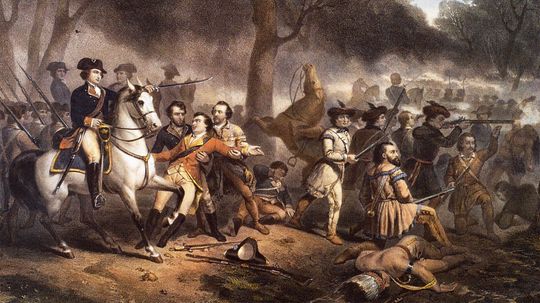
The French and Indian War, 1754–63, ended with France eliminated as a North American power, Canada and eastern Louisiana being ceded to Britain and New Orleans and western Louisiana to Spain. The British attempted to impose strict regulations on all fur trade in what is now the United States, but were persuaded by the colonists to abandon their plan in 1768.
Western Fur Trade
St. Louis was founded as a trading post in 1764 by Pierre Laclède, a fur trader of New Orleans, and René Auguste Chouteau. There were many French traders still in the region, although the east side of the Mississippi River had become British and the west side Spanish; they preferred dealing with St. Louis rather than traveling to the French Canadian posts. The land east of the river became part of the United States as a result of the Revolutionary War, and American traders were eager to move on westward. Both in America and in Europe the emergence of a large merchant-professional class vastly increased the demand for the fashionable beaver hat.
The Americans' opportunity to expand westward came when the United States in 1803 purchased Louisiana. The government was granting very few licenses to private traders, hoping rather to handle all fur trade through government trading houses located at army posts. This system had little success, however. Private traders working out of St. Louis were already dealing with the Osage, Ponca, and Mandan Indians.
In 1804 the Lewis and Clark Expedition, sent out by President Thomas Jefferson to explore the territory of the Louisiana Purchase, left St. Louis to journey up the Missouri River and on to the Pacific coast. The exploring party was followed almost immediately by fur traders, notably Manuel Lisa of St. Louis. When the explorers were returning in 1806, John Colter, a member of the group, left them to join Lisa in the fur trade. Lisa, Jean Pierre Chouteau, Andrew Henry, and their associates in 1809 formed the St. Louis Missouri Fur Company, which had posts throughout the Missouri River valley.
John Jacob Astor, an American fur trader in New York City, had founded the American Fur Company in 1808 to operate in the upper Great Lakes region. In 1810 Astor established a post, Astoria, on the Pacific coast at the mouth of the Columbia River, which had been discovered by the American sea captain Robert Gray in 1792. Meanwhile a Canadian firm, the North West Company, had spread from the Great Lakes to the Pacific coast. Rivalry with the Hudson's Bay Company ended in 1821 with North West being taken over by Hudson's Bay. Meanwhile Astor had built up a monopoly in the Great Lakes fur trade.
The trade of the Missouri River and the West gradually changed in character. In 1810–11, Andrew Henry and a party of trappers spent the winter west of the Rocky Mountains. The winter pelt of the beaver was far superior to that of other seasons, but the Indians would not trap in bitter cold weather. Much of the trapping was therefore taken over by white men, who gained the name “mountain men.” In 1822 Henry and William Henry Ashley formed the Rocky Mountain Fur Company. Among the mountain men employed by them were Jed Smith, Bill Sublette, and Jim Bridger. Other well-known trappers of the era included Kit Carson, Joe Walker, and Tom Fitzpatrick.
A new system of collecting furs from trappers and Indians was set up in 1825—an annual rendezvous held somewhere in the Rocky Mountains. Often the white trappers spent their full year's earnings on supplies and a week of wild living before heading back into the mountains for another year. Some Indians were hostile, and fortified trading posts were a necessity. Among these were Fort Laramie in Wyoming and Bent's Fort in Colorado. After Mexico gained its independence from Spain in 1821, there was some fur trade with Santa Fe.
By the end of the 1830's the beaver was virtually trapped out. The beaver hat, however, was rapidly going out of style, replaced by the silk hat. Although there was still a market for pelts of small animals and for buffalo hides, the colorful era of the mountain men came to an end. They would always be remembered, however, among the explorers and pioneers who opened up the American West to settlement.
Meanwhile, a sea-based trade in fur-bearing marine animals had been flourishing along the Pacific coast. It was begun by the Russians, who crossed the Bering Strait to Alaska in 1741 and found sea otters and fur seals plentiful in the region. The native Aleuts did the hunting and the Russians sold the pelts in China, where otter fur was prized above any other kind. The Spanish in California soon joined in the otter and seal trade, getting pelts from Indians.
This rich trade with China was unknown to the English-speaking world until Captain James Cook sailed to the west coast of North America in 1776. After the Revolutionary War American ships began to trade with China, and their crews wanted to join in the fur trade, but found their access to pelts largely blocked by the Spanish and Russians. Captain Gray was successfully engaged in this trade, however, when he found the entrance to the Columbia River.
In the early 1800's it became convenient for the Russians, who lacked a base in the area, to make an arrangement with the Americans by which Aleuts, furnished by the Russians, would hunt in California waters in American ships. The venture was so successful that in 1812 the Russians decided to take all of the profits for themselves by eliminating the need for American ships. With this in mind, they established Fort Ross on the California coast to serve as a base for their Aleut hunters.
When Mexico became independent, it permitted both Russians and Americans to hunt off California, in return for half the profits. Otters and seals were virtually exterminated by the time California was ceded to the United States in 1848. Meanwhile Alaska's supply of fur-bearing sea animals was becoming so depleted that Russia lost interest in the territory and later sold it to the United States. Otter and seal hunting was regulated by international treaty in 1911.
Buffalo hides with the hair left on were widely used as carriage robes and, in frontier areas, floor coverings. Buffalo hide also made an especially sturdy leather. The supply of buffalo seemed inexhaustible, but by the mid-1800's there were none left east of the Mississippi River. The value of buffalo hides was modest compared with the price commanded by fine furs, however, and the buffalo trade did not attract white hunters. Indians provided whatever quantity the traders specified.
As the population of the United States and Canada increased, the demand for buffalo robes and leather grew also. After the Civil War in the United States, white hunters traveled to the regions of the great buffalo herds, often by railroad, and slaughtered the animals by the thousands. As the herds dwindled, the Indians sought out the remaining bands, primarily as food for themselves but also to have hides for trade. By 1885 the buffalo were virtually wiped out, and the large-scale killing of wild land animals for their fur or hide was finished in North America.