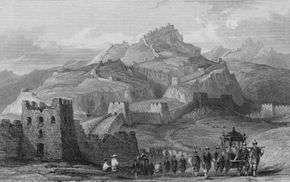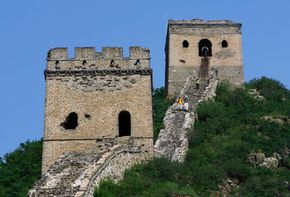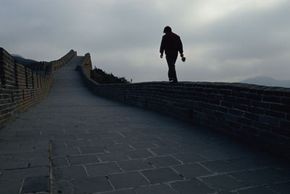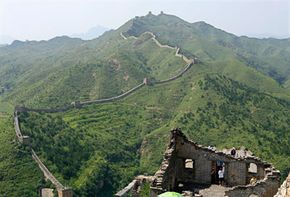
Long before tanks and long-range missiles became available for combat, militaries relied on less technologically advanced mechanisms to protect themselves against invaders. The Great Wall of China was designed to perform the most basic defensive war principle: Keep the good guys in and the bad guys out.
While China's was not the first wall built to serve this purpose (Denmark, Korea and the Roman Empire all built walls prior), the Great Wall is arguably one of the world's most famous and impressive man-made structures. The name "Great Wall of China" is largely a term bestowed upon the structure by Westerners. In fact, it has traditionally been known to the Chinese as the Wan Li Chang Cheng, which translates to "Ten Thousand Li Long Wall," or "Long Wall of Ten Thousand Li" (li is a Chinese unit of length, with two li being equivalent to one kilometer).
Advertisement
So how great is the wall? Its reported length is widely disputed and ranges anywhere from a paltry 1,500 miles (2,414 kilometers) to 4,163 miles (6,700 kilometers) [source: Power, National Geographic]. To settle the debate once and for all, researchers began in 2007 what they believe will be a four-year trek to survey the dimensions and route of the wall. This may seem unnecessarily complex, but considering the intense and treacherous topography the Great Wall crosses over -- including steep mountains, desert, grasslands and more -- it's easy to see why this is no simple feat. The study, which is being conducted by the State Administration of Cultural Heritage and the State Bureau of Surveying and Mapping, will record the wall's length from east to west (from the Gobi Desert to the Yellow Sea), since the wall was built to protect against invaders from the north. And it's not only the length of the wall that's up for debate: It's also difficult to pinpoint how many cities and provinces are included in the Great Wall's layout. One Chinese tourism bureau states that the wall winds its way across nine cities and provinces: Beijing, Gansu, Hebel, Inner Mongolia, Liaoning, Ningxia, Shaanxi, Shanxi and Tianjin [source: Travel China Guide].
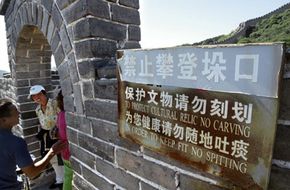
In this article, we'll learn the history behind the Great Wall, whether or not it served its purpose well and how it eventually became obsolete. We'll also take a look at the current state of the structure and how it's being protected after years of abuse by both Mother Nature and humans alike. But first, who built the wall?
Advertisement