
Colonizing Australia
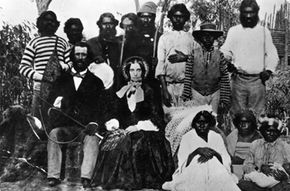
The colonization in the history of Australia was very similar to the colonization of the Americas. In addition to settlers who traveled to America voluntarily, governments used the colonies as prisons. Once the American Revolution began in 1776, the English government needed a new place to send its prisoners, since the American colonies would no longer take them. So in 1788, England sent a crew to Australia, then known as New South Wales, and began building prisons. This would mark the beginning of the fall of the Aboriginal population.
As with the American Indians, the English forced the Aboriginal people off their land. Many were beaten and killed. Others contracted diseases that were foreign to them. Their immune systems couldn't fight these illnesses off, and many people died. Starvation became a major problem – Aboriginal Australians could no longer roam the land where they found their food, and many tribes died out completely.
Advertisement
The English forced many of those who weren't killed into slavery. Women and children did everything from gathering food to cleaning. Many women were also kept as sex slaves.
When the English arrived in 1788, the Aboriginal population was in the hundreds of thousands and possibly into the millions. With the deaths that followed the arrival of the English, the numbers of Aboriginal people dwindled drastically until there was almost no one left.
Unfortunately, over the next centuries things got worse. Besides losing hundreds of thousands of lives, the Aboriginal people also lost much of their culture. They could no longer tell their stories and traditions, and in some cases, there was no one to hear them. History was lost. At the time of colonization, Aboriginal people spoke an estimated 250-300 different languages [source: Suter]. More than half of these have disappeared altogether.
Then, in the early part of the 20th century, white Australians decided the only way to save the Aboriginal people was to assimilate them to their way of life.