Aborigines in the 20th Century

The practice of slavery in Australia didn't end at the same time it did in the United States. There was no war, and there was no proclamation decreeing that all slaves must go free. In fact, slavery didn't end in Australia until the 1970s. However, it did take a different form than it did in the United States.

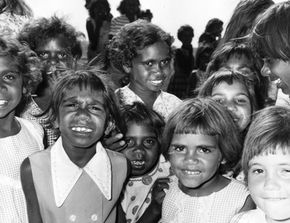
Aboriginal children.
Keystone/Getty Images
Aboriginal children were taken from their families and put in institutions for over half of the 20th century. Photo circa 1975.

Beginning in 1910, non-Indigenous Australians began to take Aboriginal children from their homes and families. These children, known as the Stolen Generation, were either given to white families -- to be raised as white children -- or to institutions and orphanages where they were forced to assimilate to white society. Between 1910 and 1970, when the practice stopped, over 100,000 children had been separated from their families and culture [sources: Parliament of Australia, The Independent].

Bruce Trevorrow
In 1957, Bruce Trevorrow was taken from his family and given to a white family. He was 13 months old. Meanwhile, his two brothers and two sisters remained with his parents. Trevorrow eventually sued the government for compensation and won. Trevorrow was the first member of the Stolen Generation to receive government compensation and was awarded $450,000.

In 1967, following the example of the Civil Rights Movement in America, the Aborigines began to fight for equal rights. The white Australians -- the only ones with the power to vote -- passed a referendum to the Australian constitution that gave Aborigines the right to vote. The passing of the referendum also meant that Aborigines could be included in future censuses, officially recognizing them as citizens of Australia.

Aborigines are still fighting for equality in Australia today, and racism is still prevalent throughout the continent. The life expectancy of a typical Aborigine lags almost 20 years behind that of a typical white Australian [source: The Independent]. Aborigines still don't own most of the land that was taken from them during the colonial period.

But over the last two decades, the Aborigines have tried to reclaim what was once theirs. Some of the major turning points were:

  • 1976 - The Aboriginal Land Rights Act was passed, allowing the Aborigines to begin staking claims on land. This turned out to be a double-edged sword, however. In order to win rights to the land, Aborigines had to prove that they were the first ones on it. To do this, they had to tell of their history. But as we saw with the Dreamtime, Aborigines consider these stories sacred and secret. Aborigines had to make a choice between betraying their ancestors and taking back their land.
  • 1995 - The Human Rights and Equal Opportunity Commission launched the National Inquiry into the Separation of Aboriginal and Torres Strait Islander Children from their Families, which resulted in recommendations for reparations and equal rights for Aborigines. At the time, the Australian government rejected all recommendations and refused to pay compensation [source: Australian Human Rights and Equal Opportunity Commission].
  • 1999 - The Australian Parliament released a statement stating that they regret what happened to the Stolen Generation.
  • 2006 - An Australian court granted the Aborigines land rights to almost 2,300 square miles of the major city Perth.
  • 2008 - The Australian government announced its plan to formally apologize to the Stolen Generation of children in order to bridge the gap between Aborigines and non-indigenous Australians [source: BBC News].

While all of these events helped to usher in equality for the Aborigines, they by no means left a perfect system in place. In the next section, we'll look at how the Australian Aborigines live today.