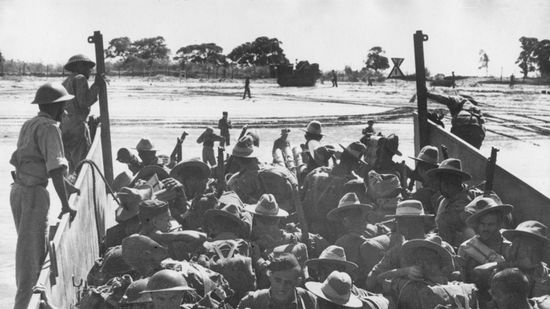
Australia's isolation was ended by the outbreak of World War I. As part of the British Empire, Australia sent some 330,000 troops (out of a population of only about 4,500,000) overseas during the war. When peace came in 1918, Australia again turned its attention to developing its own resources.
Although some manufacturing had begun, the economy remained dependent primarily upon wool and wheat. Consequently, when the Great Depression struck much of the world in the late 1920's, Australia suffered severely as wool and wheat prices fell. Economic recovery was slow, but it was under way when in 1939 Australia entered World War II as an ally of Britain.
Early in 1942, with many of its troops fighting in North Africa, Australia was suddenly faced with the threat of Japanese invasion. The Battle of the Coral Sea later that year averted this threat. Australia became a vast military base for the South Pacific campaigns. At the peak of its war effort in 1943, Australia's armed forces numbered about 633,400—from a population of 7,300,000.
The years after the war brought increased economic activity and industrial expansion. The need for more farmers and industrial workers led to highly successful attempts to attract European immigrants. The federal welfare program, begun in 1909, was extended, and most social services were transferred to federal control. In its postwar foreign policy, Australia allied itself closely with the United States and participated in Asian affairs. Australian military units fought in the Korean War in the early 1950's and in the Vietnamese War from 1965 to 1972.
In the 1970's, Australia ended its "white only" immigration policy, strengthened its ties with Asian nations, and granted large tracts of land in the Northern Territory to the aborigines. During the worldwide recession of the early 1980's, the country faced its most severe economic problems since the 1930's.
In 1986 the last vestige of British control in Australia was removed when Queen Elizabeth II signed the Australia Act. In 1991 Paul Keating, at age 47, became the youngest prime minister in Australian history. In elections in 1996 the Labor party, after 13 years in power, was defeated. John Howard, head of a coalition of conservative parties, became prime minister. Elections in 2004 kept the coalition in power, and Howard remained prime minister until 2007, when he lost an election to the Labor Party, led by Kevin Rudd .
| Important dates in Australia (since 1960) | |
| 1964 | The Menzies government introduced conscription during the Vietnam War (1957-1975). |
| 1965 | The first Australian troops arrived in South Vietnam. |
| 1972 | The Labor Party, led by Gough Whitlam, returned to power after 23 years in opposition. |
| 1974 | With a hostile Senate blocking legislation, Whitlam called a double dissolution (dissolution of the Senate and House). The legislation was passed in an historic joint sitting of both houses, but Whitlam failed to win control of the Senate. |
| 1975 | The Senate blocked the supply of money for government operations, precipitating a constitutional crisis. The governor general removed Whitlam from power. In the election that followed, Malcolm Fraser became prime minister. |
| 1983 | Bob Hawke led the Labor Party to electoral victory and became prime minister, holding office until 1991. |
| 1983 | Australia won the America's Cup yacht race. |
| 1988 | Australia celebrated its bicentennial. |
| 1991 | Paul Keating succeeded Hawke as Labor leader and prime minister. |
| 1992 | A High Court ruling recognized native land title, allowing Aborigines to claim ownership of land. |
| 1996 | A coalition of the Liberal Party and National Party came to power, with Liberal leader John Howard as prime minister. |
| 1999 | A referendum failed to achieve the majority vote required for Australia to become a republic. |
| 2000 | Sydney hosted the Summer Olympic Games. |
| 2003 | A transcontinental rail line was completed, linking Adelaide in South Australia with Darwin in the Northern Territory. |
More Options: