The Seljuk Turks and the Crusaders

The mid-11th century was a period of frequent changes in rulers and of general decline. The beginning of a decisive break between the Roman Catholic and Eastern Orthodox churches (the Great Schism) took place in 1054.

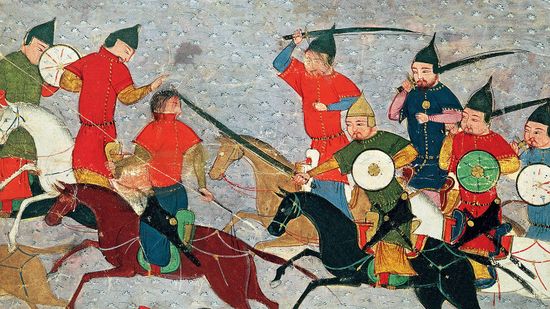
For some time the empire had had Turkic peoples as neighbors—the friendly Khazars and the aggressive Petchenegs. In the 1060's a new menace, the Seljuk Turks, approached from the east. The Byzantines met them at the Battle of Manzikert in 1071 and suffered a crushing defeat. In the same year the empire's last holdings in Italy were taken by Normans.

A strong and able emperor, Alexius I Comnenus, came to the throne in 1081. The Normans were then threatening the west coast of Greece. To help defend it, Alexius engaged the aid of the Venetian fleet, in return for special trade privileges. Meanwhile, the Seljuk Turks had captured Jerusalem and had advanced across Asia Minor, where they established the Sultanate of Rum (Rome), or Iconium. In 1090-91 the Seljuks and Petchenegs formed an alliance and threatened Constantinople. Alexius appealed to the West for troops to assist him. There was no immediate reply. By inciting one Turkish group against another, however, Alexius saved the capital and came to an agreement with the sultan of Rum.

In western Europe, where life had become centered on religion, there was already grave concern about the Turks. Pilgrims to the Holy Land—who had numbered about 700 in 1026-27 and 7,000 in 1064-65—found the Turks more dangerous to deal with than the Arabs. The West, especially France, responded to Alexius' plea by deciding to free Jerusalem from the Muslims. The Crusades to the Holy Land began in 1096.

The Crusader armies, living off the land and taking all possible loot as was the custom, were a terrible affliction to the Byzantine Empire. Alexius spent vast sums moving them through his domain, and in return he extracted a promise that former Byzantine lands recovered by the Crusaders would be returned to the empire. The promise was only partially kept, and animosity between the “Latins,” as the Westerners called themselves, and the Greeks grew rapidly.

Some Latins considered the Greeks to be heretics, little better than the infidel Muslims. The Byzantines, in addition to their fury against the marauding Western armies, resented Venice's virtual control of their economy. In 1182 there was a great massacre of Latins in Constantinople.

Two decades later rivalry for the Byzantine throne caused one contender to ask Western assistance. The Fourth Crusade was being undertaken at the time, and the Venetians were providing ships for it. In 1204 the Crusaders used the dynastic struggle as an excuse to enter Constantinople. Prompted by their desire for loot and for new lands to rule and by Venice's greed for commerce, they seized the city and the empire. The capital was ruthlessly sacked. Latin kingdoms were established to rule the conquered Byzantine lands.