Introduction to History of Europe

The history of Europe is the story of many different peoples and cultures. Some peoples lagged behind, while others surged far ahead in the development of social, intellectual, and political institutions and ideas. Some regions, because of location, became influenced by cultures far removed from those affecting the rest of the continent. Many wars and treaties have changed Europe's political boundaries throughout its history.

Important dates in Europe
c. 3000 B.C. Civilization developed on Crete and other islands in the Aegean Sea.
c. 500 to 300 B.C. Greek civilization reached its height.
27 B.C. to A.D. 180 Rome achieved its greatest power.
A.D. 300's Romans granted the Christians freedom of religion. The Roman Empire split into two parts: the West Roman Empire and the East Roman, or Byzantine, Empire.
400's The West Roman Empire fell, and the Middle Ages began.
732 A Frankish army defeated Muslim forces in Spain.
768-814 Charlemagne built an empire in Western Europe.
1054 The Christian Church split into the Roman Catholic Church and the Eastern Orthodox Churches.
Late 1000's Europeans began the Crusades.
1347-1352 The Black Death killed many of Europe's people.
1300's The Renaissance began in Italy.
1500's The Reformation brought Protestantism to Europe.
1689 The English Parliament passed the Bill of Rights.
1789-1799 The French Revolution ended absolute monarchy in France.
1815 Napoleon was defeated in the Battle of Waterloo.
1700's to mid-1800's. The Industrial Revolution swept through Europe.
1914-1918 World War I raged in Europe.
1917 The Bolshevik revolution led to the establishment of a Communist dictatorship in Russia.
1920's Joseph Stalin became dictator of the Soviet Union, and Benito Mussolini became dictator of Italy.
1933 The Nazis under Adolf Hitler took control of the German government.
1939-1945 The Allies defeated Germany, Italy, and the other Axis powers in World War II.
1940's Soviet-controlled Communist dictatorships seized control of governments in Eastern Europe after World War II.
1949 Canada, the United States, and 10 Western European nations formed the North Atlantic Treaty Organization.
1950's Western European nations began economic associations that later merged to form the European Union.
1975 Most European countries signed the first of the Helsinki Accords, pledging increased cooperation and promotion of human rights.
1989-1990 Most of eastern Europe ended Communist rule and began reforms toward giving the people more freedom.
1990 East and West Germany were unified.
1991 Most of the republics of the Soviet Union declared their independence, and the Soviet Union was dissolved. Three of Yugoslavia's six republics declared their independence.
2002 The euro replaced the traditional currencies of many European nations.

Prehistoric Europe

Most anthropologists believe that humans migrated from Africa and appeared in Europe more than 700,000 years ago. Neanderthal Man, an early form of human, emerged in Europe sometime between 100,000 and 200,000 years ago. One of the earliest forms of modern humans, Cro-Magnon Man, appeared in Europe in about 40,000 b.c. Prehistoric Europeans were hunters and gatherers until about 6000 b.c., when organized agriculture spread to Europe from the Near East.

Mediterranean Civilizations

The first major European civilization, the Minoan civilization, developed on the island of Crete about 2500 b.c. and lasted until about 1400 b.c. The Minoans were the first Europeans to develop a system of writing. Minoan culture spread to nearby islands and to the Balkan peninsula.

The Achaeans, an ancient Indo-European people, created a highly developed civilization that displaced the Minoans about 1400 b.c. and lasted until about 1100 b.c. The civilization was known as the Mycenaean civilization, after its foremost city, Mycenae, on the Peloponnesus. Mycenaean culture spread throughout much of the eastern Mediterranean region.

The Greek and Roman Period

From the Mycenaean civilization emerged a Hellenic, or Greek, civilization. From about 1100 b.c. until the Roman conquest of Greece in the first century B.C., the Greeks created a society outstanding for self-government, philosophy, architecture, mathematics, sculpture, and literature. Greek culture spread throughout most of the Mediterranean region. In central and northern Europe there were less advanced peoples, such as the Celts.

The Romans, conquerors of the Greeks and other peoples, carried on much of the Greek culture and added to it. The Roman system of law had a lasting influence upon Europe.

Alexander's Empire, 323 B.C.Alexander's Empire, 323 B.C. This map shows the European parts of the empire of Alexander the Great at its height in 323 B.C. It was the first great empire that began in Europe. It spread Greek civilization into Asia.Roman Empire, A.D. 117.Roman Empire, A.D. 117. This map shows the Roman Empire in Europe at the height of its power in A.D. 117. The empire included parts of Western and Southern Europe, Northern Africa, and Southwest Asia.

Christianity's spread throughout Europe was greatly aided after it became the official religion of the Roman Empire in the fourth century. By then, however, the Roman Empire was declining in strength. In the fifth century the western part of the empire was invaded by Germanic peoples, Vandals, Goths, Franks, and Anglo-Saxons, who established states within its territory. The eastern part became the Byzantine Empire.

The Middle Ages

The fall of Rome in 476 marked the end of the ancient period of European history. The next 1,000 years make up the Middle Ages, or medieval period. In the eighth century Charlemagne, king of the Franks, conquered all the Germanic peoples except the Anglo-Saxons and ruled an empire covering what is now France, Germany, and Italy. In 800 he took the title of Roman emperor. He also waged a series of wars against the Muslims, who had conquered Spain and developed an advanced civilization there.

The empire established by Charlemagne collapsed during the ninth century. It was replaced by many small states ruled by nobles. These were loosely bound together in larger units (such as England, France, and the Holy Roman Empire) by what is known as the feudal system.

Charlemagne's Empire, A.D. 800.Charlemagne's Empire, A.D. 800. This map shows Charlemagne's empire at its height in A.D. 800. The empire extended from central Italy north to Denmark, and from eastern Germany west to the Atlantic Ocean.Holy Roman Empire in 1250.Holy Roman Empire in 1250. This map shows the territory of the Holy Roman Empire in 1250. The empire extended from the North Sea to the Mediterranean Sea and from Eastern France to Poland. The Kingdom of the Two Sicilies, a personal possession of the emperor, was geographically separated from the empire by the Papal States.

During this time southern and western Europe suffered several invasions. The Vikings invaded from the north, the Magyars from the east, and Muslims from the south. Much of Europe was laid waste by these invaders. The only tie that bound most of Europe together was the spiritual power of the church, centering in the pope at Rome and the patriarch at Constantinople.

During the Crusades, from 1100 to 1300, the Muslims were driven from most of Spain and Europeans temporarily conquered the Holy Land. The Crusades hastened the development of trade between Europe and the Near East. The Italian cities, because of their location, were soon flourishing as a result, and gradually commerce and urban life spread throughout western Europe.

Origins of Modern Europe

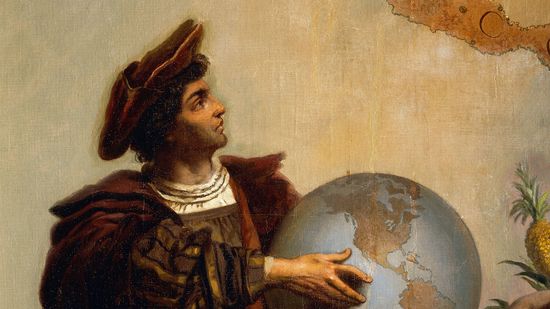
During the 14th and 15th centuries, Europe experienced a period of heightened intellectual and artistic activity. This rebirth of classical learning is called the Renaissance. The 15th century marked the beginning of the age of exploration. Christopher Columbus and other European seamen opened the way for increased world trade and great colonial empires. The cities on or near the Atlantic replaced those of Italy as the commercial centers of Europe. Rich merchants began to rival the nobles in wealth and power. A growing abundance of money permitted kings to hire officials and soldiers, gradually removing the need for feudal relationships.

World known by Europeans in the 14th centuryWorld known by Europeans in the 14th century This map shows how much of the world's lands and seas were known to Europeans by the A.D. 1300's. Areas that Europeans knew about included northern Africa, far northeastern North America, much of Asia, the Mediterranean Sea, and parts of the North Atlantic and Indian oceans.

The 16th century brought the Reformation, when many Christians rejected the authority of the pope and the Protestant movement was begun. The 17th and 18th centuries formed a period of savage wars by which the various European monarchs sought to increase their territories. England became a limited monarchy and aspirations for political freedom appeared in other parts of Europe.

Low Countries in the 16th century.Low Countries in the 16th century. The Low Countries, including most of present-day Belgium, Luxembourg, and the Netherlands, came under Spanish rule in the 1500's. The north won independence in 1648.

The Industrial Revolution, a term applied to the results of the factory system for producing goods with machinery, began in England in the 18th century. This economic change played a major role in shaping the development of modern Europe. It brought with it a new economic system—capitalism.

The Industrial Revolution began in Europe.The Industrial Revolution began in Europe. Factories developed in England during the Industrial Revolution, bringing together machines and the workers to run them. Women and children operated many machines in textile factories.

The democratic spirit was awakened in continental Europe by the French Revolution of 1789. The revolution was followed by the rise of Napoleon, who dominated much of Europe for a time.

Napoleon's EmpireNapoleon's Empire This map shows the empire at its height in 1812. Napoleon conquered or controlled most of western Europe.

Out of Napoleon's final defeat in 1815 came political arrangements that were meant to assure a permanently stable and peaceful Europe. But the ideals of liberty and nationalism had taken hold and the following decades of the 19th century were marked by more wars and revolutions. New nations, including modern Italy and modern Greece, came into existence. Austria-Hungary emerged in 1867 as an empire that dominated several national groups. Imperial Germany under the leadership of Prussia came into being after the Franco-Prussian War, 1870–71.

World Wars I and II

Destruction of both Imperial Germany and the Austro-Hungarian Empire was among the results of World War I, which engulfed Europe during 1914–18. The United States, which entered the war on the side of England, France, and the other Allied powers, contributed greatly to the Allied victory. World War I indirectly led to a revolution that overthrew Czarist Russia in 1917. In 1922 most of the territory that once made up imperial Russia united to form a Communist country known as the Union of Soviet Socialist Republics, or the Soviet Union.

The Allied statesmen drew new boundaries for several European nations and established some new nations. Along with the creation of the League of Nations, these and other arrangements were intended to assure a lasting peace. However, with the rise of Fascism in Italy and Nazism in Germany, Europe again moved toward war. Germany and Italy formed an alliance in 1936 with Japan. The three nations became known as the Axis powers. World War II began with the German invasion of Poland in 1939, and became a world-wide struggle between the Axis powers on the one hand and Great Britain, the Soviet Union, the United States, and their allies on the other. The war ended in 1945 with the defeat of the Axis powers.

Postwar Europe

The Soviet Union emerged from the war dominating most of Eastern Europe. This expansion of Communism was marked by strained relations between the Soviet Union and the Western nations, instead of the harmony hoped for by the creation of the United Nations, successor to the League of Nations. Events after the war were shaped largely by this East-West hostility, termed the “cold war.” An “iron curtain” was said to separate the Communist and non-Communist worlds.

Cold War divides Germany's capitalCold War divides Germany's capital Berlin had American, British, French, and Soviet sectors (districts) after World War II ended in 1945. The American, British, and French sectors became known as West Berlin. The Soviet sector became known as East Berlin.

Through the European Recovery Program (Marshall Plan) and later aid, the United States made billions of dollars available to non-Communist European nations to help them recover from the war and to prevent the further spread of Communism. The United States also took the lead in establishing an alliance for the defense of Western Europe (the North Atlantic Treaty Organization). Steps toward economic and political unity of Western Europe were made by the creation of such organizations as the Benelux union and the European Communities (known as the European Community during 1967–93 and since then as the European Union). The Communist countries of Eastern Europe, led by the Soviet Union, formed the Warsaw Pact organization, a military alliance, and COMECON, an economic union.

Period of Accommodation

After more than 20 years of the cold war, tensions began to ebb in the late 1960's. Western European diplomatic and economic relations with Eastern European nations and the Soviet Union improved. In 1973 the two Western European customs unions, the European Community and the European Free Trade Association, allied to allow free trade throughout non-Communist Europe.

In the mid-1970's rising fuel costs and growing inflation began to hurt Europe's external trade. During the 1980's, economic cooperation among western European nations increased and Greece, Spain, and Portugal joined the European Community.

Post-Communist Europe

In the late 1980's and early 1990's, rising nationalism and widespread demands for democracy occurred throughout eastern Europe and the Soviet Union. During 1989–90 most of the Communist regimes in eastern Europe collapsed. Germany was reunited in 1990. The following year the Warsaw Pact and COMECON were dissolved.

In 1991 nationalist fervor and demands for democracy increased throughout the Soviet Union and Yugoslavia. The Soviet Union gradually lost authority over its union republics and recognized the independence of Lithuania, Latvia, and Estonia in September, 1991. Later that year the Soviet Union collapsed and the rest of its union republics became independent.

Meanwhile, in 1990 Communist regimes fell from power in several Yugoslav republics while remaining in power in others. The non-Communist republics sought independence, and civil war between various national groups erupted in Yugoslavia in 1991. The Yugoslav federation soon collapsed and the Yugoslav republics of Bosnia and Herzegovina, Croatia, Macedonia, and Slovenia became independent.

In 1993 Czechoslovakia peacefully separated into the Czech Republic and Slovakia.

Throughout the early and mid-1990's most of the countries of eastern Europe experienced severe economic problems caused by changing centrally planned economies to ones based on market forces. In 1995 the European Union was expanded to include Austria, Finland, and Sweden.

In 1998, 11 nations of the European Union established a central bank, called the European Central Bank, to implement a common economic policy between member nations. In 2002, a common currency, the euro, became the standard monetary unit of most of the European Union member nations. Ten more European nations joined the EU in 2004 and two more in 2007. The new members included former Communist eastern European countries and Soviet republics.