Nazism and World War II

Adolf Hitler was the head of the Nazi party (National Socialist German Workers' party). He built his following by promising the Germans a return to past glory, and by blaming Germany's troubles on the Jews. In 1933 President von Hindenburg made him chancellor. When Hindenburg died in 1934, Hitler declared himself Führer (leader).

Hitler proclaimed that his regime was the successor to the Holy Roman Empire and the German Empire, and thus called it the Third Reich (empire). He built a one-party state. Many opponents of his regime were imprisoned in concentration camps and laws were passed limiting the rights of Jews and other minorities.

In March, 1935, Hitler denounced the Treaty of Versailles. He ordered compulsory military training and began to expand Germany's military forces. In October, 1936, he formed an alliance with Italy—the Rome-Berlin Axis—later joined by Japan. Meanwhile, the persecution of minority groups had been stepped up, and many Jews, Gypsies, and Jehovah's Witnesses were being sent to concentration camps.

Hitler achieved an Anschluss (union) of Germany and Austria in 1938, making Austria an integral part of Germany. Later that year, British and French leaders attempted to appease Hitler by permitting Germany to annex part of Czechoslovakia.

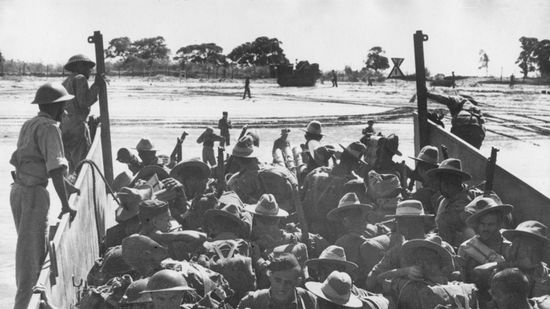
World War II started in 1939 when German forces invaded Poland. By mid-1942, Germany, at the height of its power, had conquered much of Europe and parts of Africa. However, Allied forces liberated the conquered lands and invaded Germany, which surrendered unconditionally in 1945.

In the final months of the war, Allied armies discovered hundreds of concentration camps established by the Nazis throughout Europe. In the camps Jews, Slavs, and others deemed undesirable by the Nazis had been used as slave labor or murdered. The Allies also uncovered evidence of mass executions elsewhere. Altogether about six million Jews and millions of other people were put to death at the hands of the Nazis.

As a result of the war, Germany was stripped of its conquests and was partitioned into four zones. The eastern zone was occupied by the Soviet Union and the three western zones by the United States, Great Britain, and France. Berlin, surrounded by the Soviet zone, was similarly divided. Thousands of Nazis were tried and sentenced in trials after the war for war crimes and for crimes against humanity.

Berlin sectors after World War II.Berlin sectors after World War II. Berlin was divided into American, British, French, and Soviet sectors after World War II ended in 1945. The American, British, and French sectors became known as West Berlin. The Soviet sector became known as East Berlin.