Introduction to History of Spain
The Iberian Peninsula has been inhabited since prehistoric times, first by Neanderthal Man and later by Cro-Magnon Man and various other early peoples.
The earliest Iberian civilization was centered in the south, which was rich in metals, especially copper. Phoenician traders and colonists from the eastern Mediterranean came to the peninsula about 1100 B.C. The native Iberian kingdom of Tartessus (Biblical Tarshish), in the region of the Guadalquivir River, developed a flourishing commerce. The Greeks came to trade and then established colonies along the southeastern coast. Meanwhile, waves of Celtic invaders had crossed the Pyrenees into Spain and had begun to intermingle with the Iberians.
During the sixth century B.C., Carthage (a Phoenician colony in North Africa) began to gain control of Spanish trade. In 237 B.C., Carthaginian forces under Hamilcar Barca invaded southern Spain and conquered it. Hannibal, Hamilcar's son, launched an invasion against Italy from Spain.
Rome defeated Carthage in the Second Punic War (218–201 B.C.), but pacifying the Spaniards took nearly 200 years. Spain prospered as Roman trade and industry flourished. Christianity, introduced probably in the first century A.D., rapidly gained strength among the Spaniards.
| Important dates in Spain | |
| 1000's B.C. | The Phoenicians began to colonize Spain. |
| 400's B.C. | The Carthaginians conquered much of Spain. |
| 200's B.C. | The Romans drove the Carthaginians from Spain. |
| A.D. 400's | The Visigoths took Spain from the Romans. |
| 711-718 | The Muslims conquered almost all Spain. |
| 1000's | Christian kingdoms began to drive the Muslims from Spain. |
| 1479 | The kingdoms of Aragon and Castile united, bringing almost all of what is now Spain under one rule. |
| 1492 | Spanish forces conquered Granada, the last center of Muslim control in Spain. Christopher Columbus sailed to America and claimed it for Spain. |
| 1512 | King Ferdinand V seized the Kingdom of Navarre, completing the unification of what is now Spain. |
| 1556-1598 | The Spanish Empire reached its height during the reign of Philip II. |
| 1588 | The English navy defeated the Spanish Armada. |
| 1808 | Napoleon's armies seized Madrid. |
| 1808-1814 | Spanish, Portuguese, and English forces drove the French from Spain during the Peninsular War. |
| 1810-1825 | All Spain's American colonies except Cuba and Puerto Rico revolted and declared their independence. By this time, Spain had lost almost all its empire. |
| 1898 | Spain lost Cuba, Puerto Rico, and the Philippines in the Spanish-American War. |
| 1931 | King Alfonso XIII fled the country and Spain became a democratic republic. |
| 1936-1939 | The Spanish Civil War was fought. It brought General Francisco Franco to power as dictator of Spain. |
| 1950's and 1960's | Spain achieved one of the highest rates of economic growth in the world. |
| 1975 | Franco died. Spaniards began setting up a new, democratic government to replace his dictatorship. |
| 1978 | Spaniards approved a new Constitution based on democratic principles. |
| 1982 | Spain joined the North Atlantic Treaty Organization. |
| 1986 | Spain joined the European Community, an economic organization that became the basis of the European Union. |
Visigoths and Moors
In the early fifth century A.D., Spain was invaded by Vandals and other Germanic tribes. In the second half of the century, the Visigoths achieved dominance, pushing the Vandals into Africa. The Visigothic kingdom collapsed in 711 when the Moors—North African Muslims—invaded from Morocco. Within a few years the Moors conquered nearly all of the peninsula and advanced into southern France, until turned back by Charles Martel in the Battle of Tours in 732. Many Spaniards took refuge in the northern mountains and from there kept up a bitter resistance against Muslim domination.
For nearly two centuries, the southern two-thirds of Spain was under Moorish control. A separate Muslim domain, the Western (or Spanish) Caliphate, was established at Córdoba in 929. Moorish Spain fostered scholarship and played an important part in transmitting ancient Greek and Roman learning to the Christian countries of western Europe. Córdoba became a great intellectual and artistic center.
Meanwhile, the Christian kingdoms of León, Castile, Aragon, and Navarre were being formed in the north. They exerted constant pressure along the Moorish frontier, gradually pushing it south. The caliphate, undermined by anarchy and civil war, collapsed in 1031 and southern Spain was reduced to a number of petty principalities. Although the Christians often warred among themselves, the conquest of the Moors proceeded rapidly, with the kingdom of Castile assuming leadership. The independent kingdom of Portugal was proclaimed in the mid-12th century. In 1230, Castile annexed León. Aragon, in the northeast, became a Mediterranean power, gaining control of Sicily in 1282 and of Naples in the 1400's.
Golden Age
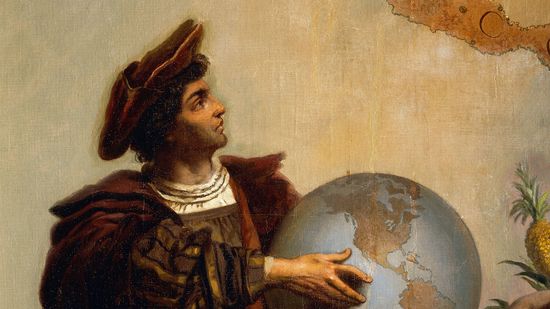
Following the marriage of Isabella of Castile and Ferdinand of Aragon, the two monarchies were united in 1479. To stamp out religious heresy, Queen Isabella had established the Inquisition in 1478, and in 1492 the monarchs expelled all Jews unwilling to convert to Catholicism. That same year, the last of the Moors were conquered, bringing all of Spain under the rule of the two monarchs. Also in 1492 the monarchs sponsored Christopher Columbus' voyage to find a direct sea route to the East. His exploration of the New World initiated the golden age of Spain.
Charles I, grandson of Ferdinand and Isabella, succeeded to the throne in 1516. He was also a grandson of the Hapsburg Holy Roman emperor, Maximilian I. When Maximilian died in 1519, Charles became Emperor Charles V. During his reign and that of his son, Philip II (1556–98), Spain controlled a vast empire. Charles imposed heavy taxation on his Spanish subjects to help finance foreign wars. However, large quantities of precious metals imported from America greatly stimulated trade and industry.
Charles abdicated in 1556, dividing his empire. Ferdinand, his brother, became Holy Roman emperor and received the Austrian dominions. Philip, his son, inherited Spain, the Netherlands, Naples, and colonial possessions in America, North Africa, and the Pacific Ocean. In an effort to prevent the Muslims from extending their control over the Mediterranean, Philip joined with Venice and Pope Pius V to defeat the Ottoman Turks in the sea battle of Lepanto (1571). (
The Netherlands revolted in the 1560's, beginning a long struggle for independence. In an attempted invasion of England, the Spanish Armada was destroyed (1588). ( Privateers preyed on Spain's treasure fleets from the New World, while the Turks threatened Spanish commerce in the Mediterranean. By the 17th century, Spain was heavily in debt. The government was incompetent and corrupt and the court seethed with intrigue.
The Moriscos (Christian descendants of the Moors), rebellious against Spanish authority, were expelled in 1609. In 1640 the Portuguese revolted and, with French aid, achieved independence. In the Peace of Westphalia (1648), ending the Thirty Years' War, Spain recognized Dutch independence. (
Spain Under the Bourbons
Following the death of Charles II (great-grandson of Philip II), the throne passed to the French house of Bourbon, with the duke of Anjou becoming Philip V (1700–46). (
Rise of Liberalism
A bitter struggle developed between the liberals and conservatives (royalists). Constitutional government was reinstated in 1837, during the reign of Queen Isabella II (1833–68). The new constitution attempted to reconcile the two factions. However, the struggle for power continued, erupting into revolution in 1868. The royalists were defeated and Isabella was deposed. Many liberals proposed a federal republic and separation of church and state. However, a new constitution (1869) reestablished the monarchy and retained Roman Catholicism as the official religion.
Amadeo of Savoy, a son of Victor Emmanuel II of Italy, was chosen king. His short reign, 1870–73, was marked by continuous turmoil. In 1873 the Cortes (parliament) proclaimed the first Spanish republic. A federal form of government was instituted, but resulted in anarchy. In 1875 Alfonso II, son of Isabella II, was proclaimed king. During his reign internal peace was restored.
In the 1890's, rebellion in Cuba led to war with the United States (1898). Spain was defeated and lost Cuba, Puerto Rico, Guam, and the Philippines. (
Alfonso XIII came to the throne in 1902. He was immediately confronted with widespread unrest. Workers in industry and agriculture protested low wages, and regional movements broke out in opposition to centralized government. Spain remained neutral during World War I. Industry developed rapidly to meet the wartime needs of other countries. However, tensions increased as workers demanded social and labor reforms. In the postwar period, strikes and anarchism were widespread and the government was unable to maintain order.
In 1923, General Miguel Primo de Rivera seized power with the king's approval and established dictatorial control over the country. However, discontent with economic depression and resistance against the illegal government caused him to resign in 1930. The king attempted unsuccessfully to conciliate the parties of the left.
The Republicans (a leftist party) won an overwhelming victory in the 1931 elections, and the king went into voluntary exile. A new constitution established the Second Republic. The new regime provided for educational reform, freedom of religion, redistribution of land, and labor reform. However, the lower classes were impatient with the slowness of the reform movement and several uprisings broke out.
Civil War
Elections late in 1933 showed a trend toward the conservatives, supporting the interests of the Catholic Church and the landlords. However, the leftists won a decisive election victory in 1936. Violent opposition to their policies led to civil war, 1936–39. ( Following the victory of the rebel forces a dictatorship was established under General Francisco Franco, leader of a rightist political party, the Falange.
World War II and After
Spain remained officially neutral during World War II, but Franco openly favored the Axis powers and allowed Spanish volunteers to fight for Germany. When the United Nations was organized in 1945, Spain was denied membership because of its close ties with the Axis powers. The United States gave Spain financial aid and in 1953 obtained the right to build military bases there. In 1955 Spain was admitted to the UN.
During the mid-1960's, the government began a policy of gradual liberalization. Press censorship was relaxed, and in 1967 popular elections were held for certain members of the Cortes. However, labor unrest, student rioting, and antigovernment demonstrations caused suspension of a number of civil liberties.
The Basques began agitating for independence in the 1960's; in the 1970's, some turned to terrorism. Meanwhile, in 1969 Franco announced that Prince Juan Carlos, grandson of Alfonso XIII, would be his eventual successor as head of state.
Franco died in 1975. His designated heir ascended the throne as Juan Carlos I. Early in his reign, King Juan Carlos took steps to bring democracy to Spain. His reforms included amnesty for political prisoners, the ending of censorship, and the legalization of multiparty politics. In 1977 parliamentary elections were held, providing Spain with representative government for the first time since 1939. The following year a democratic constitution was adopted.
During 1980–83, the Spanish government divided the country into 17 autonomous regions, giving each limited powers of self-government. In the Basque region, however, terrorists waged a campaign for complete independence from Spain. Meanwhile, in 1981 a group of conservative army officers, alarmed at Spain's democratic reforms, tried to overthrow the government. The coup was put down without bloodshed by King Juan Carlos when most of the army proved loyal and heeded his command to restore order.
In 1982 Spain joined the North Atlantic Treaty Organization (NATO). Also that year the Socialist party won a majority in parliamentary elections, coming into power for the first time since the Civil War. In 1986 Spain joined the European Community (now the European Union). The Socialists remained in power, either as the majority party or as the leading party in a coalition, for more than 13 years. Elections in 1996 brought to power a coalition led by a conservative party.
On March 11, 2004, a group of Islamic extremists set off ten bombs on four trains in Madrid killing 191 persons. In general elections held three days later, the right-wing Popular Party won a surprising victory.
ETA, a terrorist group seeking independence for Spain's Basque region, has become a serious problem for the nation. Hundreds of people have been killed in ETA's campaign of violence. Although ETA declared a cease-fire in March, 2006, the group claimed responsibility for a deadly bomb attack at a Madrid airport in December of that same year. ETA officially announced an end to the cease-fire in June, 2007.