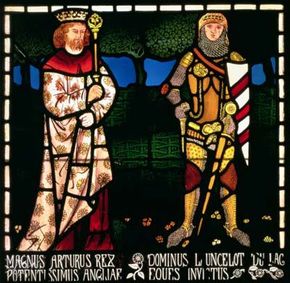
King Arthur Image Gallery King Arthur and Sir Lancelot, 1862 (stained glass). See more pictures of King Arthur.
William Morris/The Bridgeman Art Library/Getty Images
The name King Arthur conjures up a very specific image, thanks to his enduring presence in stories, novels, plays, movies and songs. In these, Arthur is a legendary hero and visionary leader who took control of Britain during a troubled time. The fictional king unites various regional British kings against common enemies and fights off countless invaders. He also goes on a quest for the Holy Grail, a chalice Jesus used at the Last Supper that's said to contain the secret of immortality. The story goes that when Britain is most in need of his services, Arthur will return.
There are certain consistencies in every Arthurian legend, but there are also many variations and complexities. For example, in some stories, Arthur pulls his sword, Excalibur, from a stone. In others, his sword was given to him by a mysterious woman who lives in a lake. The man said to be have led to Arthur's eventual downfall, Mordred, was supposedly his son by his half-sister Morgase. But other stories depict Mordred as Arthur's nephew. Which version or versions are right?
Advertisement
The short answer is that it depends on your definition of "right." Although King Arthur was ranked number 51 in a 2002 BBC poll of 100 Greatest Britons, historians and scholars continue to debate whether he existed at all [source: BBC News].
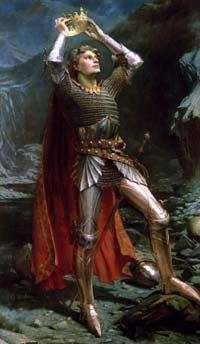
Charles Ernest Butler/The Bridgeman Art Library/Getty Images
Before we get into the historical basis for King Arthur, let's review the basics of his story. Arthur ascends to the throne after Britain's been invaded and its king deposed. A prophecy stated that the only man who could rightfully retake the throne had to be able to pull a sword from an ancient stone. One day, a young stranger walked up to the stone and pulled the sword from it effortlessly. The peasants cheered because they finally had a king again.
In some stories, the sword that Arthur pulls from the stone is Excalibur. In others, he is given Excalibur after he breaks his first sword. This sword comes from a woman known as the Lady of the Lake, a mysterious, nymphlike person eternally associated with the magical island of Avalon.
Advertisement
Arthur goes out onto the lake in a barge, and the Lady (called anything from Nimue to Viviane in various stories) stretches her hand up from the lake holding the sword. In some stories, Merlin, a wise old magician, appears at this point in Arthur's life, while in others he appears in Arthur's childhood. Like the Lady of the Lake, he's often associated with Avalon and also with pagan legends, but he's sometimes depicted as a prophet of the Holy Grail as well. After Arthur becomes king, he builds Camelot, a castle stronghold.
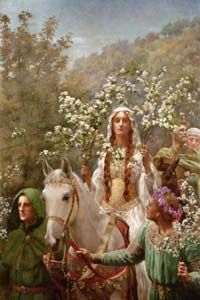
Queen Guinevere's Maying
John Collier/The Bridgeman Art Library/Getty Images
In order to fight the evil forces still sacking and pillaging the countryside, he recruits the best knights in the country to join him. These knights become the Knights of the Round Table. Some knights appear again and again in the legends (and have stories of their own, apart from Arthur), including Lancelot, Gawain, Bedevere and Galahad.
During his travels, Arthur meets and marries a beautiful young woman named Guinevere. After Arthur and his knights defeat all outsiders and calm reigns over Britain, there is a period of peace and happiness at a utopian Camelot. However, Lancelot, Arthur's most trusted knight and companion, falls in love with Queen Guinevere. In some versions of the legend, this secret affair is what leads to the fall of King Arthur and of Camelot. The affair is exposed, and Arthur goes to war with Lancelot after condemning Guinevere to death.
In other tales, man named Mordred tries to take both the throne and Guinevere for himself. Sometimes this is with the assistance of Arthur's half-sister, a pagan named Morgan le Fay. Ultimately, Arthur and Mordred meet at the Battle of Camlann. Mordred is killed and Arthur is heavily wounded.
As he lies on the battlefield, Arthur tells Sir Bedevere that he must return Excalibur to the lake. Bedevere resists at first, knowing the power that Excalibur holds. But finally, he casts the sword into the water and a feminine arm emerges to catch it. The wounded Arthur is taken to Avalon to recover from his wounds. In some stories, Arthur dies and is buried there. In others, he recovers and waits for the right moment to emerge and unite Britain again.
The Round Table
Why a round table? The idea is that all who sit at the table are equals because it has no head. The poet Wace was the first writer to mention King Arthur's round table in his "Roman de Bruit," or verse history of Britain. There are two versions of the table's origin: In one, it was given to Arthur as a wedding gift by Guinevere's father King Leodegrance (who got it from Arthur's father, Uther Pendragon). In another, the table was built by Merlin and meant to resemble the table used at the Last Supper.
Advertisement
The Literary History of King Arthur
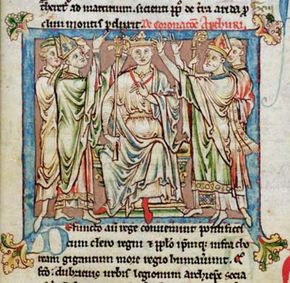
King Arthur, miniature from "Flores Historiarum," by Matthew Paris, c.1250-52 (vellum)
English School/The Bridgeman Art Library/Getty Images
Many scholars trace the first mention of Arthur to a Welsh poem called the "Gododdin," which elegizes Scottish warriors. The "Gododdin" has been attributed to a sixth-century poet named Aneirin and is often considered Britain's earliest surviving poem. Arthur is named in just one line. Other possible references to Arthur from this time period are in the "Historia Britonum" (History of Briton), written around AD 800, and in the "Annales Cambriae" (Annals of Wales), probably written a few hundred years later. Both of these texts were used as sources for multiple histories of Britain and Wales, and both are likely compilations and revisions of earlier texts. In addition, their true authors are in question, and their accuracy can't be proven.
The beginnings of King Arthur as we recognize him can be traced to Geoffrey of Monmouth. This priest and author wrote the "Historia Regum Britannae" (History of British Kings) in the early 1100s. Scholars believe that Geoffrey based this text in part on the "Historia Britonum" as well as earlier histories. Some of his contemporaries went so far as to accuse him of fabricating much of his writings.
Advertisement
However, the "Historia Regum Britannae" became incredibly popular and spread throughout Europe. It influenced French writers and led to the creation of the Arthurian romance. The poet Chretien de Troyes wrote several poems about love and chivalry in the mid-1100s that incorporated tales of Knights of the Round Table. The most significant ones established the romance between Lancelot and Guinevere and told the story of the search for the Holy Grail.
The Vulgate Cycle, or Prose Lancelot, comprises prose stories that expand on de Troyes' themes and tie Christianity even more into the Arthurian legend. Not clearly attributed to an author, these stories were written between 1210 and 1230. They explain how Joseph of Arimathea, a Biblical figure who donated his tomb to Jesus after the crucifixion, brought the Grail to Britain. In a later story, Galahad, the illegitimate son of Sir Lancelot, was able to discover the Grail because he was so pure and devoted. The Vulgate Cycle was followed by the post-Vulgate a few years later, which revised and added material to the existing stories. This is the source for the Lady in the Lake myth and the tale of Mordred as Arthur's son by his sister.
Sir Thomas Malory's compilation "Le Morte d'Arthur" (The Death of Arthur) is probably the best-known version of the Arthurian legends. It was first printed in 1485 and contains the entire story of King Arthur's life, as well as the quest for the Holy Grail and stories about two different Knights of the Round Table: Sir Gareth and Sir Tristan. Up until this time, most of the retellings focused more on pagan and Celtic elements. But in Malory's version, Christianity plays a large part. For example, Guinevere becomes a nun and Lancelot becomes a monk after their affair is discovered.
Malory's version became the basis for many more retellings. This includes the "Idylls of the King" by Victorian poet Lord Alfred Tennyson, and the T.H. White novel "The Once and Future King," which led to the Disney film "The Sword in the Stone."
With such a long and varied history, it seems impossible that Arthur could have been a real person, or that Avalon could have been a real place. But some still believe.
It is a Silly Place
The 1975 film "Monty Python and the Holy Grail," created and performed by the British comedy troupe Monty Python, parodies the Arthurian legends. For many people, this movie is the first thing that they think of when they hear the name "King Arthur." In the movie, Arthur travels around Britain recruiting knights for his Knights of the Round Table. Then God instructs the knights to search for the Holy Grail.
Although many of the characters and locations are from various Arthurian legends, there is no evidence to support the existence of the Holy Hand Grenade of Antioch, the Killer Rabbit of Caerbannog, or the Knights Who Say Ni! "Monty Python and the Holy Grail" continues to have a large cult following and was the basis for the Tony award-winning Broadway musical "Spamalot." It's not the first popular King Arthur musical -- Lerner and Loewe's 1960 "Camelot" also won several Tony Awards.
Advertisement
The Real Camelot
Sunrise over castle ruins in South Cadbury, England. This is one site said to be the location of Camelot.
Richard Nowitz/National Geographic/Getty Images
There are several questions to answer about the real King Arthur. Who was he? Where did he live? Although it's impossible to fully substantiate the mystical and Christian elements of the Arthurian legends, there are several names and locations that have been associated with King Arthur. Let's start with the places.
Advertisement
In the "Historia Regum Britannae," Geoffrey of Monmouth wrote that Arthur was born in Cornwall at Tintagel Castle. A stone was found at Tintagel in the late 1980s with an inscription containing the phrase "Artognou [descendant of Arthur], father of a descendant of Coll." Geoffrey of Monmouth names King Coel (Old King Cole of the nursery rhyme) as one of Arthur's ancestors. However, the castle was actually built in the early 1100s -- centuries after Arthur was supposed to have lived. Historians believe that Geoffrey inserted Tintagel into his narrative to please his patron, Robert, Earl of Gloucester (Robert's brother Reginald, Earl of Cornwall, lived at Tintagel).
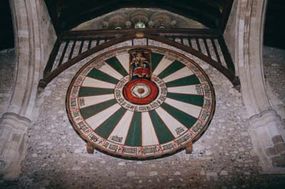
The round table that hangs in Winchester Castle, once thought to be King Arthur's
Travel Ink/Gallo Images/Getty Images
So there's no substantiated birthplace for Arthur. But what about the fabled Camelot? Malory stated that Camelot was Winchester Castle. For hundreds of years, a wooden round tabletop has hung there. It's painted like a dartboard with the names of King Arthur and 24 knights to indicate their places at the table. However, Winchester Castle was actually built in the late 11th century. The round table was carbon-dated to around 1340 and was probably painted during the reign of Henry VIII in the early 1500s to coincide with medieval interest in chivalry. Caerleon in Wales and Cadbury Castle in Somerset have also been named as possible sites, but no definitive proof has been discovered.
Geoffrey of Monmouth identifies Arthur's final resting place, Avalon, with Glastonbury. At one point, this town was an island surrounded by marshland. A large hill, or tor (Celtic for "conical hill"), rises from the plains. Glastonbury Tor is topped by the ruins of St. Michael's, an abbey built in the late 12th century. This abbey was built to replace a much older one that had been destroyed by fire. During the reconstruction, monks claimed to have found graves containing the bones of a man and a woman.
The grave was also said to hold a cross inscribed in Latin stating that the remains were of King Arthur and Guinevere. Neither the bones nor the cross exist today, but monks copied the inscription. Historians who have examined the inscription state that it's 12th century Latin, not a style that would've been used in the sixth century.
We may not have found Avalon, but what about the people of Arthurian legend?
The Other Camelot
In the United States, the word "Camelot" is also associated with John F. Kennedy's presidency. During a period of upheaval, the young and attractive Kennedy family and the president's words of inspiration brought a sense of hope to the American people. After his assassination, his wife Jackie Kennedy claimed that the couple listened to songs from the musical "Camelot" before bed, cementing the fairy tale aspect of the administration and romanticizing a history reputedly rife with affairs.
Advertisement
The Real King Arthur
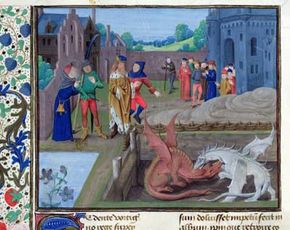
The battle of the red and white dragons with the King and Merlin looking on
English School/The Bridgeman Art Library/Getty Images
Arthur's advisor, the magician Merlin, is probably based on two different figures in Welsh history: a madman named Myrddin Wyllt and a prophet named Emrys Wledig, both of whom may have lived in the late sixth century. Geoffrey likely combined stories about both Merlins to come up with the character of Merlin as we recognize him today.
Two of Arthur's knights may have been real people as well. Sir Bedevere appears in the earliest Arthurian legends as one of Arthur's most trusted allies. He also appears in other writings, including the Welsh collection "Mabinogion." In this book, Bedivere is known as Bedwyr Bedrydant and is a member of the Royal House of Finddu, which rose to power in Wales in the early sixth century. Sir Kay was also one of Arthur's oldest companions. He appeared with Bedivere in the "Mabinogion" and may have actually been Cai Hir, a Welsh lord. Sir Kay also appears in the ancient Welsh poem "Pa Gur."
Advertisement
As for Arthur himself, some suggest that he has Roman origins. Kemp Malone, a Medieval scholar, points to a military leader named Lucius Artorius Castus. Another potential Roman source is Aurelius Ambrosius, a leader who is said to have led the British to victory against the Saxons twice in the sixth or seventh centuries. Geoffrey described him as a "king of kings."
British historian Alan Wilson suggests that Arthur was actually the Welsh king Athrwys, who lived in the seventh century. Other historians have pointed to King Áedán mac Gabráin, who ruled Dal Riata (a kingdom located in modern-day Scotland and Ireland) in the sixth century, or King Áedán's son Artuir mac Áedáin, who did live in a fortress called Camelon. However, unlike Arthur, Artuir never fought the Saxons.
Finally, some historians suggest that the name "Arthur" wasn't a name at all, but a title, as the "Arth" character in Latin can also mean "bear." With this implication, Arthur could have been just about anyone. The current school of thought is that Arthur was based on a mix of either mythological or historical figures, or that he was solely a product of imagination. Regardless of whether Arthur actually existed, the legends will continue to inspire writers.
Why Arthur?
Why has a potentially fictional king become so popular? Probably because the Arthurian legends contain universal, identifiable themes of good versus evil, betrayal, magic, chivalry and the rise and fall of a utopian kingdom. Why has he continued to inspire movies, books and music? Probably because there's such a vast canon to choose from. For example, in the 2004 film "King Arthur," the king is depicted as a Roman soldier. In the popular 1983 novelization "The Mists of Avalon" by Marion Zimmer Bradley, the women in Arthur's life, including Guinevere and his sister Morgaine, take center stage.