10 Biggest Civil War Battles With Death Tolls You Can't Imagine

By: Lena Thaywick  | 
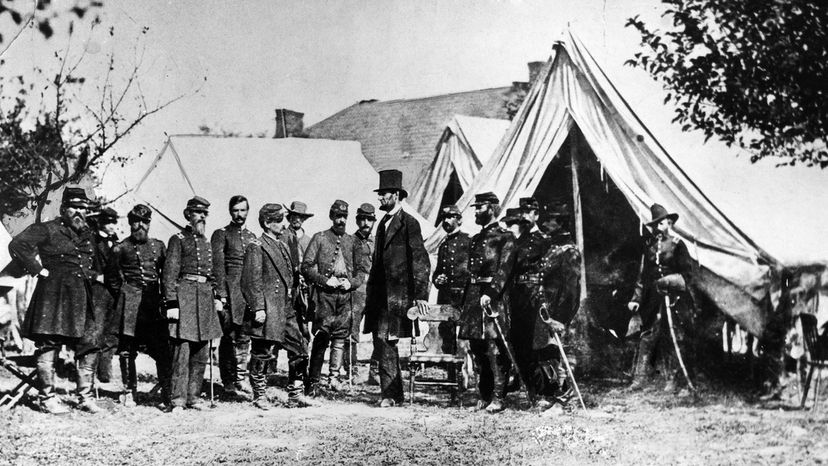
Abraham Lincoln at Antietam with Union soldiers, 1862. Everett Collection / Shutterstock

The biggest Civil War battles produced the most casualties, drew in the largest armies, or changed the direction of the war in a lasting way.

In the American Civil War, size was not just about maps and troop counts. It was also about how badly a battle hurt the Union army, the Confederate army, and the nation itself.

Advertisement

1. Battle of Gettysburg (~51,000 Casualties)

Fought in Pennsylvania from July 1 to July 3, 1863, the Battle of Gettysburg is widely treated as the turning point of the war because it stopped Lee's army in early July during its second invasion of the North.

With about 51,000 casualties, it was the bloodiest single battle of the conflict, and many historians describe the Union victory there and the fall of Vicksburg the next day as the beginning of the end for the Confederacy.

Advertisement

Gettysburg also stands as the largest battle of the Civil War in the popular imagination, even though some historians note that Fredericksburg may have had more troops on the field. The Army of the Potomac, led by Union General George G. Meade, held the Union line against repeated attacks on Cemetery Ridge and elsewhere.

That victory sent Confederate soldiers back south, blunted Lee's momentum and gave President Abraham Lincoln a moment he would later connect to national purpose in the Gettysburg Address.

Advertisement

2. Battle of Chickamauga (~34,600 Casualties)

The Battle of Chickamauga took place in Georgia from September 19 to 20, 1863, and produced about 34,624 casualties. That makes it the second-bloodiest battle of the war by most tallies.

It also ranks among the biggest civil war battles because it was one of the few major Confederate victories in the Western Theater.

Advertisement

Even so, this Confederate victory did not translate into long-term control. The fighting wrecked Union forces, but subsequent Union successes at Chattanooga opened the road into the Deep South and set up later drives toward the Confederate heartland, including the Atlanta Campaign.

3. Battle of Spotsylvania Court House (~30,000 Casualties)

Part of Grant's Overland Campaign, the Battle of Spotsylvania Court House unfolded in Spotsylvania County, Virginia, from May 8 to 21, 1864. It caused roughly 30,000 casualties and extended the brutal contest in northern Virginia between Grant and Lee.

If Gettysburg broke Confederate momentum, Spotsylvania showed how the war had become a grinding test of endurance.

Advertisement

This fight is often described as a costly tactical victory for Lee because Confederate lines bent but did not break. Union forces kept pressing, often through horrific close combat around the Mule Shoe salient, and Grant refused to retreat.

That mattered because Grant's Overland Campaign was designed to wear down Lee's army through attrition, even when no single clash produced a decisive victory.

Advertisement

4. Battle of Chancellorsville (~30,000 Casualties)

The Battle of Chancellorsville was fought in Virginia from April 30 to May 6, 1863, and caused about 30,000 casualties. Many historians call it Lee's greatest battlefield success because he split his outnumbered Confederate forces and outmaneuvered the Union army.

But this Confederate victory came with a wound the South could not afford: Stonewall Jackson was accidentally shot by his own side during the campaign and later died, depriving Lee of one of his best commanders.

Advertisement

Chancellorsville is a classic example of how a dazzling Confederate win could still weaken the larger war effort.

5. Battle of the Wilderness (~28,000 Casualties)

The Battle of the Wilderness came first in the Overland Campaign, running from May 5 to 7, 1864, in tangled Virginia woods. It left about 28,000 casualties and marked the first direct showdown between Grant and Lee.

Dense underbrush turned command and control into chaos, and fires trapped wounded men in one of the war's grimmest scenes.

Advertisement

In strategic terms, the battle of the wilderness was close to a bloody stalemate. In political terms, though, it showed something new.

Earlier Union generals often pulled back after a hard fight against Lee's army. Grant kept moving south toward Spotsylvania, North Anna, and Cold Harbor, signaling that federal troops would stay on the offensive until the Confederate capital at Richmond was threatened and the Army of Northern Virginia was pinned down.

Advertisement

6. Battle of Shiloh (~23,700 Casualties)

The Battle of Shiloh took place in Tennessee on April 6 and 7, 1862, and produced about 23,746 casualties.

Early in the war, those numbers shocked Americans who had not yet grasped how large Civil War battles could become. The fighting helped drive home that this would be a long industrial war, not a brief rebellion.

Advertisement

Shiloh also mattered because it strengthened Union operations in the Western Theater.

The battle came after the Union army had already won a major victory at Fort Donelson, and together those campaigns helped open Tennessee to deeper Union penetration. That, in turn, set conditions for later struggles at Stones River, Chickamauga, and Chattanooga.

Advertisement

7. Battle of Stones River (~23,500 Casualties)

The Battle of Stones River was fought in middle Tennessee from December 31, 1862, to January 2, 1863, and cost about 23,515 casualties. It was not a clean, tactical masterpiece, but it ended as a decisive victory for Union troops under William S. Rosecrans.

That mattered because Union morale badly needed a lift after setbacks such as Fredericksburg. Stones River also helped cement Union control in middle Tennessee and put pressure on Confederate forces trying to defend the interior South.

Advertisement

In a war where territory, railroads, and supply lines mattered as much as dramatic charges, that was a major victory.

8. Battle of Antietam (~23,100 Casualties)

The Battle of Antietam took place near Sharpsburg in Washington County, Maryland, from September 16 to 18, 1862. Its main fighting day on September 17 produced roughly 23,100 casualties, making it the bloodiest single day in American history.

Antietam was tactically inconclusive, but strategically it was a Union victory because it halted Lee's first invasion of the North. It also gave Lincoln the opening he needed to issue the Emancipation Proclamation.

Advertisement

That linked the military struggle to slavery more directly and made foreign recognition of the Confederacy more difficult.

9. Second Battle of Bull Run (~22,200 Casualties)

The Second Battle of Bull Run was fought from August 28 to 30, 1862, near Manassas, Virginia, and caused about 22,180 casualties. It followed the first battle at the same crossroads in 1861, when the First Battle of Bull Run had shattered hopes for a quick end to the war.

This second battle was a clear Confederate victory that sent Union soldiers reeling and briefly revived Southern hopes for a campaign into Union territory.

Advertisement

Bull Run is a useful reminder that there were really two battles at Manassas, and both exposed how difficult it was for the Union army to coordinate large bodies of federal troops in the field during the early war.

10. Battle of Fort Donelson (~17,400 Casualties)

The Battle of Fort Donelson took place in Tennessee from February 13 to 16, 1862, and produced about 17,398 casualties.

By pure casualty count, other fights such as Fredericksburg, Cold Harbor, Fair Oaks, and Cedar Creek can challenge it for space in a top-10 conversation. But Fort Donelson belongs on the list because of how much strategic ground it gave the North.

The Union capture of the fort helped open the Cumberland and Tennessee river corridors, strengthened Union control in the West, and forced Confederate withdrawals from Kentucky and parts of Tennessee.

That success helped set the stage for the campaign sequence that would eventually carry Union forces to the Mississippi River, crack the Confederate heartland at Vicksburg and move farther south.

How Many Died in the Civil War?

From 1861 to 1865, the Civil War killed more than 620,000 Americans, and some modern estimates push the toll closer to 750,000 or even 850,000.

More than 10,000 armed confrontations took place, but a smaller group of major battles did most of the historic heavy lifting. These war battles shaped Union control of key rivers, battered Lee's Army of Northern Virginia and helped determine whether the Confederacy could survive.

Gauging the Importance of Individual Battles

Not every giant fight made this top 10 by casualty totals, but several still shaped the war in major ways:

  • Fredericksburg in December 1862 involved roughly 200,000 total forces and produced about 18,000 casualties, with frontal assault after frontal assault smashing against strong Confederate lines in a lopsided Confederate victory.
  • Cold Harbor in 1864 became infamous for roughly 12,000 Union casualties, many suffered in a very short time during another frontal assault.
  • The long Siege of Petersburg from June 9, 1864, to April 2, 1865, helped trap Lee outside Richmond, while North Anna added another brutal chapter to the Overland Campaign.
  • The Siege of Vicksburg, fought from May 18 to July 4, 1863, ended in a Union victory that gave the North control of the Mississippi River and split the Confederacy in two.
  • Chattanooga opened the route into the Deep South. Fighting around Charleston Harbor and Fort Sumter in South Carolina symbolized the opening and the long emotional arc of the war.

Even later victories in places such as Cedar Creek in the Shenandoah Valley and operations touching West Virginia helped tighten Union control over vital regions.

By April 9, 1865, the logic of attrition had done its work. Lee surrendered to Grant at Appomattox Court House, and more Confederate surrenders followed.

In American history, that is why the biggest Civil War battles matter so much: They were not isolated bloodbaths. They were the steps that pushed the Union army from early chaos at Bull Run to final victory.

We created this article in conjunction with AI technology, then made sure it was fact-checked and edited by a HowStuffWorks editor.

Advertisement

Loading...