The Flag of Texas: Brief History of an Icon

By: Lena Thaywick  | 
Welcome to Texas State Sign
Yeehaw! Nick Fox / Shutterstock

The flag of Texas, known proudly as the Lone Star Flag, is one of the most recognizable symbols in the United States. Often associated with Texas pride and independence, the flag design reflects the state’s rich history and lasting identity as the Lone Star State.

Advertisement

Design and Structure

This is the Texas State Flag flying in the wind
The Lone Star is always a five-pointed star. Joseph Sohm / Shutterstock

The Texas state flag features a blue vertical stripe covering one third of the length along the hoist. The remaining two thirds are divided into equal horizontal stripes: the upper stripe white and the lower stripe red.

In the center of the blue stripe sits a regular five pointed white star, sometimes called the lone star. The flag’s regular five-pointed star represents the unity of Texas and Texans as one. By law, the Texas flag’s width-to-length ratio is 2:3 (the height of the flag is two-thirds the length).

Advertisement

When manufactured, the Texas flag usually includes two brass grommets for flying from a flagpole. The blue stripe takes up the entire left side, while the white stripe and red stripe complete the design.

The star can be inscribed within a circle passing through each of its five points, further emphasizing symmetry.

Advertisement

Historical Background

The Lone Star Flag became the official flag of Texas on January 25, 1839, by the Republic of Texas Congress meeting in Houston, which was the capital at that time.

It became the second official flag of the independent Republic of Texas when adopted in 1839 (the first official flag was the 1836 "Burnet’ flag).

Advertisement

Even before statehood, the “lone star” had already been used as a symbol of Texas during the Revolution. For example, a single star featured on Sarah Dodson’s Lone Star flag of 1835, an early emblem of Texan independence.

Over time, the design has come to stand for the spirit of independence, resilience, and pride in Texas history.


Advertisement

Comparisons and Confusion

The Texas flag is sometimes compared to the Chilean flag, which also features red, white, and blue with a lone star.

However, the design differences are clear: The Chilean flag uses a smaller blue square in the upper hoist corner, while the Texas flag dedicates the entire left side to its blue vertical stripe.

Advertisement

Use and Display

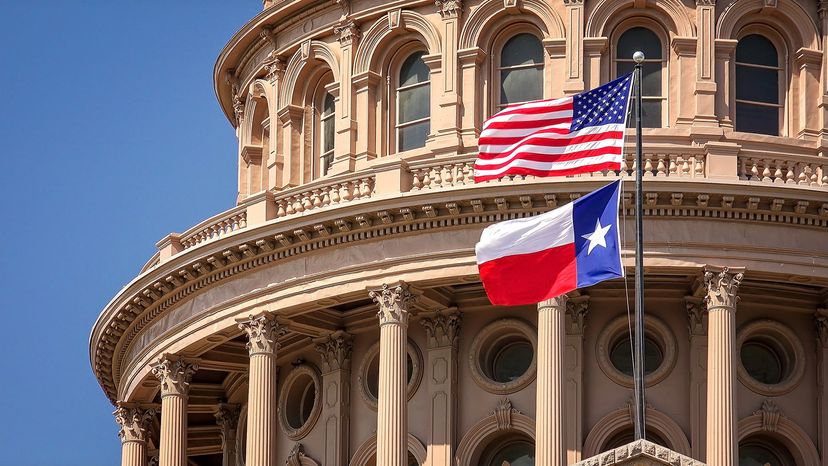
American and Texas state flags
The U.S. flag flies with the Texas state flag on the dome of the Texas State Capitol. CrackerClips Stock Media / Shutterstock

The Texas state flag is flown across government buildings, schools, and homes, often displayed with deep pride. When flown at half staff, it follows the same protocols as the U.S. flag. Texans also fly the flag on days commemorating Texas independence and other historic events.

Quality materials ensure the long lasting durability of the flag, which remains a symbol of unity and strength. Whether in battle, at the governor’s office, or in backyards, the flag of Texas stands as a reminder of the state’s independent spirit and enduring legacy.

Advertisement

We created this article in conjunction with AI technology, then made sure it was fact-checked and edited by a HowStuffWorks editor.

Advertisement

Loading...