How Many Countries Are in Europe? Surprisingly Not a Simple Answer

By: Lena Thaywick  | 
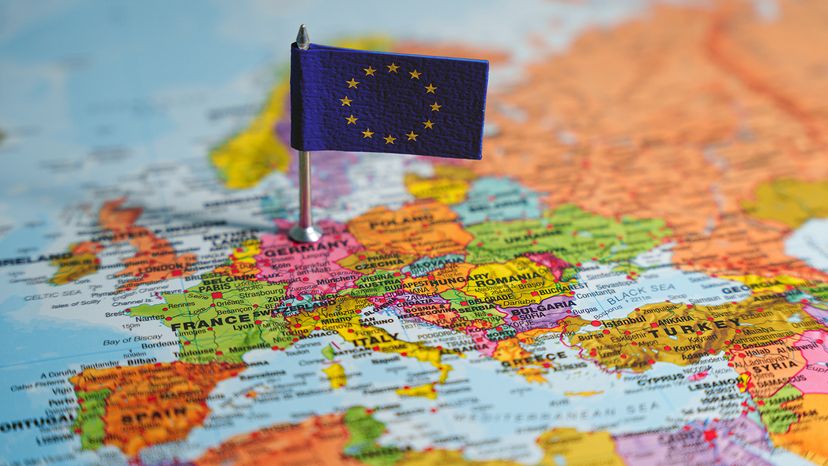
The UN and Council of Europe have different counts, and both are way off from the number of countries in the EU. Rokas Tenys / Shutterstock

How many countries are in Europe? It depends on how you define the continent and what counts as a country.

Most international organizations say there are 44 sovereign states in Europe. Broader definitions that include transcontinental nations and disputed territories can push that number closer to 50.

Advertisement

Europe sits in the northern hemisphere and forms the western portion of the larger Eurasian landmass. Although it is the second-smallest continent, its political map is complex and shaped by centuries of history, war, and political change.

Europe’s Borders and Geography

Europe is generally defined by natural geographic boundaries. The continent is bordered by the Arctic Ocean to the north, the Atlantic Ocean to the west, and the Mediterranean Sea to the south.

The eastern border separating Europe from Asia follows several natural features. These include the Ural Mountains, the Ural River, the Caspian Sea, the Caucasus Mountains and the Black Sea.

Advertisement

Because this boundary cuts across land rather than ocean, some nations sit in two continents; countries such as Russia and Turkey are often called transcontinental countries because parts of their territory lie in both Europe and Asia.

Cyprus is another interesting example. Although it sits geographically in Asia Minor, it is usually counted among European countries due to culture, politics, and its membership in European institutions.

Advertisement

How Europe Is Divided Into Regions

To understand how many countries exist on the continent, geographers often divide Europe into several regions. The United Nations geoscheme organizes European countries into four main areas: Northern Europe, Western Europe, Eastern Europe, and Southern Europe.

Northern Europe includes 10 countries: Denmark, Estonia, Finland, Ireland, Latvia, Lithuania, Norway, Sweden, and the United Kingdom. The region also includes the British Isles and parts of Scandinavia.

Advertisement

Western Europe contains nations such as France, Germany, Switzerland, Belgium, the Netherlands, Luxembourg, Austria, Monaco, and Liechtenstein. Many of these countries helped form the early institutions of European cooperation after World War II.

Eastern Europe includes states like Poland, Romania, Hungary, Slovakia, Moldova, Belarus, and Ukraine. Russia also appears in this regional grouping because much of its population lives west of the Ural Mountains.

Southern Europe—sometimes called Mediterranean Europe—includes countries such as Spain, Portugal, Italy, and Greece along with smaller states like Malta, San Marino, and Vatican City.

Advertisement

The UN's Official Country Count in Europe

According to the United Nations, there are 44 internationally recognized sovereign states in Europe. This count excludes countries that span two continents or have disputed international recognition.

Some organizations use slightly different counts. The Council of Europe lists 46 member states, while broader geographic definitions can include as many as 51 countries when transcontinental nations such as Turkey, Russia, Georgia, Azerbaijan, and Kazakhstan are added.

Advertisement

Disputed territories also complicate the answer. Places like Kosovo or Transnistria operate as independent governments but are not recognized as full UN member states.

The European Union and Political Integration

Another reason the question can be confusing is the European Union. The EU is a political and economic union that began in Western Europe and expanded eastward after the dissolution of the Soviet Union in 1991.

As of 2023 the European Union has 27 member states. The organization created shared institutions including a parliament, a court system, and a central bank, and many members use the euro as a common currency.

Advertisement

The United Kingdom left the EU on January 31, 2020 after a referendum held in 2016. Despite this departure, the EU still represents a large share of Europe’s population and economy.

Integration across the continent did not start with the EU. Institutions such as the Council of Europe, founded in 1948, helped encourage cooperation after World War II, and laid groundwork for modern European alliances.

We created this article in conjunction with AI technology, then made sure it was fact-checked and edited by a HowStuffWorks editor.

Advertisement

Advertisement

Loading...