Why Did the Roman Empire Fall? Corruption, Inflation, and Division

By: Lena Thaywick  | 
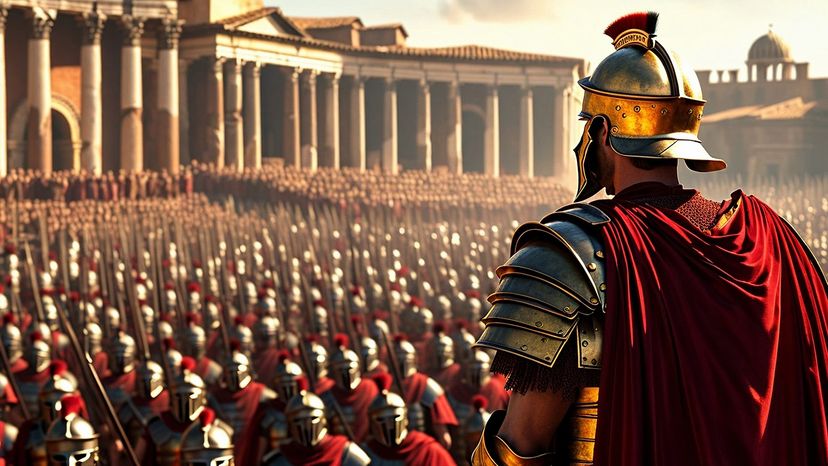
Ancient Rome was a tale of two empires. One flourished for an extra millennium, and the other crumbled under weak leadership and economic strain. Shutterstock.AI Generator / Shutterstock

It’s one of the most debated questions in world history: Why did the Roman Empire fall?

The answer isn’t simple, because Rome didn’t fall in a single moment. Instead, the decline of the Western Roman Empire was a long, complex process shaped by many internal and external pressures.

Advertisement

Economic Troubles and Internal Corruption

The Roman economy began to falter in the second and third centuries. Plagues like the Antonine Plague and Cyprian Plague reduced the population and workforce.

Inflation, heavy taxation, and reliance on slave labor further strained the economy. Roman citizens faced a declining standard of living, and the military often lacked funding.

Advertisement

Meanwhile, corruption in the central authority grew worse. Many Roman emperors gained power through violence or bribery, and political turmoil became a regular part of life. The once-loyal Roman soldiers sometimes supported new emperors in exchange for payment, undermining stability.

A Split Empire and Weak Leadership

By the late third century, the Roman Empire was divided into the Eastern and Western Empires. While the Eastern Roman Empire (later called the Byzantine Empire) remained strong in Asia Minor and the eastern Mediterranean region, the Western Roman Empire struggled.

The empire split created two centers of power and weakened central control. Western Roman emperors had difficulty maintaining authority over a vast territory that included much of Europe and North Africa.

Advertisement

Roman history during this period is full of short reigns and civil wars that eroded political stability.

Invasions and Military Pressure

During the fourth and fifth centuries, waves of barbarian tribes—including Visigoths, Vandals, and Huns—began to push into Roman territory. These Germanic tribes and others from northern Europe migrated south during the Migration Period, leading to a series of devastating conflicts.

The sack of Rome by the Visigoths in 410 C.E. and the invasion of northern Africa by the Vandals in 429 C.E. signaled the empire’s crumbling defenses.

Advertisement

By the time the last Western Roman emperor, Romulus Augustulus, was deposed in 476 C.E., much of the western provinces had already been lost.

The Role of the Eastern Empire

As the Western Empire declined, the Eastern Roman Empire under emperors like Leo I retained wealth and military strength. With its capital city in Constantinople, the Eastern Empire survived for nearly a thousand years longer.

The Eastern emperor often viewed the western emperors as weak or unimportant, and there were few efforts to unify the entire empire again. The imperial insignia was eventually sent east, symbolizing a shift in imperial power.

Advertisement

Long-Term Cultural and Environmental Factors

Roman culture had also changed. As central control declined, independent power centers formed across the western provinces. Wealthy cities became isolated, and local elites replaced imperial governance.

Some have speculated that lead poisoning from Rome’s water pipes contributed to its decline, but modern evidence indicates this was not a significant factor. In contrast, climatic changes during the late Roman period are recognized by historians as contributing factors in Rome’s long decline.

Advertisement

Edward Gibbon famously argued in "The Decline and Fall of the Roman Empire" that the loss of civic virtue and the rise of Christianity played a role. While controversial, it highlights how many elements—social, political, military, and environmental—converged to bring about the fall of Rome.

We created this article in conjunction with AI technology, then made sure it was fact-checked and edited by a HowStuffWorks editor.

Advertisement

Advertisement

Loading...