11 Countries Near Italy: Historical Importance and Summer Travel Ideas

By: Lena Thaywick  | 
Whether you're planning a multi-country Europe trip or digging into world history, understanding the geography surrounding Italy will help. Pyty / Shutterstock

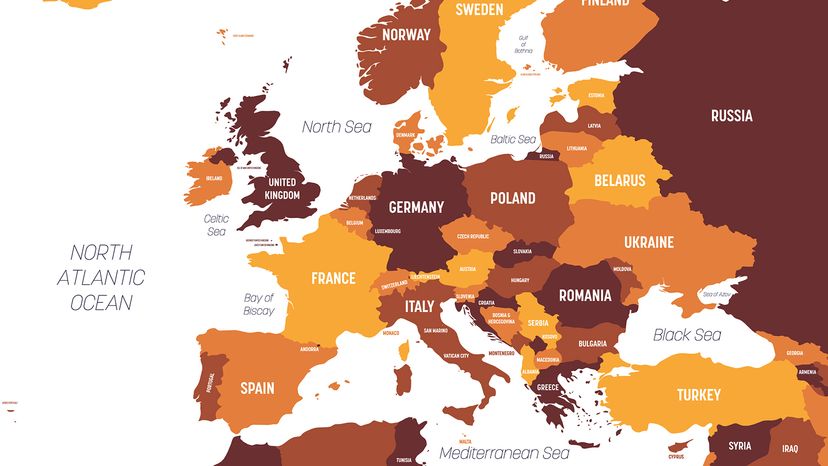
Looking at the countries near Italy helps explain why the Italian Republic has played such a central role in European history, trade and culture.

Located in southern Europe, Italy sits on the Italian Peninsula and extends into the Mediterranean with islands like Sicily and Sardinia. Its position places it at a crossroads between Western Europe, Central Europe, and even North Africa across the sea.

Advertisement

Italy shares land borders with four countries and surrounds two independent enclaves within its territory. It also maintains maritime borders with several nations across the Adriatic Sea and wider Mediterranean, giving it a strategic location that has shaped its government, economy and history for centuries.

1. Switzerland

Switzerland forms the longest land border with Italy, stretching across the Alps along Italy’s northern boundary. This border runs through dramatic terrain that includes peaks near Monte Bianco, the tallest mountain in the Alps.

Northern Italy regions like the Po Valley connect economically with Swiss cities, making this one of the most important cross-border areas in Europe. The border has remained largely stable since World War II.

Advertisement

2. France

France borders Italy to the west and has deep historical ties to the Italian Peninsula. The modern border was finalized in 1947 after World War II, though earlier agreements like the Treaty of Turin shaped parts of it.

Major Italian cities such as Turin sit near this border, linking the two countries through trade, culture, and shared alpine geography.

Advertisement

3. Austria

Austria borders northern Italy, particularly in regions like South Tyrol. This area reflects a long history tied to the Austro-Hungarian Empire before becoming part of Italy after World War I.

Today, Austria and Italy are both part of the European Union, allowing easier movement across their shared border of roughly 404 kilometers (251 miles).

Advertisement

4. Slovenia

Slovenia shares a land border with Italy, extending about 232 kilometers (144 miles). This eastern boundary lies near the Adriatic Sea and includes the historically contested region of Trieste.

Both countries are part of the Schengen Area, meaning border controls are minimal for most travelers, although temporary measures have been used during migration crises.

Advertisement

5. San Marino

San Marino is one of the world’s oldest republics and is completely surrounded by Italian territory. Located on mountainous terrain in central Italy, it has a land border of about 24 miles (39 kilometers).

Despite its small size, San Marino maintains its own government and identity while remaining closely connected to Italy’s economy and culture.

Advertisement

6. Vatican City

Vatican City is another country located entirely within Italy, specifically inside the city of Rome. It is the smallest sovereign state in the world, with a border of about 2.0 miles (3.2 kilometers).

As the center of the Catholic Church, it plays a global role despite its tiny size.

Advertisement

7. Albania (Maritime Border)

Across the Adriatic Sea to the east lies Albania. Although it does not share a land border with Italy, the two countries are connected by maritime boundaries and trade routes.

Ports in southern Italy and along the Adriatic coast link the countries through travel and commerce.

Advertisement

8. Greece (Maritime Border)

Greece lies southeast of Italy across the Ionian Sea. These countries have interacted for thousands of years, from ancient times through modern European Union cooperation.

Ferries and shipping routes connect Italian cities like Naples to Greek ports, reinforcing economic and cultural ties.

Advertisement

9. Malta (Maritime Border)

Malta sits south of Sicily in the Mediterranean. Though small, it is an important neighbor with strong historical links to Italy.

Its location between Europe and north Africa highlights Italy’s role as a bridge between continents.

Advertisement

10. Tunisia and Libya (North Africa)

Across the Mediterranean, Italy shares maritime proximity with north African countries such as Tunisia and Libya. These connections emphasize Italy’s strategic position in the central Mediterranean.

Trade, migration, and historical ties continue to link these regions with southern Italy.

11. Croatia and Montenegro (Adriatic Neighbors)

On the eastern side of the Adriatic Sea, Croatia and Montenegro are among the surrounding countries connected to Italy by water. These coastal nations share long maritime traditions with Italy.

The Adriatic Sea serves as a key corridor for shipping, tourism, and cultural exchange across the region.

Why Italy’s Location Matters

Italy’s geography explains much about its influence. The Alps protect its northern border, while the peninsula stretches into the Mediterranean, giving it access to major sea routes.

With a total land border of about 1,116 miles (1,836 km) and a coastline of roughly 4,722 miles (7,600 km), Italy connects multiple regions of Europe and beyond. Its position has helped shape everything from ancient trade networks to modern economic systems and political relationships.

We created this article in conjunction with AI technology, then made sure it was fact-checked and edited by a HowStuffWorks editor.

Advertisement

Loading...