Why Did the Han Dynasty Fall? Warlords and Puppet Emperors

By: Lena Thaywick  | 
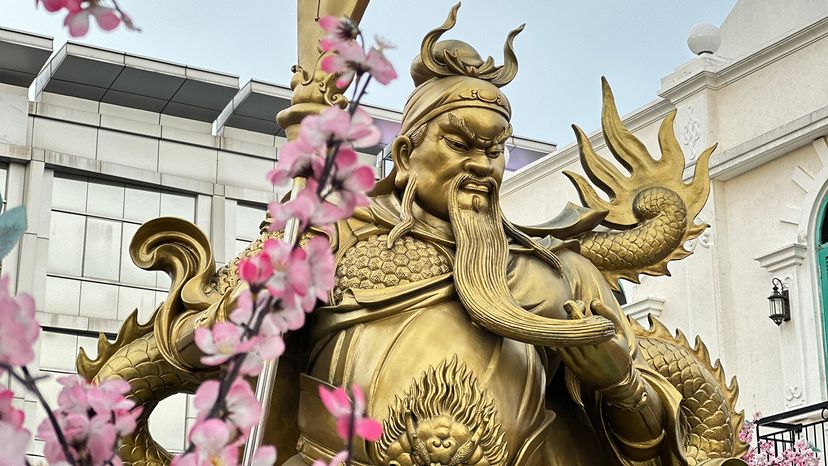
Guan Yu, also known as Guan Gong, was a military general serving under Liu Bei during the late Eastern Han dynasty. Mattia Al Azizzy / Shutterstock

Why did the Han dynasty fall? How did one of the most durable early Chinese empires unravel from the inside? There's not a singular answer.

The Han dynasty shaped Chinese identity, governance, and culture so deeply that its collapse still echoes across East Asian cultures.

Advertisement

Like the Roman Empire, the Han did not fall in a single moment. It frayed, cracked, and finally came apart.

The Han Dynasty’s Long Arc of Power

The Han dynasty succeeded the Qin dynasty and, after a brief interruption by the short-lived Xin dynasty (9 to 23 C.E.), ushered in what historians call a golden age in ancient China.

Early rulers of the Western Han built a strong imperial dynasty with centralized administration, standardized law, and expanding territory across western China.

Advertisement

Under later figures like Emperor Zhang, the Han empire reached economic and cultural stability that made it the model for later dynasties.

When the Han Government Began to Weaken

Problems surfaced during the Eastern Han period’s rule, when the Han government became dominated by palace politics.

Rulers such as Emperor Huan and the boy emperor Ling inherited power young, leaving real authority to eunuchs and regents. Emperor Huan died after ordering indiscriminate killing of rivals, a move that deepened corruption instead of restoring order.

Advertisement

When Emperor Ling died, the empire lost what little balance remained.

The Yellow Turban Rebellion Shook the Empire

The Yellow Turban Rebellion, also called the Yellow Turban Revolt, was the breaking point for the Han dynasty’s empire.

This mass uprising drew strength from poor people, heavy taxes, and famine. The Han emperor relied on regional generals to suppress it, but that decision militarized politics.

Advertisement

Once the rebellion was crushed, those generals kept their armies. The Han empire quickly broke into warlord kingdoms.

Court Chaos After Emperor Ling Died

After Emperor Ling died, the succession crisis turned deadly.

Emperor Shao, also known as Liu Bian, was proclaimed emperor but ruled only briefly. His regent, He Jin, tried to eliminate the powerful eunuchs and summoned General Dong Zhuo to the capital.

Advertisement

That move backfired.

Dong Zhuo seized control, replaced Emperor Shao with the young emperor Xian, and ruled through a puppet ruler.

Advertisement

Emperor Xian and the Rise of Warlords

Young Emperor Xian never controlled the Han dynasty government.

Warlords like Yuan Shao, Cao Cao, Liu Bei, and Sun Quan fought in the emperor’s name while building independent power bases. Cao Cao ruled the court by keeping Emperor Xian as his own puppet ruler.

Advertisement

The Eastern Han emperors faced a reality where imperial orders meant nothing without armies to enforce them.

The Han Dynasty Ultimately Collapsed Into Three Kingdoms

By the early third century, the Han dynasty collapsed in all but name.

Cao Cao’s son, Cao Pi, forced Emperor Xian to abdicate, formally ending the Han. China fractured into the Three Kingdoms period, with the kingdoms ruled by Wei, Shu Han, and Wu.

Advertisement

Shu Han, led by Liu Bei and later guided by Shu chancellor Zhuge Liang, claimed to restore the Han but never reunified China.

Aftermath and Long-term Impact

The fall of the Han dynasty reshaped Chinese history. The Jin dynasty eventually reunified China, but centuries of division followed.

Later dynasties, from the Tang to the Qing, studied why the Han dynasty fell so they could avoid repeating it. Even today, “Han Chinese” reflects how deeply this empire defined a civilization.

Advertisement

We created this article in conjunction with AI technology, then made sure it was fact-checked and edited by a HowStuffWorks editor.

Advertisement

Loading...