Image Gallery: Caves Who knew they had cameras back then? See more pictures of caves.
Petrified Collection/The Image Bank/Getty Images
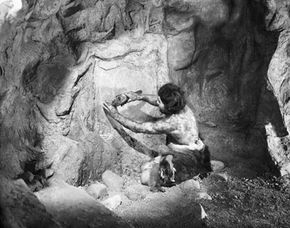
The stereotypical caveman is a brutish, hulking figure, physically strong but with a feeble intellect. Hairy and heavy-browed, communicating through crude gestures and grunts, cave dwellers are typically seen in movies and TV shows where anthropological accuracy isn't a primary goal.
Who were the real cave dwellers? Cavemen (along with cavewomen and cave children) did exist, although perhaps not in the Hollywood mold. Early humans and humanlike species used caves for shelter, and the little we know about them comes from what they left behind in those very dwellings.
Advertisement
Scientists have long debated the role caves played in the development of early humans. We'll never know the full story, but we can piece together a picture of prehistoric cave life through archaeological sites like Lascaux. Within that famous cave in France is a collection of astonishing cave paintings that hint at a symbolic, possibly religious life for those primitive humans.
But cave dwellings weren't limited to early humanlike species -- some caves have been occupied for thousands of years, even into modern times. Some people even choose to live in cave homes today, because they're efficient, sturdy and environmentally friendly.
What would it be like to live inside a cave? Why someone would choose to inhabit one, and what have archaeologists have found preserved inside them? We're going to explore the pros and cons of cave life and visit the most famous cave dwellings in the world.
Cave Defense
Caves definitely protected cave dwellers from nasty weather, and probably from a lot of dangerous animals as well. Many animals simply refuse to enter caves, although cave bears would certainly have been a problem. But what about protection from other cave dwellers? It turns out it wasn't much of an issue. During the Paleolithic Era, systematic violence was extremely rare. There were conflicts between groups, but cooperation was the norm. Well-hidden caves were probably beneficial, but they didn't need to be forts.
Prehistoric/The Bridgeman Art Library/Getty Images
We know that cavepeople existed -- early humans and other species closely related to humans inhabited caves. The question is, how important were cave dwellings to these primitive peoples? We'll probably never really know, because they left no historical records other than a few cave paintings and scattered artifacts. However, the general consensus among anthropologists and archaeologists is that caves very rarely served as permanent settlements. They may have provided seasonal shelter or been temporary camp sites for nomadic groups that moved from place to place, following the herd animals they hunted for food.
Some of the prehuman or humanlike species that may have lived in caves include Homo antecessor, Homo neanderthalensis (Neanderthals), Homo erectus and Homo heidelbergensis. Early humans, Homo sapiens, also used caves sporadically. Living as hunter-gatherers, these species didn't create permanent settlements. They had several ways of building shelters for themselves, such as stretching animal hides over bone, building rough wooden lean-tos or creating earthen mounds. When they came across a cave suitable for shelter, they used it.
Advertisement
The most common caves in the world are made of limestone, which is eroded by acidic water. Although there are millions of caves, many of them are unsuitable for shelter. The entrances may be located on an inaccessible cliff face, or the entrance itself may be a long vertical shaft. Surrounding terrain often blocks the view of the entrance to casual observers, which is why many previously inhabited caves remained hidden until modern humans rediscovered them. And it's not just the outside that's intimidating -- cave interiors are rarely safe places. They're filled with crevices, unstable gravel slopes, multiple entrances and exits, shafts and potential rockfalls. Once you move more than a few dozen meters from the entrance, they're also utterly dark. And without naturally occurring ventilation shafts, the air could quickly become unbreathable. A cave suitable for living in is actually quite rare.
The Neanderthals are one particular species known to have had a predilection for cave living. They existed throughout a wide swath of Europe during a glacial period. The harsh climate forced Neanderthals to be adaptive, creative survivors. Archaeologists believe they used two main strategies: circulating mobility and radiating mobility. With circulating mobility, each group of Neanderthals had several temporary camps, some of which included caves, spread throughout a region. They moved from place to place in search of the best hunting grounds. With radiating mobility, the group had one central camp. Hunting parties headed out from camp, moving farther and farther afield to find food. In at least several cases, these main camps were caves [source: Tattersall]. The caves suited the Neanderthals' purposes especially well because they lived in very small groups of about a dozen individuals. Few caves could support a larger population. There is evidence that in at least one case, Neanderthals and early humans lived in the same cave at the same time and shared resources [source: Viegas].
In the next section, we'll examine the archaeological evidence of prehistoric cave life -- in particular, cave paintings.
The Cave-dweller Era
The era that most people think of when they talk about "cavemen" is the Paleolithic Era, sometimes referred to as the Stone Age (it's actually one part of the Stone Age). It extends from more than 2 million years into the past until sometime between 40,000 and 10,000 years ago (depending on who you ask). Ironically, there are probably more humans permanently living in caves today that at any time in human history.
Advertisement
Cave Paintings and Artifacts
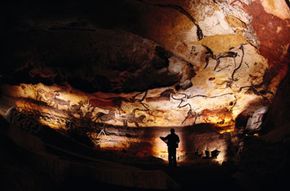
Paintings of animals crowd calcite walls at Lascaux.
Sisse Brimberg/ National Geographic/Getty Images
Many of the remnants of Paleolithic societies have been found in caves. That doesn't mean that people spent a lot of time living in caves -- the environment of a cave simply preserves these remnants from erosion, corrosion and decay, allowing them to last for tens of thousands of years. But not all caves are so helpful. Caves that have water sources inside them, known as active caves, make it difficult to determine what life was like in the past. Floods and changes in the water's course spread detritus like bones, stone fragments and tools throughout the cave, often hundreds of meters from where they were first dropped.
Even cave art isn't really restricted to caves. Again, caves preserve the art better, but Stone Age paintings of animals have been found on rocks and cliffs throughout Africa [source: Constable]. The most famous cave in the world is Lascaux, near Montignac, France. It was discovered in 1940, and the entrance was later modified to create an entryway and masonry floors for visitors. However, the cave was eventually sealed off and climate-controlled to prevent damage to the paintings, which are very sensitive to the flashes from cameras and the carbon dioxide given off by visitors.
Advertisement
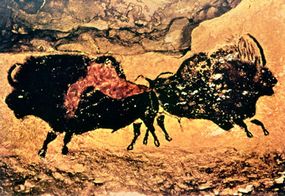
Painting of bison at Lascaux
Paleolithic/The Bridgeman Art Library/Getty Images
We can only speculate about the purposes of the cave paintings found at Lascaux and other sites. They may have been part of religious rituals, simple representations of life as the cave dwellers experienced it, or superstitious homages created in hopes of a successful hunt. One thing is clear: The main subject on the minds of the cave dwellers was the animal life around them. The overwhelming majority of the images painted onto the cave walls depict animals, mainly herd animals such as bison, horses and boars [source: Aujoulat]. Some images seem abstract, depicting grid and dot patterns. These may have been a primitive form of calendar or sign, or they may have represented images seen while in a trance [source: Price]. It's just as interesting to consider what wasn't depicted by cave art: very few trees or other vegetation, and few images of humans. We have no idea why they neglected these subjects.
The cave paintings, particularly at Lascaux, are remarkably detailed. Some of them depict large animals at near life size. The primary pigments used were iron oxides for red and manganese for black. Ochre created a variety of yellow or orange shades. Cave dwellers applied the paint by blowing through a tube or directly from the mouth. They also used brushes made from animal hair or plant material, along with their fingers, rocks and other tools [source: Aujoulat]. Sometimes the images were engraved in addition to being painted. Many of the paintings were made deep within the cave with the aid of torches and lamps. The lamps were pieces of stone with a handle on one end and a hollow carved at the other. A piece of animal fat was placed in the hollow and lit with an ember [source: Aujoulat].
Along with paintings, we've found other things inside caves that give us hints about the lives of the cave dwellers. They made jewelry and engraved small items out of bone or ivory (and probably wood, though none of those survived). Some cave dweller cultures buried their dead with such items, suggesting some kind of religious belief or belief in an afterlife.
Some people still live in caves today. We'll find out why and where in the next section.
What's a Troglodyte?
Troglodyte is a word sometimes used in a general way as a synonym for "caveman." It's a Greek word that, literally translated, means "someone who lives in a hole." There are historical and Biblical references to a tribe of people on the western coast of Africa who lived in caves, called Troglodyti or Troglodytae.
Advertisement
Modern Cave Dwellers
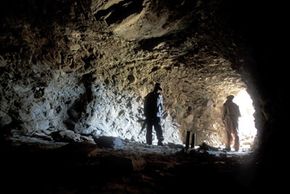
In Afghanistan, Taliban insurgents have made frequent use of caves as places to live and hide from U.S. troops. This cave in the Tora Bora Mountain is Bin Laden's last known house.
Reza/Getty Images
Some people choose to live in a cave today because it's tradition, while for others, it's an economic necessity. There are people who build their own cave homes for environmental reasons. Most modern cave homes were intentionally carved out of the rock -- not many people live in natural caves.
In the Mount Hebron region of the West Bank, in the Middle East, a large clan of Palestinians lives in a network of caves that their grandparents built 100 years ago. The area has been claimed by Israeli settlers, and the Israeli army has threatened to remove them from the caves [source: AFP]. While the settlement has had aboveground buildings added to it, it was originally built because the people there didn't have the resources to build houses.
Advertisement
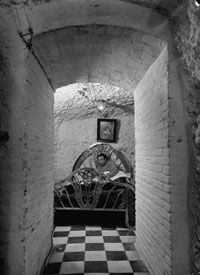
The interior of a Spanish cave home
Dmitri Kessel/Time Life Pictures/Getty Images
In southern Spain, there's a long tradition of cave dwellings. Here, the caves were dug out of hard clay and earth. Near Granada, a network of ancient caves are sometimes inhabited by homeless people. Many purpose-built caves have been renovated to include modern security, air conditioning and electricity as well as running water. It's something of a trend for Europeans to own a refurbished cave house, either as a vacation home or a permanent residence.
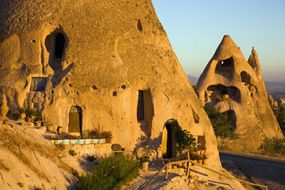
Cappadocia is a region in Turkey known for an elaborate system of cave dwellings. The landscape there is harsh and rocky with little plant life -- it's often referred to as lunar. The natural caves in the area provided adequate shelter in the absence of other building materials, while the rock was frequently carved into man-made caves. In the early years of the Christian religion, anchorites, people who withdrew from society for religious reasons, chose to live here in order to pray and meditate without the distractions of the world. The caves became even more important in the 7th and 8th centuries, when Arabs persecuted Christians in the region. Cappadocian Christianity literally went underground, building elaborate subterranean churches with arches that mimicked aboveground architecture. These churches eventually grew into an entire underground city. These were eventually abandoned, then rediscovered by locals who used the rooms for storage.
The cave dwellings of Cappadocia
David Sutherland/Photographer's Choice/Getty Images
A contractor with subterranean building experience can build homes into the sides of hills, dig down into the ground, or convert a previously existing underground installation, such as an abandoned missile silo. You can even build an "underground" home aboveground, by piling earth around the sides and even on the roof of a house, a practice used for centuries in parts of Europe.
Moisture issues are the main problem with cave houses. Proper drainage and ventilation can help, but an underground home isn't a good idea in an area prone to flooding. Another drawback is light. Living without natural light from windows can be very depressing, and it can even have physiological effects. Cave builders work around this obstacle by using clever light shafts. The insides of the shafts are coated with highly reflective materials, allowing maximum light to travel through them. Even rooms that are far from the surface can receive some natural light.
There are several benefits to building underground. The home has a low environmental impact because few construction materials are needed (although care must be taken not to damage the environment when digging out the cave). Cave homes are remarkably energy-efficient. Most underground chambers maintain a temperature in the 50s (Fahrenheit) regardless of the outdoor, aboveground weather. This means only minimal heating is required in the winter, and they stay pleasantly cool in the summer. An underground home also takes up a small amount of space on the surface, leaving you space to plant gardens, attract wildlife or just have a bigger yard. Plus, it's very difficult to break into an underground home -- there are no windows to break through, just one main door and some ventilation shafts.
The Horrific Tale of Sawney Bean
Alexander "Sawney" Bean was reportedly a cave-living cannibal who lived in Scotland sometime in the 18th century. He didn't commit his murderous feeding spree alone, either -- his wife and 45 children and grandchildren (most of them the products of incest) inhabited an isolated cave for 25 years. They attacked solitary travelers, killed them and ate them. The depravity was ended when the King of Scotland sent a band of armed men to the cave to root out the Beans, who were all executed [source: BBC].
This fantastic tale is almost certainly a myth, as only a handful of reports exist in local publications. No official records have been found that confirm such a family ever existed, and the horrifying nature of the case (not to mention the direct involvement of the king) would surely have left more concrete evidence.
Aujoulat, Norbert. Lascaux : Movement, Space and Time. Abrams, 2005.
Constable, Nick. Atlas of Archeology. Mercury Books (July 1, 2008).
Leary, Charles & Perret, Vaugh. "Down To Earth Living: The Cave Houses Of Southern Spain." http://www.escapeartist.com/OREQ11/Cave_Houses.html
Lynch, John. Walking with Cavemen: Eye-To-Eye with Your Ancestors. Headline (January 2003).
Price, Matthew. "Underground Art." Washington Post, Dec. 17, 2006. http://www.washingtonpost.com/wp-dyn/content/article/2006/12/14/AR2006121401459.html
Tattersall, Ian. The Last Neanderthal : The Rise, Success, and Mysterious Extinction of Our Closest Human Relatives. Basic Books; (December 2, 1999).
Viegas, Jennifer. "Neanderthals and humans shared cave." Discovery News, May 3, 2005. http://www.abc.net.au/science/news/stories/s1358479.htm