In a perfect world, everyone would have food and shelter, and a true utopian society would be devoid of sexism, racism and other forms of oppression. But for most of the world's population, this perfect society isn't possible. Communism is one proposed solution to these problems.
Most people know what communism is at its most basic level. Simply put, communism is the idea that everyone in a given society receives equal shares of the benefits derived from labor. Communism is designed to allow the poor to rise up and attain financial and social status equal to that of the middle-class landowners. In order for everyone to achieve this equality, all means of production must be controlled by the state. In other words, no one can own his or her own business or produce his or her own goods because the state owns everything. Wealth is redistributed so that the members of the upper class are brought down to the same financial and social level as the middle class.
Advertisement
According to the philosopher Frederich Engels' "Principles of Communism," the plan for ultimate financial and social equality is built on the principle that the system should spread around the world until all countries are on board [source: Engels]. This central goal has caused capitalist nations to keep their guards up, fearing that communist economic practices might spread to their countries.
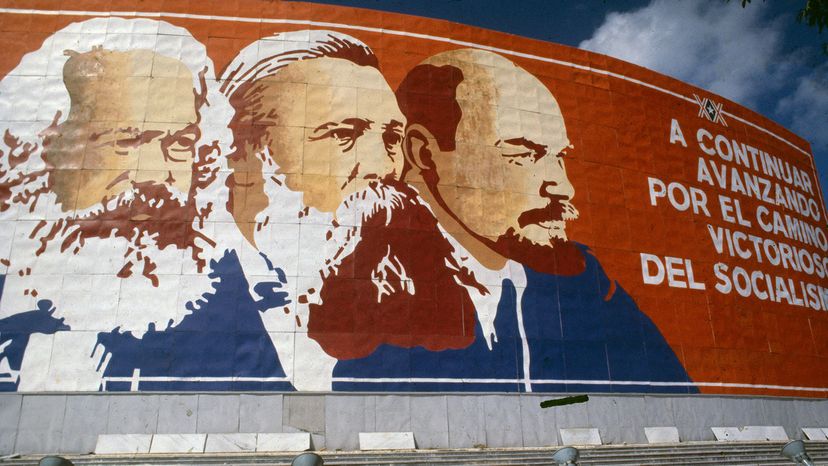
The political theory of socialism, which gave rise to communism, had been around for hundreds of years by the time a German philosopher named Karl Marx put pen to paper. Marx, also known as the father of communism, spent most of his life in exile in Great Britain and France. He and Engels wrote "The Communist Manifesto" in 1848, which later served as the inspiration for the formation of the Communist Party. Communism is sometimes known as Marxism, though there are differences. You might say that Marxism is the theory and communism is the implementation of Marxism.