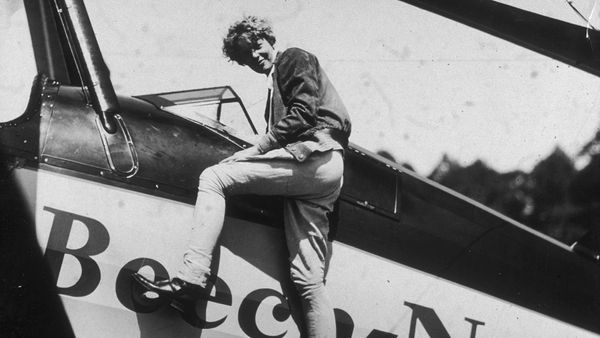
In the face of a mystery or lack of evidence, the imagination tends to fill in the gaps itself. We seem to have an innate need for finality, for a full, clear picture -- a need that finds us preferring wild conjecture to the questions in our heads. Such is the case with the disappearance of early aviatrix Amelia Earhart and her navigator Fred Noonan. It's not enough to suppose that somewhere in the southwestern Pacific Ocean lies a Lockheed Electra two-seat airplane that may only be found by sheer chance, if at all.
This leaves too much room for doubt, and a mystery has developed in the 70 years since she vanished. To some, the 39-year-old Amelia Earhart was an American spy sent to carry out espionage against the Japanese, who caught and executed her. (Even though, the Japanese aided the search effort in the days following the disappearance.) To others, she survived the mission and was forced to become Tokyo Rose, the infamous wartime radio personality. Perhaps the most bizarre theory out there is that she secretly returned to the U.S. and assumed the identity of Irene Craigmile Bolam, a wealthy New Jersey banker and housewife. This is, of course, not to mention the hypothesis that she was abducted by aliens [source: Heller].
Advertisement
Even those who take more scientific approaches to the Earhart disappearance tend to maintain a certain fervent dedication to uncovering her final whereabouts. Various private expeditions -- with multimillion-dollar price tags -- have been carried out in the decades since the U.S. Navy called off its search in the weeks after she vanished in July 1937. Despite the use of increasingly sophisticated sonar to scour the ocean bottom and modern archaeological techniques to comb tiny islands, the fate of Earhart and Noonan remains undetermined.
This isn't to say that no evidence has been uncovered. Nor that searchers are likely to give up their pursuit of the truth about the Earhart mystery.
Advertisement