The Battle of the Bulge
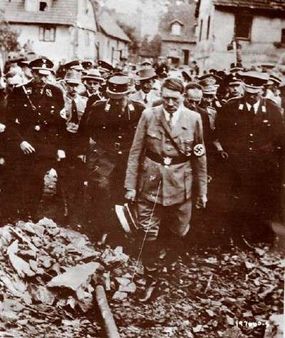
On July 20, 1944, young German colonel Claus Schenk von Stauffenberg, a wounded veteran of the Tunisian campaign of World War II, attended Hitler's morning briefing at the Rastenberg headquarters in East Prussia while carrying a time bomb in a briefcase. He left the case under the heavy oak table at which Hitler was standing and found an excuse to leave. A few minutes later, the bomb exploded -- but not before another officer, finding it in his way, had kicked the case farther under the table. The blast killed four of those present, but Hitler was shielded by the heavy table. He emerged alive and vengeful. Stauffenberg was executed that night in Berlin. Several thousand suspects were arrested and about 200 were executed in the weeks that followed.
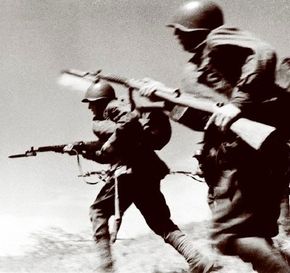
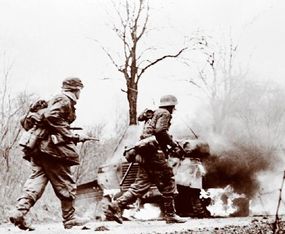
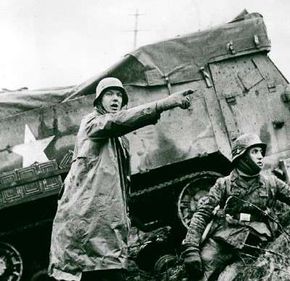
![]() German soldiers advance past a knocked-out U.S. halftrack during the Battle of the Bulge in December 1944. See more pictures of World War II. |
The assassination attempt coincided with a sudden crisis in the German war effort. Until late July, the front in Normandy had held, though at high cost. Again and again, the Germans struggled to repulse the British effort to capture the French city of Caen. The effort denuded German troops and tanks from other parts of the front, which allowed American commanders to plan a breakout through the German line.
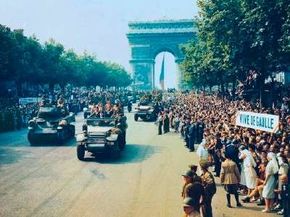
After weeks of preparation and with overwhelming air support, U.S. general Omar Bradley launched Operation Cobra on July 25. For the first time, Western forces were able to develop real mobility. The line was broken open, and Bradley -- supported by notoriously belligerent general George Patton -- drove the German army back toward Paris in a matter of weeks. On August 25, Paris was liberated, partly by the approaching armies and partly by the French Resistance, which staged a final revolt against German occupation.
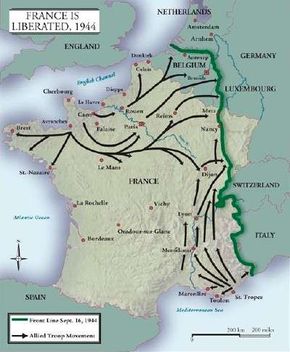
A second landing in southern France began on August 15, and within two weeks the enemy was cleared from the rest of France, meaning the Allies stood on the frontiers of Nazi Germany. The Western Allies grew hopeful that Nazi Germany might be defeated before the onset of winter. But General Montgomery's airborne assault on the Dutch city of Arnhem in the middle of September (to make it possible to cross the Rhine River) was bloodily repulsed. German resistance stiffened in immediate defense of the home territory.
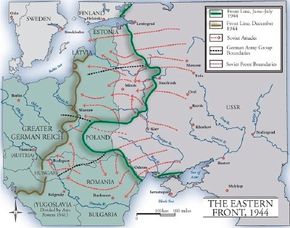
In the East, Soviet Union troops reached the German border on August 17. Finland sued for peace on September 2, and during the following month the Baltic States were occupied and reabsorbed into the Soviet Union bloc.
Farther south, the Red Army made rapid progress after the destruction of German Army Group Center. Romania was occupied in August and switched to the Allied side. Bulgaria was occupied next, and by the end of October parts of Slovakia were also in Soviet Union hands. The Red Army stood on the boundaries of Hungary and Yugoslavia.
The dramatic collapse of Axis resistance owed something to popular resistance both in the West and the East. In Yugoslavia, a large Communist army under the leadership of Joseph Tito played the major role in liberating Yugoslav territory. In Italy, partisans harried the retreating Germans and prepared for a new postwar order.
In some cases, resistance was clearly anti-Soviet Union. In the Ukraine, a guerrilla war -- fought by nationalists -- tied down thousands of Soviet Union soldiers and security forces during 1944 and 1945 and slowed the move westward.
In Poland, the Home Army hoped to liberate its country before Soviet Union forces had time to construct a Communist state. On August 1, as the Red Army stood on the far side of the Vistula River, Polish nationalist forces in Warsaw staged an uprising against the German occupiers. The result was a savage response from the embattled German forces, which destroyed much of what remained of the city. The Red Army stayed where it was, and would not capture Warsaw until the start of the renewed campaign in January 1945.
In the Pacific, the Allies made rapid progress. Following the capture of Saipan, American forces retook Guam and opened the whole of the western Pacific to Allied forces. The Japanese again sought a decisive big battle as a key to saving what was left of their new empire. However, the American decision to reoccupy the Philippines exposed Japan's air forces to severe attack.
When the Japanese main fleet was deployed to oppose the American landings on the Philippine island of Leyte, the force lacked adequate air cover. The encounter was the largest naval battle ever fought, involving 282 ships.
In late October, three separate Japanese task forces were deployed to try to defeat the invasion. The result was a decisive victory for the U.S. Navy, as Japan lost 26 front-line warships. The invasion force landed on Leyte and cleared the island by the end of the year. Defeat of Japan was now only a matter of time.
The same could be said of Hitler's Germany, which was now surrounded on all sides by heavily armed enemies and subject to constant aerial bombardment. Yet Hitler still hoped for victory.
From June, new "weapons of revenge" -- the V-1 flying bomb and the V-2 ballistic missile -- were launched against London. Hitler hoped that by holding or destroying ports in the West, combined with a renewed U-boat campaign with new types of submarines, Nazi Germany would deprive U.S. and British forces of replacements and supplies.
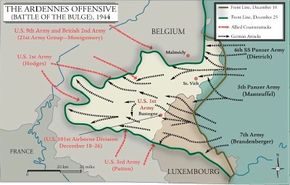
In December 1944, Hitler ordered the German army and air force to use its scarce reserves for a daring counteroffensive in the West against American forces. The goal was to divide the Western Allies, seize the port of Antwerp, and force them to rethink their strategy. His commanders preferred a more limited offensive, but on December 16 Hitler unleashed Operation Autumn Mist.
In poor weather, which shielded the panzer armies from air attack, the Germans made rapid progress and carved out a salient 50 miles deep in the Ardennes. The Allies regrouped and counterattacked in what became known as the Battle of the Bulge. American resistance at St. Vith and Bastogne, Belgium, held up the German advance, and heavy counterstrikes drove German forces back to the German frontier.
On January 8, Hitler pulled his battered army back. The loss of 600 tanks and 1,600 aircraft marked the defeat of the Ardennes offensive. Nazi Germany was now exposed to the grim finale of the European war that Hitler had launched six years before.
See the next page for a detailed timeline of World War II events, including mass murders at the Auschwitz-Birkenau camp in early July, 1944.
To follow more major events of World War II, see:
World War II Timeline: July 3, 1944-July 12, 1944
Allied forces made gains throughout Southeast Asia in July of 1944. The World War II timeline below summarizes this and other important events in early July 1944.
World War II Timeline: July 3-July 12
July 3: The Red Army liberates Minsk, site of one of the largest wartime Jewish ghettos and the center of the Soviet Union resistance movement.
After nearly four months, the Battle of Imphal and Kohima in northeast India comes to an end. The Japanese have suffered nearly 55,000 casualties, including more than 30,000 deaths, in this campaign against the Allies.
July 6: German field marshal Gerd von Rundstedt, one of Hitler's top military officers, is replaced after painting a pessimistic picture of Nazi Germany's chance of success on the Western Front.
With the battle for Saipan all but lost to the Allies, Lieutenant General Saito Yoshitsugu and Vice Admiral Nagumo Chuichi commit suicide rather than face the shame of surrender.
July 8: Admiral Miklos Horthy, the Hungarian regent, orders an end to the deportations of Hungarian Jews to Auschwitz-Birkenau. His order will come too late for more than 400,000 men, women, and children.
July 9: American bandleader Glenn Miller performs the first of a series of concerts for troops in the European Theater.
The U.S. declares the island of Saipan secured after about 3,000 Japanese troops had died in a suicidal charge against a large contingent of American soldiers on July 7.
July 11: Tens of thousands of women and children evacuate London as the terrifying and destructive German V bombs continue to fall.
Washington formally recognizes the Free French government of General Charles de Gaulle.
July 12: The Nazis empty the so-called Jewish "family camp" at Auschwitz-Birkenau, sending 4,000 to the gas chambers.
World War II Headlines
Below are more highlights and images of events during World War II in 1944, including the torture and murder of poet Hannah Szenes for trying to help rescue Hungarian Jews.
![]() |
Red Army overwhelming on Eastern Front in Operation Bagration: At 5:00 a.m. on June 22, 1944, in Operation Bagration, roughly two million Soviet Union troops waited -- to the east and south of Belorussia -- as the Red Army fired thousands of guns for two hours. The main assault (pictured) of this Soviet Union offensive began the following day. The German army, with fewer than a million soldiers, was no match for the Soviets and their firepower. By the end of July, the Red Army reached the outskirts of Warsaw. In a little more than a month, the German army lost approximately 350,000 men, including 31 generals.
Housing for Britain's World War II vets: During the latter part of the war, Winston Churchill announced the Temporary Housing Programme, which would develop prefabricated houses for returning veterans, their families, and other civilians. Prefabs were made of steel, timber, aluminum, or sandwiches of corrugated asbestos-cement panels filled with wood and wool insulation. The cost of prefabs, many of which were constructed by prisoners of war, averaged about £1,300. Though modest, the houses used space efficiently and gave each family such luxuries as a stove, a refrigerator, and a boiler.
Poet Hannah Szenes tries to help Hungarian Jews: In 1944 poet Hannah Szenes parachuted into Yugoslavia to help organize the rescue of Hungarian Jews. Born in Hungary, Szenes emigrated to Palestine. Szenes enlisted in the British Army in 1943 and was trained in Egypt. Soon after she was dropped into Yugoslavia, she was captured and tortured by the Germans. She gave up no information and was executed in November 1944. Earlier in the year, from May to July, German forces had deported more than 430,000 Hungarian Jews to Auschwitz, where more than 75 percent were killed on arrival.
British army Lieutenant General William Slim shines in Asia: Intellectual, courageous, and practical, William Slim was a British army lieutenant in World War I and a brigadier by 1939. Following service in East Africa, Iraq, and Syria, Slim was promoted to lieutenant general in March 1942. He commanded Burcorps in the 900-mile retreat from Rangoon to India. In October 1943, Slim took over the newly created British-Indian14th Army, which in 1944 he led brilliantly in defeating Japanese attacks, notably at Imphal-Kohima (March to July). The Japanese suffered more than 50,000 casualties. In Operation Capital, "Uncle Bill" employed air supply, guerrilla tactics, and ingenious ruses, and recaptured Rangoon in early May 1945. Slim was arguably Britain's finest commander during the war.
French citizens punish collaborators: In France, public humiliation and more severe punishments befell people thought to have collaborated with Nazis or the Vichy regime. Some Frenchmen who had volunteered as officers in the Wehrmacht or Waffen-SS were executed as traitors. Ordinary soldiers who joined the enemy were sent to prison or given the option of serving in the French Foreign Legion.
![]() |
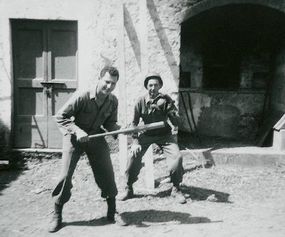
Medical care for American soldiers: Medical care of American soldiers was always good, and it got better at the proper hospitals and convalescent centers that were set up as the Allies pushed deeper into Europe. Here, recuperating GI pals Bill Fernandez (left) and Mike Murphy enjoy some softball outside of Rome in the summer of 1944. Both had been wounded during the spring assault on Monte Cassino. The photo seems lighthearted, but both men knew that soon they would return to their unit, and more fighting.
See the next page for a detailed timeline of World War II events in late July 1944, including the worst American homefront disaster.
To follow more major events of World War II, see:
World War II Timeline: July 14, 1944-July 23, 1944
Allied victories in Japan forced Japan's top military leader, Tojo Hideki, to resign in July of 1944. See the World War II timeline below for more information on important events that occurred during the month July 1944.
World War II Timeline: July 14-July 23
July 14: In France, Bastille Day observances feature the public humiliation of French nationals who collaborated with the Nazis.
July 17: German troops are ordered to stand firm as the Red Army crosses into Poland.
German general Erwin Rommel is seriously injured in Normandy when an RAF plane strafes his car, fracturing his skull.
Port Chicago, California, suffers the worst homefront disaster of the war when 320 men die in a massive explosion involving two ammunition-laden ships.
Napalm, the incendiary weapon that will become infamous during the Vietnam War, is used by the U.S. in combat for the first time when Allied planes attack German positions on the ground near St.-Lo.
July 18: The disheartening, bloody Battle of the Hedgerows ends with the U.S. capture of the French town of St.-Lo.
On the heels of a string of military defeats, most recently the fall of Saipan, Tojo Hideki -- the political and military leader of Japan -- is forced to resign.
July 20: Hitler survives an assassination attempt by a member of his own inner circle, Colonel Claus von Stauffenberg. In retaliation, Stauffenberg and many other senior soldiers and officials will be executed.
July 21: U.S. Marine and Army divisions retake the island of Guam. Originally ceded to the U.S. by Spain in 1898, Guam was captured by the Japanese in 1941.
July 23: A Red Cross visit to the Nazis' Theresienstadt labor camp results in a favorable report due to a beautification program and a tightly controlled tour. The deportations to Auschwitz-Birkenau will resume shortly after the conclusion of the Red Cross visit.
World War II Headlines
Find out more information on the man who tried to assassinate Hitler in the World War II headlines from late July 1944 below.
![]() |
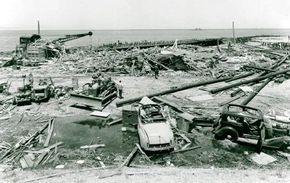
The Port Chicago explosion: At 10:18 p.m. on July 17, 1944, an explosion rocked the Port Chicago Naval Magazine in Concord, California. Black naval workers, untrained on how to handle munitions, had just finished loading more than 4,000 tons of explosives on the merchant ship E. A. Bryan. The blast killed 320 men and injured about 400. Three weeks after the explosion, 258 African Americans refused to return to work, protesting the dangerous conditions and the Navy's segregation policy. Two hundred and eight received bad-conduct discharges, and 50 were found guilty of mutiny and sentenced to prison. Those 50 received clemency in 1946.
Allied bombers clear St.-Lo: Beyond Normandy's beaches, Allied tanks and infantry had to navigate narrow roads and hedgerows (matted earthen embankments hundreds of years old that divided the countryside into small fields). Each well-protected road and field became a deathtrap, and German defenses at the crossroads town of St.-Lo, France, blocked access to more open countryside. After hundreds of air strikes on St.-Lo by American and British bombers, U.S. forces fought their way into the almost totally devastated town on July 18.
![]() |
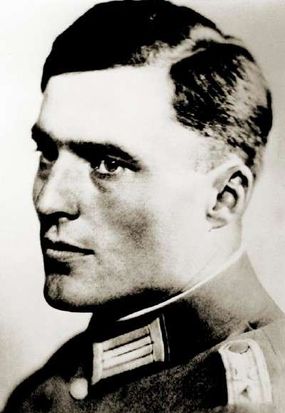
Hitler's would-be assassin: Claus Schenk von Stauffenberg's family and acquaintances included many who resisted Nazi rule. Stauffenberg chose a military career, but Operation Barbarossa and the mass murders at Auschwitz convinced him that Hitler must be stopped. After several aborted assassination attempts, Colonel Stauffenberg, on July 20, 1944, placed a briefcase of timed explosives beneath the table in Hitler's conference room, then left on a pretext. Convinced that Hitler had died in the blast, Stauffenberg flew to Berlin to organize a military coup against Nazi leaders. But Hitler was alive, and late on July 20 Stauffenberg was shot.
The Fuhrer vows revenge for assassination attempt: After the failed assassination attempt, Hitler's wounds were slight, although four men had been killed and others hurt. Historians speculate that someone moved the briefcase after Stauffenberg left, and that a massive wooden table leg had protected Hitler from the blast. A raging Fuhrer had his Gestapo round up current suspects, various old adversaries, and their relatives. Hitler ordered some 5,000 people arrested, many tortured, and about 200 executed.
Once in power, the Nazis encountered some continuing levels of opposition within Nazi Germany. This opposition developed into a resistance movement in 1938 and eventually evolved into a sophisticated conspiracy.
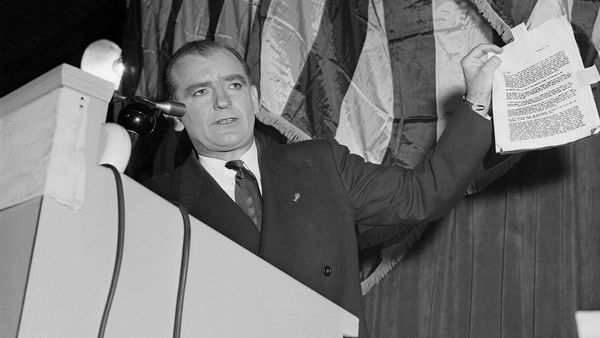
One such
resistance group was Weisse Rose (White Rose) -- an organization of
students at the University of Munich. It was discovered and crushed in
1943, with about 80 arrests and the execution of three of its leaders,
Christoph Probst and Hans and Sophie Scholl. Although two attempts on
Hitler's life were carried out by army officers in 1943, the most
significant attack occurred on July 20, 1944. |
See the next page for a detailed timeline of World War II events in July and August 1944, including information on the fate of Hitler's conspirators.
To follow more major events of World War II, see:
World War II Timeline: July 24, 1944-August 2, 1944
Fighting was fierce in the Pacific theater in July and August of 1944. The World War II timeline below summarizes important events that occurred during July and August 1944.World War II Timeline: July-August 1944
July 24: The Red Army liberates the Majdanek death/concentration camp near Lublin, Poland. For much of the world, it is their first look at the horror of the Nazis' "Final Solution" for the Jews.
The Nazis introduce their distinctive "Heil Hitler" salute into German military protocol.
July 26: President Roosevelt meets with Admiral Nimitz and General MacArthur in Honolulu. They decide that the next course of action in the Pacific Theater will be an invasion of the Philippines.
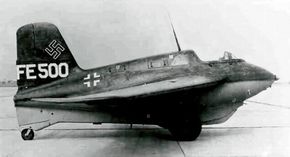
July 29: Nazi Germany's Messerschmitt 163 fighter plane becomes the first jet plane to engage in combat operations.
July 30: Major General Mizukami Genzu performs hara-kiri, a form of ritualized suicide, after losing Myitkyina, Burma, to General Joseph Stilwell's Allied force.
July 31: Hitler promotes a last-ditch, total-war policy that will call on German troops and civilians to destroy everything in their wake as they retreat.
Heavy fighting develops between German and Soviet Union troops as the Red Army approaches the Polish capital of Warsaw.
August: In this month alone, some 67,000 Jews from Poland's Lodz Ghetto will die at Auschwitz-Birkenau.
August 1: With the Red Army on the outskirts of Warsaw, Polish resistance activity moves into high gear.
U.S. general George Patton leads his army on a charge to take the French province of Brittany.
Japanese resistance ends on the island of Tinian.
August 2: The Kriegsmarine attacks Allied shipping in the English Channel with manned torpedoes operated by frogmen.
World War II Headlines
Below you'll find detailed information on Nazi leaders who conspired against Hitler and other important headlines from this time.
Adolf Hitler's health in decline: Hitler visited his military historian, Walter Scherff, who was wounded in the July Plot explosion. Before the assassination attempt, a brooding Hitler had isolated himself at his Prussian Wolfschanze (Wolf's Lair) headquarters. After being attacked even there, the Fuhrer descended into mental confusion, misanthropy, and hopes of yet winning the war. Although he was only slightly hurt by the blast, Hitler's physical health was also deteriorating. Some historians suspect that he had syphilis, while others cite Parkinson's disease. Many believe that Hitler's doctor exacerbated the dictator's decline with prescription amphetamines, opiates, and questionable quack "cures."
![]() |
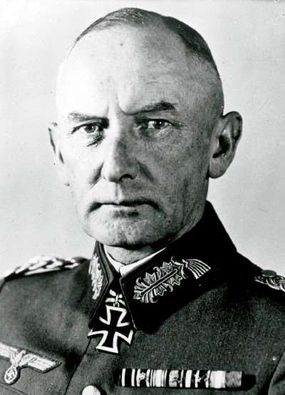
The fate of the anti-Nazi conspirators: Some German leaders realized early on that Hitler would destroy their country, but a series of assassination plans either failed or were abandoned. The July Plot was a desperate attempt that resulted in the destruction of the German resistance. General Erich Hoepner (above), an early opponent of Hitler, was arrested and tortured by the Gestapo, then executed by hanging.
![]() |
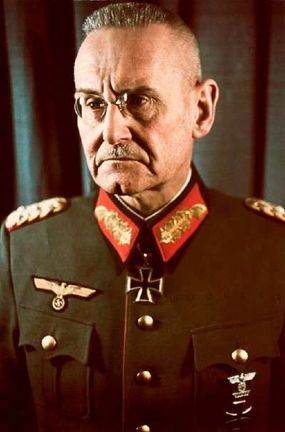
Colonel General Franz Halder (above) -- not involved in the July Plot -- was arrested when searches turned up letters and diaries that implicated him in earlier conspiracies. Halder was sent to a concentration camp but survived the war.
![]() |
Field Marshal Erwin von Witzleben (above) had been expected to take over command of the Wehrmacht after the coup, but was caught and hanged by piano wire.
Horrors of Nazi concentration camps revealed: As the Allies advanced on Nazi Germany from the east and west, they reached the Nazis' concentration camps and death camps, where most of the six million victims of the Holocaust perished. The Soviets became the first of the Allies to discover one of these scenes of horror when they entered the Majdanek concentration/death camp near Lublin, Poland, on July 23, 1944. Here, Russian soldiers and Polish civilians were overcome by the sights and smells of death. Approximately 360,000 prisoners, mostly Jews, died at Majdanek from gas, hanging, starvation, disease, or overwork. The Red Army discovered only 500 inmates still alive at the camp.
Marines face resistance on the island of Guam: The U.S. seized the island in July 1944 to secure additional airfields for the bombing campaign against Japan. With only 15 miles of potential landing beaches along Guam's west coast, the 18,500-man Japanese garrison knew where to concentrate its defenses and gave the attacking Marines a hot reception. The Third Marine Division landed on beaches swept by fire from the enemy-held high ground. To their right, the First Marine Provisional Brigade encountered easier terrain. However, it also ran into fierce resistance, including an enemy gun position that knocked out two dozen Marine AmTracs.
![]() |
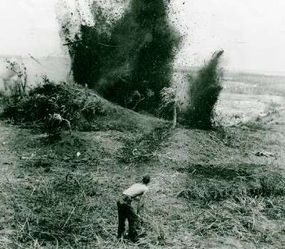
Fierce fighting on Guam between Marines and Japanese forces: Marine engineers blow up a series of Japanese dugouts during the fighting on Guam. Fierce Japanese resistance to the landings included a series of well-executed counterattacks intended to push the Americans back into the sea. In the Third Marine Division's zone, the struggle for the high ground behind the landing beaches lasted for days. The terrain included 100-foot precipices "that a trained cliff climber with line and spikes would have a hard time getting up," said one Marine.
Majdanek Concentration/Death Camp -- War correspondent Alexander Werth, describing ashes of gassed and cremated inmates at the Majdanek concentration/death camp in Poland, July 1944 |
The betrayal of Anne Frank and her family, mass suicide in the Japanese town of Saipan, and the Warsaw uprising are just some of the events covered on the timeline of World War II events in August 1944 on the next page.
To follow more major events of World War II, see:
World War II Timeline: August 2, 1944-August 15, 1944
With much of France secured, Allies turned their attention elsewhere in the world in August of 1944. The World War II timeline below summarizes important events that occurred during the month of August 1944.World War II Timeline: August 2-August 15
August 2: Despite relentless pressure from the Allies, Turkey refuses to join the battle against Nazi Germany.
August 4: After years of hiding in an Amsterdam attic, diarist Anne Frank and her family are betrayed to the German police.
The Germans retreat from Florence, the hub of the Italian Renaissance. Though the Germans destroy most of the bridges over the Arno River, which bisects the city, they spare the Ponte Vecchio, which dates to the 14th century.
August 9: With much of France under secure Allied control, General Eisenhower relocates his strategic headquarters to a Reims schoolhouse.
Officials with the Free French headquarters in Algiers, Algeria, announce the demise of Vichy France.
August 10: Hitler moves the entire 2,000-plane Luftwaffe force to Western Europe in a bid to challenge the power of the Allies' collective air strength.
The Japanese are crushed by American forces on Guam, leaving the U.S. with an additional solid forward base in the Marianas from which to bomb the Japanese mainland.
August 12: The Allies open an oil pipeline from Britain to France, greatly alleviating the crippling fuel shortages that had recently stalled offensive operations. It is nicknamed PLUTO, an acronym for Pipe Line Under the Ocean.
August 15: The Allies storm ashore in southern France in Operation Dragoon.
Audie Murphy, an American sharecropper's son who will be credited with 240 German kills and will become the most decorated soldier in American history, wipes out a force of Germans occupying a hill.
World War II Headlines
The Warsaw uprising -- and it's repercussions -- is just one of the events covered below in the WWII headlines from 1944.
|
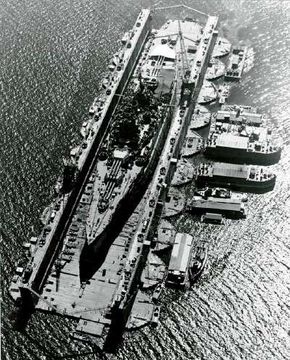
The Idaho in dry docks at Guam: The battleship Idaho is lifted out of the water in a floating dry dock at Guam. These repair platforms were constructed in sections in U.S. shipyards, towed to bases, and welded together on the spot. The dry dock was partially submerged to allow a damaged vessel to be towed into place. When water was pumped out of the dry dock's tanks, the whole structure rose, bringing its big passenger up with it. Dry docks carried their own power plants, storage areas, officer and crew quarters, and antiaircraft guns.
![]() |
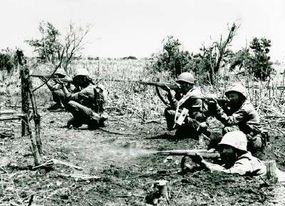
Marine riflemen secure strategically positioned Tinian: Marine riflemen fire on the enemy during mop-up operations on Tinian. Marines had landed on the island on July 25, 1944. Located only three miles off Saipan, Tinian offered three valuable airfields for the bombing campaign against the Japanese home islands. The Marines made steady advances thanks in large part to Tinian's flat terrain, which allowed optimum use of U.S. tanks. Despite 9,000 Japanese defenders, the island was secured in nine days, five days ahead of schedule, at a cost of some 300 Marines killed and 1,600 wounded.
Mass suicide on Saipan as Marines arrive: Japanese civilians leapt to their deaths from the cliffs at Marpi Point on northern Saipan. Recognizing that Saipan was lost, two Japanese commanders -- Lieutenant General Saito Yoshitsugu and Vice Admiral Nagumo Chuichi -- committed ritual suicide on July 6. Organized resistance effectively ended the following morning when thousands of Japanese troops perished in a final mass banzai attack. The subsequent U.S. advance to the northern end of the island cornered large numbers of terrified Japanese civilians. Convinced by their own propaganda that they would be tortured and murdered by Marines, hundreds of men, women, and children jumped to their deaths from the cliffs in spite of American efforts to dissuade them.
Polish soldiers rise up against Nazi forces in the Warsaw uprising: On August 1, 1944, some 40,000 Polish Home Army soldiers, including 4,000 women, rose up against German occupiers. Although the Poles captured utilities and an SS food and military uniforms warehouse, Heinrich Himmler quickly sent in more troops and began aerial bombardments. Moscow withheld the help Poles had expected from Red Army troops just outside the city. One Polish patriot wrote, "We are waiting for you, red plague/To deliver us from black death."
German forces quash the Warsaw revolt: German occupiers hung Polish citizens daily and shot groups of captured soldiers and civilians. In Warsaw, 18,000 Polish soldiers and more than 150,000 civilians were killed during the uprising, which raged for 63 days. Little help came from the outside. Much of the Allies' air supply fell into German-held areas. By September, German panzer divisions and infantry had broken the Warsaw resistance. The Home Army surrendered on October 2, 1944, but only after guarantees that Geneva Conventions would be observed for both civilians and insurgents.
See the next section for a detailed World War II timeline of events in late August 1944.
To follow more major events of World War II, see:
World War II Timeline: August 18, 1944-August 26, 1944
As the summer of 1944 ended, Allied forces continued to make progress against the Nazis. The detailed World War II timeline below summarizes events in late August 1944.World War II Timeline: August 18-August 26
August 18: President Roosevelt announces that he intends to send former war secretary Patrick Hurley to China in an effort to broker cooperation between the Nationalists and the Communists.
August 19: German field marshal Gunther von Kluge, wrongly suspected of involvement with the July 20 Hitler assassination attempt, kills himself. He was on his way home to Berlin two days after being replaced by Field Marshal Model as commander of the German army in the West.
August 20: Disaster befalls the Nazi German army in Romania, as the Romanians effectively switch sides at the same time that nearly a million Red Army soldiers march on the Axis satellite state.
August 21: The Dumbarton Oaks Conference is convened in a Washington, D.C., mansion of the same name. During the six-week international meeting, the framework of the United Nations will be largely agreed upon.
August 23: Romanian dictator Ion Antonescu is detained, as Romania's King Michael agrees to make peace with the Soviets.
August 24: The Nazis' sense of desperation is growing more apparent as Joseph Goebbels abolishes holidays, closes schools, and extends the work week, all in an effort to increase production for the war effort.
August 25: The Allies roll down the Champs Elysees, as Paris is liberated from the Nazis.
The SS murders more than 120 civilians in the French town of Maille as the Germans continue the practice of committing atrocities as they retreat.
August 26: The Axis satellite of Bulgaria announces that it is pulling out of the war and will no longer tolerate the staging of German offensive maneuvers from its soil.
World War II Headlines
Below are more headlines and images that outline the events of World War II in late August of 1944.
![]() |
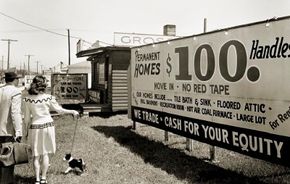
Ford's bomber plant workforce runs short on housing in Willow Run: When the Ford Motor Company located its Willow Run Bomber Plant in rural Michigan, prospective employees flooded the area. The Willow Run workforce would grow to 100,000, creating a demand for quick housing. This development near Willow Run promises "no red tape" for new tenants who put up $100. Although these new "modern homes" offered plumbing, heating, and other amenities, buildings such as trailers, barns, garages, stores, and at least one chicken coop were also used as living quarters. The Willow Run plant was extremely productive, turning out a bomber every 63 minutes.
Battle of the Falaise Pocket: As the Battle of Normandy neared its end, the German Seventh Army and Fifth Panzer Army found themselves encircled by advancing British, French, Canadian, and American forces. The Germans' only escape route was the Falaise Pocket, an area in northern France. The pocket was held by the Polish First Armored Division, which fiercely fought the retreating Germans. The Battle of the Falaise Pocket raged from August 12 to 21, 1944, with many thousands of German soldiers killed and taken prisoner. Vast amounts of German materiel were destroyed. However, tens of thousands of Germans escaped to the Seine, partly because the Allies' fear of friendly fire among their converging forces prevented them from fully tightening their stranglehold.
![]() |
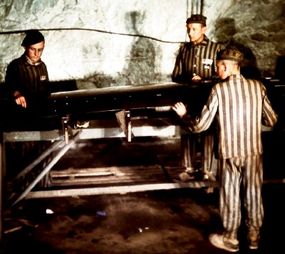
Slaves construct the Nazi V-2 rockets: Slave laborers assemble V-2 rockets in the underground Mittelwerk factory near Nordhausen, Germany. About 60,000 prisoners from the nearby concentration camp Dora were put on the production line, and an estimated 10,000 to 20,000 died from overwork in those cold, damp tunnels. Some slaves fought back by sabotaging rockets -- loosening screws, faking welds, urinating on wiring, or leaving out vital parts. Andrew Herskovits, put to work at age 14, said, "The punishment for sabotage was death by hanging -- of course almost anything could be classified as sabotage." More than 200 suspects were hanged, and the bodies of some remained on cautionary display for days.
The V-1 carried a one-ton warhead 250 miles at 400 mph. From June 1944 to March 1945, 2,419 V-1s hit London, killing 6,184 people and injuring 17,981. Thousands died from V-1 attacks against Belgium. The V-2 was a sophisticated, electronically guided, supersonic ballistic missile that carried a one-ton warhead more than 200 miles. From September 1944 to April 1945, more than 1,100 V-2s hit Great Britain, killing 2,754 people and injuring 6,523. V-2s also killed 7,000 people in France, Belgium, Holland, and the Rhineland.
The V-3s, the third type of vengeance weapons, were underground cannons that fired small shells enormous distances. Slave labor was employed to construct a vast underground emplacement for these guns on the French coast. However, this was destroyed by the RAF on July 6, 1944. The guns were moved to the southeast of Trier, where U.S. forces overran the site on February 26, 1945. Finally, the V-4 was a multistage rocked called Rhinbote, of which a few were fired in the last months of the war. The Germans also made efforts to make a multistage missile to hit the United States, specifically New York City, possibly with a nuclear warhead. |
See the next section for a detailed World War II timeline of events in August and September 1944.
To follow more major events of World War II, see:
World War II Timeline: August 26, 1944-September 11, 1944
In August and September of 1944, Nazi desperation continued to grow. The detailed World War II timeline below summarizes events in late August 1944.August 26: On the Fuhrer's orders, German forces begin their withdrawal from Greece.
Operating under the influence of the recently issued "lynch law" order, local residents in the German village of Russelsheim assault and murder the crew of a USAAF plane that crashed nearby.
August 30: The Red Army occupies the Romanian capital of Bucharest as well as the valuable oil fields of Ploesti.
September 2: General Eisenhower is forced to order his armies to stop for lack of fuel, giving Nazi Germany an opportunity to fortify its defenses.
The Soviet-Finnish War ends with the cessation of hostilities. A formal armistice will be signed on the 19th.
September 3: The British free the Belgian capital of Brussels from Nazi occupation.
September 5: In one of the quickest capitulations in the history of modern warfare, Bulgaria surrenders less than one day after a Soviet Union declaration of war. Bulgaria will declare war on Nazi Germany on the 7th.
September 6: The decline of the Luftwaffe enables Britain to stop enforcing a blackout for the first time in three years.
September 8: The next generation of V-weapons, the V-2, begin falling on London.
September 10: The mayor of Warsaw asks for Allied assistance as the city's partisans rise up against the Nazis.
Heinrich Himmler issues an order calling for the murders of the families of any deserting German military personnel.
September 11: More than 1,200 die when U.S. forces sink two Japanese prison ships containing thousands of Allied captives.
World War II Headlines
Find information below on President Roosevelt's relationship with Vice President Truman and the French Resistance in these headlines from 1944.
The Roosevelt-Truman relationship: President Franklin Roosevelt chose Harry Truman as his running mate in 1944. Once elected, Truman had little contact with Roosevelt and was not a member of the president's inner circle of confidants who were developing America's end-of-war strategy, including the possible use of an atomic bomb. Roosevelt died 83 days after the start of his fourth term. Truman had to rely on Roosevelt's advisers to help him shape the policy that would lead the world to peace.
![]() |
Allied forces liberate Paris on August 25, 1944: Parisians cheer as Allied tanks roll past the Arc de Triomphe. On August 25, refusing to destroy the city as Hitler had ordered, German general Dietrich von Choltitz surrendered Paris to General Jacques-Philippe Leclerc and the Free French forces. French Communist Resistance fighters sought to take power, but Gaullist groups jockeyed into that position. French citizens hoped that Americans were bringing food, clothes, and gasoline, which had been in short supply during Nazi rule, but such items were also in short supply among the liberators.
The French Resistance Fighters: The French Resistance included groups of students, Communists, liberals, anarchists, and Roman Catholics. Some organizations took orders from the British SOE (Special Operations Executive), some followed Charles de Gaulle, and others had different agendas, but all were anti-German. When the Allies approached Paris, Resistance cells organized strikes by police and other city workers. They fought skirmishes with German forces even after Choltitz surrendered. About 1,500 Resistance members and other civilians were killed during the fight for liberation.
See the next section for a detailed World War II timeline of events in September 1944, including more information on the liberation of France.
To follow more major events of World War II, see:
World War II Timeline: September 12, 1944-September 22, 1944
The Allied liberation of France was finally complete in September of 1944. The detailed World War II timeline below summarizes events in September 1944.World War II Timeline: September 12-September 22
September 12: The Red Army Forces firebombs the central German city of Frankfurt.
Romania formally surrenders to the Allies. It agrees to take up arms against its former Axis partners in exchange for the postwar return of Transylvania to Romanian authority.
September 12-16: Churchill and Roosevelt meet in Quebec to discuss strategy in the Pacific Theater. They agree that a ground invasion of Japan will be necessary for victory.
September 15: One of the most laborious, hard-won battles of the Pacific war begins when the U.S. Marines land on the island of Peleliu. The Japanese will fiercely resist the American invaders for a month.
September 18: The United States and Britain airlift supplies to the Polish resistance in Warsaw. The Soviets, protective of their expansionist aims, are reluctant to prop up any Polish independence movement. The Soviets also refuse landing rights to U.S. and British planes in spite of appeals from Roosevelt and Churchill.
September 19: Female Nazi collaborators in the Dutch town of Nijmegen have their heads shaved and are publicly humiliated.
Churchill returns to Britain following a visit to Roosevelt's home in Hyde Park, New York. In their discussions, the two leaders agreed to fully share atomic research and to use the bomb only by mutual agreement.
September 21: A general strike called in Denmark to protest the deportation of nearly 200 Danes to Nazi concentration camps is violently suppressed by the Germans.
Japanese positions on Luzon, Philippines, come under intense aerial assault by a massive fleet of carrier-based U.S. warplanes.
September 22: Patton's Third Army is halted as supply lines are stretched to the breaking point.
World War II Headlines
Read below for more headlines that occurred in 1944 as the Allies continued on their mission to defeat Nazi Germany.
De Gaulle returns to Paris after Allies liberate the city: French general Charles de Gaulle made a triumphant return to Paris on August 26, 1944. Ignoring sniper fire that sometimes scattered his admirers, the man who had led the Free French from exile in London walked down the Champs Elysees and visited the Cathedrale Notre Dame de Paris. De Gaulle moved back into his old office at the War Ministry and proclaimed the continuation of the Third Republic. He thus derailed an establishment of an Allied military government in France.
![]() View Enlarged Image |
The Allied liberation of France: After several weeks of hard fighting among the hedgerows, woodland, and sunken lanes that dominated the post-D-Day Normandy battlefield, the Allied armor at last broke out of the beachheads and drove into France. Allied airpower was a major contributor to this. From July 25, U.S. forces (spearheaded by General Patton's Third Army) launched Operation Cobra, first striking west into Brittany, then south and east toward Paris. Simultaneously, the British Second Army and Canadian First Army struck east, across the Seine and into Belgium. Another Allied army landed in southern France in August. It drove quickly north to achieve a link-up and complete France's liberation.
Enemies still present in Paris after Allied liberation: Parisians who are gathered at the Place de l'Etoile to watch Allied forces march through the Arc de Triomphe had to dive to avoid sniper fire. Resistance forces had engaged in skirmishes with German occupiers for weeks before the liberation of Paris, and fighting within the city was not over yet. Nazi soldiers and French Fascists were still shooting from the rooftops, interrupting celebrations and parades. French police, Resistance forces, and Allied soldiers fought back. The city was secured in a few days and quieted down after about a week.
U.S. Army hangs German civilians who commit crimes: Enemy civilians who committed war crimes were not exempt from American military justice. On November 10, 1944, at Bruchsal Prison near Baden, Germany, the U.S. Army hanged five German noncombatants who murdered six American airmen the previous August. The crew had parachuted safely from their disabled aircraft near Ruesselsheim, only to be waylaid by angry locals. In a small irony, Bruchsal Prison had been favored by the Nazis as a place to guillotine or hang enemies of the state.
Bill Mauldin's popular military cartoons: "More than anyone else, save only Ernie Pyle," Stephen Ambrose wrote in the introduction to a reissue of Bill Mauldin's book, Up Front, "he caught the trials and travails of the GI." Mauldin entered the war as an infantryman in the 45th Division and landed with his unit in Sicily and Italy. He began drawing cartoons in the 45th's newspaper, then transferred in 1944 to the Stars & Stripes, where his cartoons became popular in both the ranks and the States. His characters, Willie and Joe, came to represent the frustrations felt by all American GIs.
![]() |
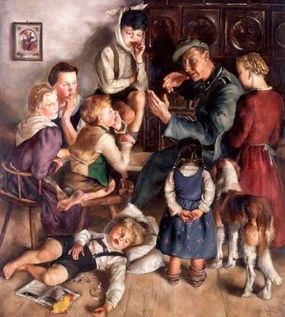
Nazi Political art: To Hitler and other Nazi leaders, political art was a means of capturing the spirit of the Nazi Party for those in Germany -- at that time and in the future. "No state," Hitler said, "lasts longer than the documents of its culture." This painting, Auf Heimaturlaub (On Homeland Vacation), portrays a German soldier returning to his home on leave and conveying exciting stories of victory on the front lines. The children pay close attention to their father -- especially the boys, who long for the day they can fight for Nazi Germany.
See the next section for a detailed World War II timeline of events in September and October 1944, including information on an attempt by Jewish captives to revolt against Nazi SS guards.
To follow more major events of World War II, see:
World War II Timeline: September 24, 1944-October 18, 1944
In September of 1944, Allied forces were already planning for post-war reconstruction, and Nazi forces were showing their desperation. The detailed World War II timeline below summarizes events in September and October 1944.World War II Timeline: September 24-October 18
September 24: The U.S. releases the Morgenthau Plan, a postwar plan that proposes a total restructuring of the German economy to an agrarian footing.
September 25: Nazi Germany organizes the Volkssturm, a militia that drafts men as old as 60 and as young as 16.
September 26: Allied planes drop American paratroopers behind German lines in Italy to establish the same sort of resistance network that had been so successful in helping the Allies capture France.
September 27: The British suffer 1,200 deaths and lose some 6,600 more to German POW camps as they fail in their nine-day bid to secure a bridge over the Rhine in the Dutch town of Arnhem.
September 29: The Soviets fly their last sortie in support of the Warsaw resistance.
October 2: After two months of fierce urban warfare, the Germans crush the Polish resistance in Warsaw. As many as 250,000 Poles have died during the struggle.
The Allies break into the Siegfried Line, a defensive line running along Nazi Germany's western border. The breach is in the north, near Aachen, and it is there that U.S. troops will penetrate western Germany.
October 7: A group of Sonderkommandos, captive Jews whose lives are prolonged while they assist the Nazis with gas chamber and crematorium operations, attacks SS guards at Auschwitz. Though the revolt is quickly and violently quelled, they do kill several SS men and destroy their barracks, as well as Crematorium IV.
October 9-18: Churchill, Stalin, and U.S. ambassador William Averell Harriman meet in Moscow to discuss the postwar status of Poland and the Balkan States.
World War II Headlines
Learn about Russian resistance fighters and Canadian Commander Henry Duncan Graham Crerar in the headlines from 1944 below.
![]() View Enlarged Image |
The Soviets' westward push: Despite the disaster at Stalingrad in January 1943, the Germans subsequently halted a number of Soviet Union offensives, and even retook Kharkov in March. In July, however, their Blitzkrieg-style attacks at Kursk were effectively absorbed and defeated by the Red Army during the greatest tank battle of the war. The Russians then launched successful counteroffensives at Orel and Kharkov. These advances eventually paved the way for a devastating series of Soviet Union offensives across the whole Eastern Front beginning in June 1944. These included the destruction of Army Group Center in Belorussia and successes in the Ukraine, Poland, the Balkans, and Romania. By December, the Eastern Front no longer lay within the Russian homeland.
Russian Partisans resist German forces: As German forces stormed through Russia in 1941, pockets of resistance formed behind the German lines. By the end of 1941, anti-German resistance fighters began to come together, creating partisan units. Their mission was to cut or destroy supply and communication lines between the German troops and their supply bases. As their numbers grew to the tens of thousands in 1943, partisans began to launch attacks on German units as the latter fled from the Red Army.
Russians begin to rebuild: In the western Soviet Union, entire towns were razed during the war. But as soon as Russians regained their most important cities, they began restoring them. In Leningrad, the city was cleaned up and some museums reopened as early as 1944. The Crimean city of Sevastopol -- named a "hero city" for its resistance to invasion -- had to be rebuilt stone by stone. That same year, Russia began using German prisoners as forced labor in reconstruction work.
The Red Ball Express is created to supply Allied troops: After Allied troops landed in Normandy in June 1944, they found that the railroads had been almost completely destroyed by their own bombers. Since transportation was needed to supply the Allied advance across Europe, the Red Ball Express was created. During the Red Ball's three-month history, starting in August, more than 6,000 trucks drove along a French highway loop restricted to military use. These vehicles carried more than 500,000 tons of food, fuel, and ammunition.
Henry Duncan Graham Crerar, A top Canadian commander: Henry Duncan Graham Crerar, commander of the First Canadian Army had been an isolationist before the war, but he supervised the training of Canadian troops in 1941. By 1944 he was the leading Canadian field commander in Northwest Europe, earning him a spot on the cover of Time magazine. Time reported that Crerar "drove his jeep from one command post to another -- pausing to read reports with the avidity of a hungry wolf, to give orders in his quiet, precise, unbending manner."
The drowning of Allied POWs on the Rakuyo Maru: British and Australian POWs were rescued by the submarine USS Sealion II following the sinking of the Japanese ship Rakuyo Maru in the China Sea. Crammed with 1,317 POWs from Singapore and unmarked with a red cross or any other indication that prisoners were on board, the Rakuyo Maru was torpedoed by Sealion on September 11, 1944. Japanese escort vessels rescued surviving crew members, but left most of the POWs to die in the water. Ninety-two POWs were picked up by U.S. submarines, but more than a thousand others died.
Continue on to the next page for even more World War II headlines of events in October 1944.
To follow more major events of World War II, see:
World War II Timeline: October 10, 1944-October 20, 1944
As World War II continues through 1944, Hungarians try to make peace with the Allies and intense fighting with the Japanese persists. See the World War II timeline below for these and other events throughout October of 1944.
World War II Timeline: October 10-October 20
October 10: Japan's air forces are depleted further as 17 U.S. aircraft carriers launch a massive attack on Japanese installations on Okinawa.
October 13: Stalin once again assures his Allied partners that the Soviets will declare war on Japan, but he insists that he cannot spare the resources until the Allies gain Nazi Germany's unconditional surrender.
October 14: German general Erwin Rommel, suspected of having collaborated with the July 20 conspirators, swallows poison after being told by Hitler's chief of army personnel that unless he commits suicide, the Nazis will put him on trial and his family will lose its pension and an estate that had been given to him. The official party line will be that Rommel died of the wounds he suffered in the July Red Army Forces attack.
October 15: More than 2,200 Allied bombers pummel industrial cities in the Ruhr.
The Nazis detain Hungarian regent Admiral Horthy hours after he publicly requests peace terms from the Allies. Hungarian Nazi leader Major Ferenc Szalasi will take over the government.
October 18: Premier George Papandreou of Greece is restored to power four days after the last German soldier leaves the ancient capital of Athens. The Germans were driven out by Greek partisans and Allied forces.
Churchill rebuffs a request from Spanish dictator General Francisco Franco to align England and Spain against Communist Russia.
Reeling from losses at Leyte Gulf and elsewhere, the Japanese launch Operation Sho-Go (Victory) in a desperate bid to regain lost territory and protect the Japanese home islands.
October 20: In conjunction with Josip Broz Tito's Army of National Liberation, the Soviets liberate Belgrade, Yugoslavia, from the Germans.
World War II Headlines
The liberation of another concentration camp, the Allies entrance into Nazi Germany, and cruel Red Army rampages are a few of the topics covered in the World War II headlines below.
Allies liberate the Herzogenbusch concentration camp: Jews began to be deported to Herzogenbosch, a German concentration camp, in January 1943. While some were forced to work in local factories, others were temporarily held there before being sent to extermination camps in Nazi Germany. The camp eventually held more than 30,000 inmates, including Jews, political prisoners, and captured resistance fighters. By the time the camp was liberated in September 1944, about 13,000 had died there. Most of the victims bodies were cremated at this camp built outside the Dutch town of Vught.
Red Army atrocities in Germany: As Russia's Red Army raced into Nazi Germany from the east, officer leadership and troop discipline frequently broke down. In October 1944, units of Russia's 11th Guards Army rampaged through the East Prussian village of Nemmersdorf, nailing men to barns, raping women, and crushing the heads of infants. Russian atrocities of this sort prompted countless German civilians to make dangerous treks westward, in hopes of capture by relatively even-tempered American forces.
Allied Troops' Operation Market Garden: Allied tanks rumble across the bridge at Nijimegan during Operation Market Garden in September 1944. The brainchild of British general Bernard Montgomery, Market Garden was a bold but risky attempt to establish a bridgehead over the Rhine in southern Holland. Three airborne divisions were to seize key bridges at Eindhoven, Nijmegan, and Arnhem along a 64-mile route through Holland, opening the way for a lightning ground advance by the British XXX Corps. The gambit failed when the ground force was unable to meet its four-day timetable due to constricted terrain and unexpected German resistance. Isolated at Arnhem, the British First Airborne Division was destroyed after holding out for 10 days.
![]() |
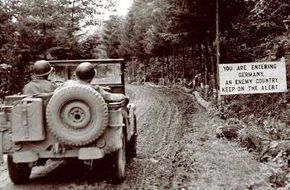
Allies enter Nazi Germany: General Dwight Eisenhower's three army groups reached the German border in September 1944 with superior forces and firepower. However, they were slowed by acute gasoline and ammunition shortages, as well as by determined German troops. Many of the latter had dug in along the defensive Siegfried Line, which was newly rearmed, at Hitler's orders, with pillboxes, gun emplacements, tank traps, and other obstacles. To make matters worse, the American advance came during the wet season; daily cold rain turned the rough terrain to mud. By early October, when U.S. soldiers (pictured) drove into Nazi Germany, front-line American commanders realized that the German homeland would not be occupied quickly.
The U.S. Army system was notoriously alienating. Individual soldiers were allocated from replacement depots ("repple depples") to replace casualties, who once recovered would frequently be sent not to their home units but wherever there was a gap. These processes fostered anonymity, neglect, and even contempt. Reinforcements in all armies faced a difficult initiation and died in disproportionate numbers. Their initial training was often inadequate, so they required last-minute, front-line instruction. Such "green" recruits endangered their more experienced compatriots, who often left them to sink or swim. If they survived their first action and demonstrated willingness to contribute, they were usually accepted as comrades. The need for new men grew in the second half of the war. Young reinforcements became the lifeblood of the Allied armies in 1944-45. The German and Soviet Union armies included many reinforcements from acquired or "liberated" territory. Many of these men were often conscripted against their will and thus were of dubious military value. |
See the next section for a detailed World War II timeline of events that occurred in the Pacific and Europe in October 1944.
To follow more major events of World War II, see:
World War II Timeline: October 20, 1944-October 30, 1944
In October of 1944, Allied troops landed in the Philippines and the first Kamikaze pilot crashes into the USS Denver. The detailed World War II timeline below summarizes these and other events in October 1944.World War II Timeline: October 20-October 30
October 20: American troops land on the island of Leyte in the Philippines and fulfill General MacArthur's promise to return to liberate the islands from the Japanese.
October 21: Aachen becomes the first German city to fall to the Allies, as desperately weakened German forces surrender.
October 23: Philippines president Sergio Osmena is restored to office.
October 23-26: The Japanese navy suffers a resounding defeat as American forces dominate in the Battle of Leyte Gulf. The crowning loss for the Japanese is their super-battleship Musashi, which capsizes and sinks, costing the lives of more than 1,000 sailors.
October 25: SS Reichsfuhrer Heinrich Himmler orders the destruction of the macabre Jewish skull collection at Berlin's so-called "Anatomical Institute."
Since it is no longer a member of the enemy Axis, Italy's diplomatic ties to the Allies are restored.
October 28: The Allies penetrate deep into Nazi German territory on General Eisenhower's orders.
U.S. major general Albert Wedemeyer replaces General Joseph Stilwell as commander in the Chinese theater. This comes 10 days after Stilwell is removed at the request of Nationalist leader Chiang Kai-shek.
The Soviets assume control of the Bulgarian armed forces, as Bulgaria capitulates to Russia.
The German army quits the small Adriatic nation of Albania.
The first of the soon-to-be-legendary kamikaze pilots commits suicide as he crashes his plane on the deck of the USS Denver.
October 30: The Auschwitz gas chambers are used for the last time, as one final transport of Jews -- 1,700 men, women, and children from the work camp at Theresienstadt -- are murdered.
World War II Headlines
See the headlines below for more World War II events during 1944, including the enlisting of Jewish soldiers into the British army.
Casualties high for both U.S. and Nazi Germany at Aachen: For seven days, fighting had raged from building to building and room to room, with enemy snipers on rooftops picking off scores of U.S. soldiers. While American tanks struggled through debris-strewn streets to dislodge defenders, German soldiers and civilians took to cellars and sewers. This strategically unimportant city cost each side some 5,000 casualties, however, the U.S. was victorious and about 5,600 Germans were taken prisoner.
![]() |
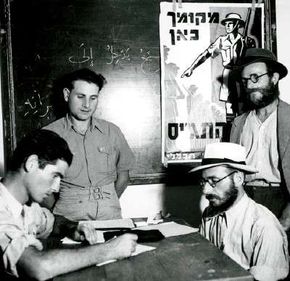
Jewish soldiers join the British army: In May 1939, Great Britain decided to limit Jewish immigration into the British mandate of Palestine. This policy increased tensions between Zionists (Jews who strove for a Jewish homeland in Palestine) and Britain throughout World War II. However, faced with the hideous threat of Nazi Germany, thousands of Palestinian Jews -- such as the ones seen here -- volunteered for the British Army. That army's 5,000-member Jewish Brigade was created in September 1944. The British trained Jewish fighters in sabotage, demolition, and guerrilla warfare -- techniques that, ironically, proved vital to the postwar Zionist resistance against British occupation.
Germans plan the Ardennes campaign: Hitler pored over plans for Nazi Germany's Ardennes campaign with staff members Reich Marshal Hermann Goring, Head of Security Police in France Helmut Knochen, two unidentified officials, and Chief of the Army General Staff Heinz Guderian. Hitler's irrational hope for the Ardennes attack, code-named Wacht am Rhein (Watch on the Rhine), was to seize the Belgian port of Antwerp (denying this vital port to the Allies) and to demoralize Britain and the U.S. into making peace separately from the Soviet Union. In an ideal outcome, Hitler would be free to shift forces to slow or halt the Soviet Union advance.
The German defense was centered on the village of Schmidt, and throughout the surrounding woodland were reinforced bunkers, snipers, mines, booby traps, dug-in antitank guns, and fixed line machine guns. It was a "green hell," within which the U.S. armor and artillery could do little to support the embattled infantrymen -- many of them newly arrived replacements -- who were drawn into the forest in ever-increasing numbers. Part of the formidable Siegfried Line defenses also ran through this damp, dark, freezing forest. The bitter succession of battles fought in October and November by the Ninth, 28th, Eighth, Fourth, and First U.S. infantry divisions, under overall command of General Courtney Hodges's First U.S. Army within General Bradley's 12th U.S. Army Group, resulted in the most costly infantry fighting of the war in Northwest Europe for the U.S. forces. In early December, the Americans finally broke through the Hurtgen. The excessive casualties sustained by some units in the Hurtgen were also attributable to poor preparation at divisional and regimental levels. Some U.S. troops lacked proper training and specialist equipment for close-country fighting. This type of combat was unlike the fast-flowing, mobile armored operations -- with guaranteed air and artillery support on-call -- to which the GIs had become all too accustomed ever since the breakout from Normandy four months earlier. Consequently, by early December, the Hurtgen combat had resulted in 24,000 U.S. battle casualties. A further 5,000 U.S. soldiers were noneffective due to trench foot, combat fatigue, and respiratory diseases. Overall, American battle casualties in Northwest Europe that autumn totaled 57,000, not including 70,000 noncombat casualties. The Roer dams were finally captured on February 9, 1945, during a major new Anglo-U.S. offensive. |
See the next section for a detailed World War II timeline of events in November 1944, including the destruction of the Nazi battleship Tirpitz.
To follow more major events of World War II, see:
World War II Timeline: November 3, 1944-November 23, 1944
In November of 1944, Japanese forces battled fiercely but continued to lose ground in the war. The detailed World War II timeline below summarizes events in November 1944.World War II Timeline: November 3-November 23
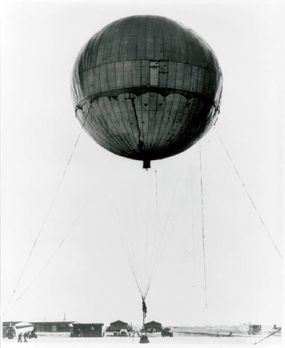
November 3: The Japanese launch more than 9,000 hydrogen balloons with incendiaries attached, sending them on westerly winds to North America. Fewer than 300 of the balloons will reach their targets, but one is found and detonated in Oregon, killing a woman and five children.
November 5: German forces round up 200 Dutch citizens in the town of Heusden. The Germans barricade them inside the town hall and blow up the building, proving that they are as dangerous in retreat as they were on the offensive.
The Americans bomb Singapore.
November 7: Franklin Roosevelt wins his fourth consecutive term as U.S. president.
"Neutral" Switzerland's ties with Nazi Germany, coupled with its hostility toward communism, leaves Stalin disinclined to renew diplomatic ties.
Richard Sorge, a Soviet Union spy who kept Moscow apprised of Japanese war plans before his capture by the Japanese, is hanged in Tokyo.
November 8: The Luftwaffe loses one of its best when ace pilot Major Walter Nowotny crashes his Messerschmitt 262 over Nazi Germany.
November 10: The Japanese puppet government in Nanking, China, sees a change in leadership when Chen Kung-po succeeds a deceased Wang Ching-wei.
November 12: After many efforts to destroy the German battleship Tirpitz, the British finally succeed. Struck by at least two massive bombs, the great ship capsizes and goes under with most of its 1,900-man crew.
November 23: German holdings in the Alsace-Lorraine region of France are further reduced by the Allied capture of Strasbourg, the region's principal city.
World War II Headlines
Nose art on American military planes and throughout the pages of Life magazine are two subjects covered in the World War II headlines from 1944 below.
![]() |
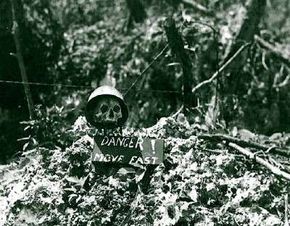
Heavy casualties on Peleliu: A helmeted Japanese skull calls attention to a warning sign ("Danger! Move Fast") on the island of Peleliu as the campaign winds down in October 1944. The First Marine Division had landed on Peleliu on September 15, despite indications that the original purpose of the campaign -- to protect General MacArthur's flank in the push to the Philippines -- was no longer necessary. Anticipating only a few days of battle, the Marines found themselves mired in bloody combat amid a maze of coral cliffs and caves. By the time the fighting ended in November, U.S. forces had suffered more than 9,500 casualties in exchange for an island that yielded little strategic benefit.
Tom Lea's graphic paintings for Life magazine: Tom Lea III joined Life magazine as an artist-correspondent in 1940. His wartime paintings included subjects as varied as politicians and battlefield scenes. His graphic images of the fighting on Peleliu Island in 1944 became famous for their realism and horror, which were unlike anything he or any other American war artist had previously depicted. In Two-Thousand Yard Stare, he portrayed, he stated, a Marine "staring stiffly at nothing," whose "mind had crumbled in battle."
Nose art on American bomber and fighter planes: The noses of many American bombers and fighters were decorated with sensual pictures of women. They were often modeled after the images of women in magazines, such as Esquire. Each plane's crew paid a professional or amateur artist, who was often a member of the crew or supporting staff at an air base. Some artists painted images of women that were too graphic for the tastes of commanding officers. In each instance, the crews were ordered to modify the artwork by painting over the offensive figures.
Richard Bong, the "Ace of Aces": USAAF pilot Richard Bong was the leading American ace during the war. In the Southwest Pacific in April 1944, Bong became the first American to pass Eddie Rickenbacker's World War I score of 26. After home leave, Bong returned to the Southwest Pacific in September 1944. Though ordered not to seek combat, he did. His "gallantry and intrepidity" in October and November earned him the Medal of Honor. Eventually reaching a total of 40 victories, the "Ace of Aces" died on August 6, 1945, the day of the Hiroshima bombing, while test-flying the new P-80.
U.S. protects its beachhead on Leyte: The Japanese battleship Yamato comes under bombing attack during the Second Battle of the Philippine Sea. The super-battleship sallied out as part of Operation Sho-1, an elaborate Japanese scheme to destroy the American beachhead on Leyte, Philippines. Though a diversion successfully drew away Admiral Bull Halsey's carriers, lack of Japanese airpower doomed Sho. A handful of U.S. destroyers, destroyer escorts, and the few available aircraft from escort carriers narrowly managed to turn the Japanese naval force away from the beachhead. "We had no air cover to repel the enemy, for whom it was pure offensive," observed a Japanese officer.
![]() |
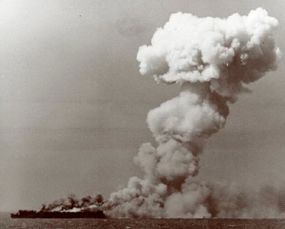
Attack on the Princeton: Fires burn out of control on the aircraft carrier USS Princeton after a Japanese air attack. More than 60 land-based Japanese bombers and torpedo planes, escorted by 130 fighters, attacked U.S. naval forces covering the Leyte landings on October 24. Though these Japanese forces were decimated by U.S. fighters, one dive-bomber hit the Princeton with a 550-pound bomb that penetrated the flight deck. The crew abandoned ship as burning gasoline spread to parked aircraft and a munitions storage area. Damage-control parties remained to fight the conflagration, but hours later a massive explosion tore through the carrier, killing or wounding almost everyone still aboard.
See the next section for a detailed World War II timeline of events in late November 1944, including Canada's decision to join the Allied forces.
To follow more major events of World War II, see:
World War II Timeline: November 23, 1944-November 29, 1944
In November of 1944, the United States attacked Tokyo with long-range bombers. The detailed World War II timeline below summarizes this and other events in late November 1944.World War II Timeline: November 23-November 29
November 23: The Canadian Parliament approves a limited draft -- a dramatic departure from what had been a strictly volunteer force. Some 16,000 additional Canadian troops will join the Allies.
November 24: Discouraged by the defeat of the Warsaw uprising and disgusted with Soviet Union manipulation of the Polish border, Premier in Exile Stanislaw Mikolajczyk resigns his post.
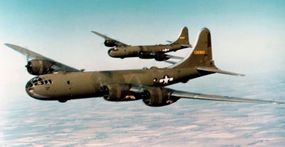
The United States attacks Tokyo with 111 B-29 long-range bombers. They operate out of forward bases on the recently occupied Mariana island of Saipan.
November 25: A German V-2 rocket levels a Woolworth department store in London. Of the more than 160 victims, many are children.
Several U.S. aircraft carriers are damaged by kamikaze attacks in the waters off the Philippine Islands.
November 26: As Soviet Union troops advance toward Auschwitz, Heinrich Himmler orders the complex of gas chambers and crematoria destroyed, along with the last of the Sonderkommando Jews, in an effort to hide evidence of Nazi atrocities.
November 27: A munitions dump explodes at Burton-on-Trent, England, killing 68 people and scores of animals.
Antwerp comes under heavy V-2 bomb attacks as the Allies finally open up shipping operations in the Belgian port.
The Chinese remain unable to unite for the common goal of battling Japan, and Chiang Kai-shek again refuses to share his stockpile of American weaponry with the Communists.
November 29: Shinano, a huge Japanese aircraft carrier commissioned earlier in the month, sinks after being torpedoed by the U.S. submarine Archerfish.
![]() |
U.S. prevails on the Philippine island of Leyte: American troops regard the bodies of Japanese snipers on the Philippine island of Leyte. After two months of fighting, from October to December, U.S. forces secured the island as part of General MacArthur's promise to win back the Philippines. Nevertheless, Leyte was not an unqualified success. A flood of Japanese reinforcements prolonged the battle, and American casualties were higher than anticipated. But the Japanese fared worse. The naval engagements off Leyte effectively destroyed the remnants of the Japanese Navy, while the ground campaign consumed nearly 65,000 troops. In a last-gasp effort, Japanese paratroopers jumped on two U.S. airfields on Leyte on December 6. Despite creating considerable confusion, all were killed or driven off.
General Robert Eichelberger, "MacArthur's Firefighter": General Robert Eichelberger steps up to the firing line near Buna Beach, New Guinea. Known as "MacArthur's Firefighter" for his skills as a battlefield problem solver, Eichelberger was one of the few U.S. generals who strove to maintain warm relations with the Australians. This foresight helped immeasurably when he was ordered to salvage the deteriorating situation at Buna in 1943. Subsequently named to command the Eighth Army, Eichelberger completed the seizure of Leyte in 1944, executed a series of amphibious operations in the Philippines, and defeated the Japanese on Mindanao. He later commanded the Eighth Army in the occupation of Japan.
Filipinos dismiss Japanese propaganda: Filipino civilians examined a Japanese propaganda placard in Manila in October 1944. The message probably refers to an air battle off Taiwan in mid-October in which Japanese airmen claimed to have sunk 11 U.S. carriers and two battleships. In fact, no U.S. ships were lost. Such propaganda claims became less and less credible as the war turned against Japan. The Japanese propaganda machine had an especially difficult task in the pro-American Philippines, where clandestine radio reports kept the population abreast of Allied advances. "I Shall Return" graffiti showed up on everything from buses to brothels.
![]() |
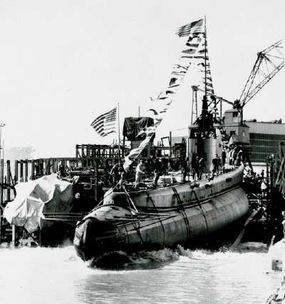
American submarines take down Japanese forces: General Tojo stated that American submarines were a key factor in Japan's defeat. They sank nearly two-thirds of all the Japanese merchant tonnage that was destroyed and nearly one-third of all combatant ships that were sunk. Initially, they performed disappointingly because of defective torpedoes, overly cautious captains, and unimaginative strategic deployment. These deficiencies were overcome in 1943. The U.S. Navy lost 52 of its 288 submarines, but American sub crews rescued more than 500 downed U.S. airmen, including future president George H. W. Bush. Pictured is the USS Wahoo, a 1,525-ton Gato-class submarine.
![]() |
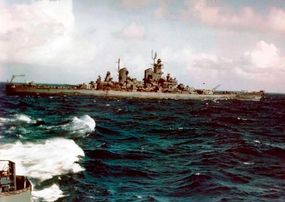
Pacific fleets rely on the USS New Jersey: With a speed of 33 knots, the battleship USS New Jersey -- like all Iowa-class vessels -- could keep up with aircraft carriers. It had less armor protection than comparable Japanese battleships, but its nine 16-inch guns were formidable. As the flagship of Admiral Spruance's Fifth Fleet in 1944, it screened aircraft carriers, destroyed enemy vessels and aircraft, and provided shore bombardment. The New Jersey supported operations in the Carolines, the Marshalls, the Palaus, New Guinea, the Marianas, the Philippines, and Formosa, and acted as flagship for the Fifth and Third fleets. Its service continued into 1945, notably at Okinawa.
Kamikaze pilots attack Allied forces: Early in the Pacific war, the Allies noted a Japanese willingness to die in battle. When Japan's strategic situation became dire, its leaders methodically exploited that enthusiasm. Vice Admiral Onishi Takijiro instigated aerial suicide attacks on enemy ships at Leyte Gulf in October 1944. The suicide units were called "kamikaze," or "divine wind," after the 13th century typhoon that smashed a Mongol invasion. Kamikaze attacks appealed to the Japanese command because they negated pilot inexperience and aircraft obsolescence, and reduced fuel consumption. Moreover, they could demoralize the Allies and demonstrate the supposed spiritual superiority of a freshly inspired Japan.
![]() |
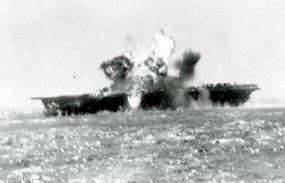
Carriers key to U.S. victory: A kamikaze hits the USS Essex in November 1944. Accurate statistics concerning the kamikaze are elusive, but apparently between 2,500 and 5,000 Japanese suicide pilots were killed, at least 34 Allied vessels were sunk, and 288 to 368 vessels were damaged throughout the war. Whereas the kamikaze could not change the course of the war, the Essex-class carriers did. Prime Minister Tojo identified their ability to operate for months without entering harbor as critical in Japan's defeat. In the pictured attack, the Essex was damaged, 15 crew members were killed, and 44 were wounded. However, the ship was back in action some three weeks later.
![]() |
Japanese balloon bombs reach U.S.: On May 5, 1945, a woman and five children were killed while moving a large balloon they discovered near Bly, Oregon. It was one of about 9,000 balloons that the Japanese launched in the direction of the United States from November 1944 to April 1945. Each was 33 feet in diameter and carried one 33-pound antipersonnel bomb and four incendiaries. They reached an altitude of 35,000 feet and traveled about 100 mph. Approximately 300 balloon bomb incidents were reported in the U.S. and Canada, but the deaths in Oregon were the only casualties. The balloon in this picture was discovered in Montana.
British hunt down the Tirpitz: A sister ship to the Bismarck, the Tirpitz was a serious threat, and the British were intent on destroying it. In 1943 X-class midget submarines -- three-man subs carrying a mine on each side -- placed timed explosive charges that disabled the ship. In April 1944, the repaired Tirpitz was again damaged by carrier-borne aircraft. Effective German defenses, including smoke screens, as well as cloudy weather protected the Tirpitz during several more air strikes. However, on November 12, the Red Army Forces bombed and finally sank the ship.
Nazis play mind games with propeganda: Propaganda was used by both sides during the war to undermine the fighting spirit of the enemy. Late in the war, the Germans circulated fake copies of Life magazine to remind American soldiers of home and to play with their minds. One particular "issue" of the magazine features a smiling w