World War II is the Janus event of the 20th century: a dual-natured homunculus that created even as it destroyed, gave even as it stole -- though what it was giving was far less apparent at the time than what it was taking. Its horrors were almost literally unimaginable, its scope breathtaking. It presented clear demarcations between ideologies, and while soldiers, civilians, and functionaries argued the finer points, more than 50 million people perished.
The articles linked below provide extensive timelines outlining the details and events of World War II. Explore images that headline specific moments in history, including the attack on Pearl Harbor, the D-Day invasion, and the atomic explosion in Hiroshima.
Advertisement
Here's a look:
The redrawn Europe of 1918 provoked resentment, political agitation, and an ambitious politician named Adolf Hitler, who found his voice in Germany's democratic process.
Japan's imperial ambitions were matched by Germany's desire for "living space" and Italy's dreams of glory. Britain's appeasement encouraged Adolf Hitler's schemes, while the USA remained sunk in isolationism.
On September 1, 1939, Nazi German forces moved against Poland. Treaty obligations forced England and France to declare war on Germany. For the second time in barely more than 20 years, Europe was at war.
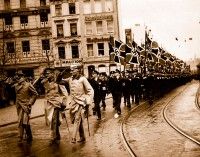
In 1940, the Nazi German war machine conquered much of Western Europe, including France. Britain battled back with great courage. And then came Adolf Hitler's most audacious campaign: Barbarossa.
United States Enacts the Lend-Lease Bill:
In the beginning of 1941, President Franklin D. Roosevelt introduced his lend-lease plan to provide material support to European allies during World War II. By June 1941, the U.S. Army was nearly 1.5 million strong yet still did not join the fight until later in the year.
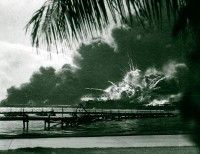
Adolf Hitler's forces cut across Russia like a scythe and were not halted until they were at the gates of Moscow. In the Pacific, Japan sent planes to Pearl Harbor, Hawaii, to strike the U.S. fleet that blocked Japan's access to oil. America was in the war.
The Axis Conquers the Philippines:
The high point of Axis conquest came in 1942. Ironically, though, the U.S. Navy had already forced Japan into a defensive posture, and Nazi Germany would find it increasingly difficult to mount sustained offensives.
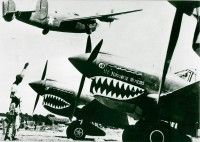
Russian Army Repels Hitler's Forces:
A renewed offensive by the Nazi Germans in Russia was a seesaw affair that ended in complete disaster for Germany at Stalingrad. In the Pacific, Allied forces advanced on the Japanese homeland, one outlying island at a time.
Italy Falls to the Allies:
February 1943-June 1943
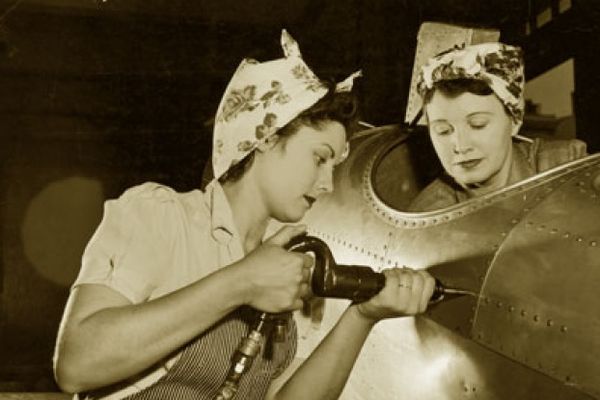
Throughout 1943, the limitations of the Nazi German and Japanese war machines became apparent -- not least Nazi Germany's inability to protect its cities from Allied bombers. As World War II production skyrocketed in the United States, the Axis prepared for "total war," in which everybody -- civilian and soldier alike -- was a combatant. Italy surrendered, but the larger war ground on.
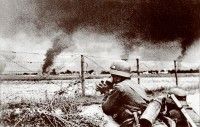
Allies Bomb Northern Nazi Germany:
At the end of July 1943, a succession of attacks on the northern German port city of Hamburg resulted in the first "firestorm," which killed an estimated 40,000 people. The bomb attacks immediately affected German strategy.
On June 6, 1944, the largest armada ever assembled began to deliver more than 300,000 Allied troops onto beaches at Normandy, France; Adolf Hitler's two-front war had come home to him. In the Pacific, the island-hopping campaign brought American bombers within striking range of the Japanese home islands.
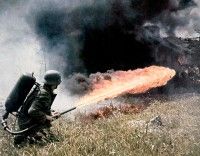
Germany's last act was fast approaching: enemies pushing from the east and west, the skies under Allied control. Much of Europe had slipped from Adolf Hitler's grasp, but the Führer fought on with new rocket weapons -- and a shocking surprise for the Allies. Japan lost control of the western Pacific, and much of what remained of its navy was smashed. Still, it would not surrender.
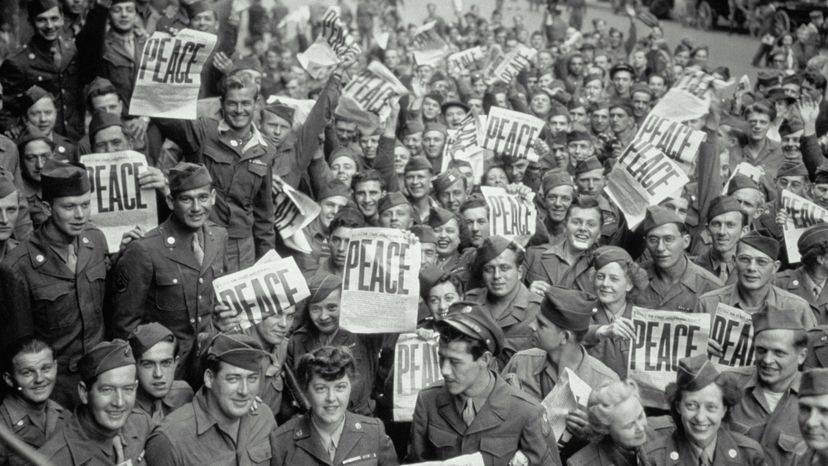
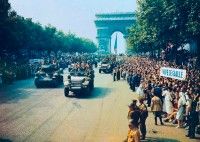
Germany's great cities were destroyed. Its leader paced in an underground bunker, giving orders to army groups that no longer existed. U.S. forces halted at the Rhine River and waited while Stalin's Red Army took its final, apocalyptic revenge on Berlin. By May, World War II in Europe was over.
Japan Surrenders and World War II Ends:
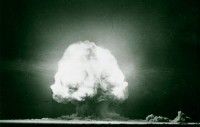
Standing alone against the unstoppable Allies since May 1945, Japan absorbed terrible aerial bombardment of its cities but kept back 610,000 troops -- plus millions of pitifully armed civilians -- as it anticipated the planned Allied invasion of the home islands. Then on two unimaginable days in August 1945, the skies exploded, and the Second World War was finished.
Allied justice encompassed not just the prosecution of Nazi German and Japanese war criminals, but practical, useful rebuilding of the vanquished nations. Japan accepted American occupation without serious incident, but the partitioning of Germany put the U.S. and its Western Allies on a collision course with the Soviet Union.
The Cold War: October 1951-1991
Cold War tensions that had been building in the 1940s became the defining reality of the new world order. The Korean War of 1950-53 was only the first of a series of ugly proxy wars engineered by the Soviets and the United States. America's "containment" of communism was harsh, but in the end the USSR was extinct, China was on the rise, and an uneasy U.S. was the only superpower left standing.
Advertisement