Introduction to French Revolution

French Revolution, a revolution by the people of France that lasted from 1789 to 1799. The original goals, to create a constitutional monarchy and reform the financial and political structure of the nation, soon developed into a move to overthrow the king and establish a republic. In the course of the revolution the immense land holdings of the Roman Catholic Church as well as of the feudal lords were taken over by the government and sold to the bourgeoisie (middle class) and peasants. The First Republic was established and thousands of persons accused of opposing a republican form of government were put to death.

The revolution was followed by the dictatorship of Napoleon and, in 1815, by a return of the monarchy. But the French people had learned that inequality did not have to be borne, and they were never again dominated as before by the privileged class. The success of the American Revolution helped influence the French people to revolt. In turn, the French Revolution, in spite of its excesses, spread ideas of freedom and equality throughout Europe.

Background

At the beginning of the French Revolution, there were three classes of people in France. The privileged class consisted of nobility and high-ranking clergy; the middle class, of merchants and professional people; and the lowest class, of peasants and working people. The peasants, who either were tenant farmers or owners of tiny plots of land, were heavily taxed by the government. They had additional dues imposed by the feudal lords and the Church. What was left of their meager crops barely sustained them. When crops failed, as in 1788, there was near famine. Bread prices became so high that many city workers were near starvation.

The bourgeoisie consisted of doctors, lawyers, manufacturers, merchants, and government officials. They carried much of the tax burden, but had almost no voice in government, which remained in the hands of the king and the privileged class. Their thinking was influenced by the writings of French intellectuals. One of these, Voltaire, attacked the absolute authority of the monarch and the power of the Church. Another, Jean Jacques Rousseau, urged that a country should be governed according to the will of the people.

Toward the end of the 18th century, France's financial condition became desperate. Louis XV, who reigned 1715–74, emptied the treasury by his extravagance and poor government. He was succeeded by Louis XVI, a well-meaning but weak king. Queen Marie Antoinette and the court were extravagant. Assistance to the United States in the Revolutionary War also drained France's resources. France was almost bankrupt. Louis needed money badly, but the common people were already taxed to the limit and the land-owning aristocracy was exempt from taxes. In this crisis, Louis called a meeting of the States-General, the national assembly, which had not met since 1614.

Beginning of the Revolution

The States-General met at the royal palace of Versailles, outside Paris, on May 5, 1789. It was composed of three groups: the clergy, the nobility, and the “third estate,” or common people. By tradition each group cast one vote.

Although everyone agreed that the country's financial system must be reorganized, the third estate hoped for other reforms as well. It suggested that each deputy have a vote, knowing that it would have a majority. Marie Antoinette insisted that the king oppose this suggestion. The third estate withdrew to a tennis court and took an oath not to disband until a constitution had been written and accepted. It named itself the National Assembly.

Many low-ranking clergymen, who also felt the need for reform, joined the group. Some nobles also were won over to it. Support grew, and Louis was forced to recognize the group as the successor to the States-General. At the same time, he ordered troops moved to the vicinity of Paris. The people of Paris thought the king would use the troops against the assembly, destroying their chance for a voice in government. They started to riot, seized a supply of arms, and on July 14, 1789, stormed and destroyed the Bastille, the prison stronghold looked upon as a symbol of political oppression.

Encouraged by this successful show of popular power, revolutionaries in Paris formed a new city government called the Commune. Louis XVI acknowledged the power of the people, visiting the city's new mayor and reinstating a popular minister he had dismissed.

The revolution spread quickly throughout France and aristocrats began fleeing. In the National Assembly representatives of the nobility and clergy were both frightened by the uprisings and inspired by the democratic spirit of the people. On August 4 they gave up all their inherited privileges. “Liberté, égalité, fraternité” (Liberty, Equality, Brotherhood) became the rallying cry of the revolution. The old political and social order (ancien régime) disappeared completely in less than two months.

Fall of the Monarchy

In August the National Assembly wrote the Declaration of the Rights of Man, a statement claiming for the people certain basic liberties that the government could not deny. It was the first step in a two-year process of writing a constitution. In the Assembly various political factions formed; these included the Jacobins, who wanted to greatly increase the power of the third estate, and moderates, led by the Comte de Mirabeau, who favored a limited, constitutional monarchy.

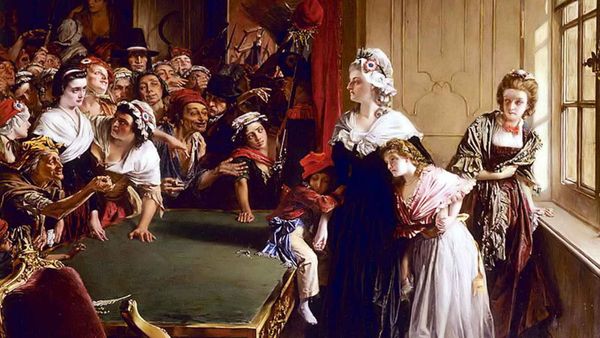
Rumors that the king was plotting against the people caused a Paris mob to march against Versailles on October 5, 1789. The royal family was forced to move into Paris. The court and the Assembly established themselves in the Tuileries palace. Influenced by the many political clubs that had become common in the city, the Assembly became more radical. The king was deprived of all power, and church property was confiscated.

Marie Antoinette, whose brother was Holy Roman Emperor and the ruler of Austria, urged Louis to leave France and seek foreign assistance. Mirabeau, however, counseled the king to remain and support the revolution. In April, 1791, Mirabeau died. In June the king and queen tried to leave the country. They were halted and brought back to Paris. Louis accepted the new constitution limiting his authority. The National Assembly was dissolved, and was replaced by a new body, the Legislative Assembly, which convened in October.

Other European rulers considered the French Revolution a menace to the established order throughout Europe and were urged by exiled French nobles to take action. Early in 1792 the Austrian army was moved to the French border, leading France to declare war on Austria in April. Although Louis XVI had accepted the revolutionaries' actions, foreign rulers considered him a helpless pawn and a victim of the revolution. Prussia allied with Austria against the revolutionary government, and the Prussian commander threatened to destroy Paris if the king were harmed.

The Paris mob, led by Georges Danton, an extremist who wanted the monarchy abolished, reacted angrily to the Prussian threat. Suspecting a secret agreement between the king and the foreign rulers, the mob stormed the Tuileries and took the royal family prisoner. The Assembly called for a national convention to create a new government. Throughout France royalists were imprisoned. Encouraged by the Paris Commune and Jean Paul Marat, a radical journalist, mobs stormed the jails and massacred thousands of royalist prisoners.

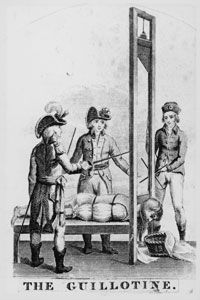
In September, 1792, the National Convention met. The monarchy was abolished and the First Republic of France was established. The king was brought to trial on charges of treason and convicted; he was guillotined in January, 1793.

The Critical Period of the Revolution

French troops were victorious on several fronts. The Austrian-Prussian advance was checked at Valmy, France (September, 1792). French forces seized the Austrian Netherlands (Belgium) and continued into Germany. Savoy and Nice were taken from Sardinia. After the beheading of Louis XVI, however, Great Britain, Holland, and several other countries joined Austria and Prussia against France, forming an alliance known as the First Coalition.

In the National Convention a struggle among factions ended in victory for the Jacobins, led by Maximilien Robespierre, Marat, and Danton. Girondists (moderates) were expelled. The Committee of Public Safety was formed in April, 1793, to crush opposition.

A period of mass political executions, known as the Reign of Terror, followed. By its end in July, 1794, Robespierre, Danton, and Marat were all dead. The more moderate period that followed was known as the Thermidorean Reaction. (Thermidor was the name used for July in the calendar France adopted in 1792.)

Military reverses in 1793 had caused the Committee of Public Safety to raise 14 new armies by conscription. (This was the first instance in modern history of compulsory military service under national law.) Later that year, a rebellion broke out in the Vendée, a region in western France near Nantes, largely because of the government's conscription policy. During the suppression of the rebellion, 1793–1800, more than 300,000 people were killed.

By the end of 1793 enemy forces were driven from France. The French retook Belgium and marched into Holland. By July, 1795, peace treaties existed with Holland, Prussia, and Spain.

France Under the Directory

In a reaction against bloodshed and dictatorship, the National Convention wrote a new constitution, under which executive power would be held by a group of five known as the Directory. When the constitution went into effect in September, 1795, an uprising broke out in Paris. It was put down by troops under Napoleon Bonaparte, and elections were held.

In the continuing war with Austria and the Italian states, French armies won many victories. Napoleon conquered northern Italy. Austria and Sardinia signed peace treaties. A series of republics under French domination were created around France's borders. Napoleon occupied Egypt, but the French fleet was destroyed by the British at the Battle of the Nile (1798). Austria, Russia, Turkey, Naples, and Portugal then joined Great Britain in a coalition (the Second Coalition) against France.