Introduction to History of Russia

From at least the seventh century B.C. to the second, southern Russia was dominated by the Scythians, nomadic mounted herdsmen. Next came the Sarmatians, who ruled until the Goths, a Germanic tribe, arrived in the second century A.D. The Goths ruled until driven out by the Huns about 370. The Scythians, Sarmatians, and Goths were masters of various subject peoples, including Slavs. The dominions they established were primarily for purposes of trade, for the main trading routes that extended from the Baltic to the Black Sea passed through their lands. When the Huns came, this trade was interrupted.

From the second century to about the sixth century, many Slavs migrated from the southern Russian lands to the northeast and northwest. Slav settlements to the east soon reached as far as the Don River. The Khazars, from the Caucasus, moved north in the 600's and gained mastery over the Slavs in the southern Russian steppes, winning control of the trade routes to the Black Sea. In the forest region north of the Khazar lands many Slav trading centers or towns developed along these trading routes. One of the principal towns was Kiev, with a population of Slavs controlled by Khazars.

Important dates in Russia
A.D. 800's East Slavs established the state of Kievan Rus.
1237-1240 The Mongols conquered Russia.
c. 1318 The Mongols appointed Prince Yuri of Moscow as the Russian grand prince.
1480 Ivan III broke Mongol control over Russia.
1547 Ivan IV became the first Russian ruler to be crowned czar.
1604-1613 Russia was torn by civil war, invasion, and political confusion during the Time of Troubles.
1613 Michael Romanov became czar. He started the Romanov line of czars, which ruled until 1917.
1703 Peter I founded St. Petersburg and began building his capital there.
1812 Napoleon invaded Russia but was forced to retreat.
1861 Alexander II freed the serfs.
1905 Japan defeated Russia in the Russo-Japanese War. A revolution forced Czar Nicholas II to establish a parliament.
1914-1917 Russia fought Germany and Austria-Hungary in World War I.
1917 The February Revolution overthrew Czar Nicholas II. The Bolsheviks (who were later called Communists) seized power in the October Revolution. V. I. Lenin became head of the government. Russia withdrew from World War I.
1918-1920 The Communists defeated their anti-Communist opponents in a civil war.
1922 The U.S.S.R. was established.
1941–1945 The U.S.S.R. fought Germany in World War II.
1957 The U.S.S.R. launched Sputnik 1, the first artificial satellite.
1961 Yuri A. Gagarin became the first person in space.
1991 Communist rule ended, and the Soviet Union was dissolved. Russia and the other Soviet republics became independent nations.

Imperial Russia, 1505–1612

Ivan the Terrible. When Basil III died in 1533 the throne went to his three-year-old son, Ivan IV, who later became known as “the Terrible." The government was run by a regency headed by the metropolitan and Ivan's mother. During Ivan's boyhood there was much conflict among the boyars over control of the government. In 1547, at the age of 17, Ivan was crowned czar, or tsar (from the Latin Caesar), the first ruler to be given that title.

Ivan was obsessed with suspicion and at times probably suffered from spells of insanity. He often engaged in irrational and sadistic acts, and killed his oldest son in one of his fits of rage.

To establish his absolute rule over Russia, Ivan made it his policy to destroy the power of the boyars. In 1565, Ivan divided Russia into two parts, the poorer of which was placed under a traditional style of administration in which the boyars were allowed to rule. The other—the stronghold of the most powerful boyars—was declared to be Ivan's personal domain, the Oprichnina. A personal army, the Oprichniki, roamed throughout his domain seizing estates in his name and murdering real or suspected enemies of the czar. This reign of terror reached a climax in 1570 with the massacre of thousands of people in Novgorod, where Ivan suspected a plot against him.

The formation of the Oprichnina helped to increase greatly the number of service nobility; for the confiscation of boyar estates made it possible for Ivan to reward many of his followers with land. In return for their land, members of the service nobility not only had to continue to serve the czar, but also had to keep peasants working the land.

In Russia the relationship of peasant to landlord was basically feudal. The peasant was required to supply a certain amount of labor and goods to a landlord in exchange for the use of land and equipment. The peasant was free to change masters, and did if he thought another landlord offered more. Some peasants who were too deeply in debt to leave managed to run away.

Many members of the service nobility owned less land and were poorer than the boyars; as a result, they had difficulty in keeping their peasants, who tended to desert them in hard times to work lands for wealthier lords. In support of their service nobility, Ivan and czars who followed passed laws that added restrictions on more and more of the peasantry. These restrictions, over a period of time, reduced a large part of Russia's peasantry to serfdom. Thus, at a time when serfdom was declining in western Europe it was being established in Russia.

Ivan conquered the khanates of Kazan and Astrakhan and gave Russia control of the lower Volga. He warred with Poland and Sweden in order to conquer Livonia on the Baltic Sea. He was successful at first, but later (1582) had to accept an unfavorable peace. In 1581 the Cossacks conquered the Tatar khanate of Sibir (Siberia). As a result Ivan was able to annex this territory to his domain. Trade was opened with the English by way of the White Sea in the far north. Printing was introduced into Russia.

Beginning in the 16th century, Russian fur traders, particularly the merchant Stroganov family, began expansion into Siberia.

Boris Godunov

When Ivan died in 1584 the throne went to his feebleminded son, Fyodor. Boris Godunov, a minor noble, outmaneuvered several powerful boyars to become regent and the real ruler of Russia. Acting in the name of Fyodor, Boris in 1597 issued a law requiring landowners to return runaways to their former masters. Meanwhile, in 1589 the metropolitan of the Eastern Orthodox Church at Moscow was made patriarch. This event marked Moscow's emergence as a new center of Orthodox Christianity.

When Fyodor died without an heir in 1598, the patriarch called a national council to elect a new czar. Boris Godunov was chosen, but he had a troubled reign. The boyars, dissatisfied with Boris as czar, were rebellious. The peasants, who were losing their freedom and sinking into serfdom, were ready to join any uprising.

"Time of Troubles."

The rumor spread that Dmitri, Ivan's youngest son, who had died in 1591, was still alive. In 1603, a young man appeared in Poland and claimed to be Dmitri. With Polish support he invaded Russia. This was the beginning of the period known as the “time of troubles." Godunov died in 1605 as he was preparing to meet the pretender's threat. The pretender succeeded Godunov as czar but was murdered the next year.

For the next several years Russia was beset by warring armies supporting various leaders who claimed the throne. During this period, Polish and Swedish troops invaded Russia, and Moscow came under Polish occupation. Ladislas, the son of the Polish king, was chosen czar, but he was deposed in 1612 when the Russians regained control of Moscow.

Imperial Russia, 1613–1796

The Romanov Dynasty

In 1613 a national assembly, made up of representatives of some 50 cities and towns, was formed to elect a new czar. It chose Michael Romanov, the son of Philaret Romanov, a powerful boyar. During most of Michael's reign his father was the patriarch of Moscow and was the real ruler. Civil order was restored and some territory was regained from the Poles and Swedes. Western influence began to be felt in' Russia. The wealthier nobility adopted many western European customs, and foreign mercenaries trained and led the regular Russian army.

In 1645 Michael was succeeded by his son Alexis I. Serfdom was made official by the legal code of 1649. There were many peasant revolts, the most serious being that of Stenka Razin and his Don Cossacks (peasant horsemen from the Don River). Stenka led his Cossacks through Russian lands, causing the peasants to rebel against their landlords, but he was finally defeated. Alexis fought two wars with Poland and won most of the Ukraine, but tried without success to win territory on the Baltic Sea in a war with Sweden. Another important event was the church schism caused by the reforms of Nikon, who became patriarch in 1652. Most of those who refused to accept the reforms joined together to form a sect called the “Old Believers."

Meanwhile, by the mid-1600's, fur traders had crossed Siberia and extended the empire's frontiers to the Pacific Ocean in the east and to China in the southeast.

Alexis Died In 1676

By his first wife he left two sons, Fyodor and Ivan, and a daughter, Sophia, and by his second wife he left four-year-old Peter. Fyodor became czar but died in 1682. Ivan and Peter were then proclaimed joint czars under the regency of Sophia. In 1689 Sophia was driven from power by Peter's mother and forced into a convent. The sickly Ivan died in 1696, leaving Peter as the sole ruler.

Peter the Great

The young czar was a giant in size. He had driving energy, wide interests, and a deep curiosity. He was ruthless in demands on his people. Violent in his rages, he was often savage and brutal.

Peter devoted most of his reign to wars of expansion. In 1696 he captured the fortress of Azov on the Black Sea from the Crimean Tatars, vassals of the Ottoman Turks.

The czar realized he must modernize his country before he could make it a great power. In 1697 he spent several months visiting western Europe, where he absorbed much that he saw. He had to hurry home to put down a revolt. Peter ordered his people to adopt Western dress and the men to shave their beards. He also began to import more Western technology, to modernize the army, and to build a navy.

Peter's Wars

The czar made an alliance with Poland and Denmark, and in 1700 began war against Sweden to gain control of the eastern Baltic. In the Battle of Narva the Russian army met disaster at the hands of Charles XII. Peter rebuilt his army and in the Battle of Poltava in 1709 destroyed the Swedish army. When the war ended in 1721 Russia gained most of the eastern Baltic. Peter received the title of “Emperor of All the Russias." In the south Peter was unsuccessful in war with the Ottoman Turks and had to give up Azov.

Peter's Reforms

Although Peter added new taxes, he also increased the efficiency of government and made a number of other reforms, largely as an outgrowth of his constant need to support his war efforts. The census of 1718 was taken so that the government could keep a better account of the taxpayers, and the efficiency of tax collections improved. Peter reformed the state administration and set up an advisory body called the Senate. He also established schools to provide trained administrators and industrial technicians. To increase Russia's military potential, Peter brought in Western experts to improve industrial production.

He abolished the patriarchate, and set up the Holy Synod under government control. Peter also improved the training of priests.

Most of Peter's reforms were set up in haste, and few were completed when he died. The people suffered from overtaxation and from fulfilling Peter's continual need to replenish his armies. As a result of the census of 1718 and the poll (head) tax that followed, increasing numbers of peasants were reduced to serfdom. This was because landlords, in reporting to the government, did not have to make a distinction between peasants and serfs. The landlord therefore tended not to make a distinction in other situations and to treat his peasants as if they were his serfs.

On the land won from Sweden Peter built his new capital, St. Petersburg. Peter made Russia more Western in its outlook and ways of doing things.

Peter's Successors

For nearly 40 years after Peter died in 1725 the imperial guards and the nobles made and unmade rulers. Most of these monarchs allowed court favorites, who were often German, and adventurers to run the government.

In 1741 a palace revolution supported by the imperial guards gave the crown to Elizabeth, a daughter of Peter the Great. French influence then became dominant. Russia became increasingly involved in European politics and wars. In the Seven Years' War (1756–63) Russia joined Austria, France, Saxony, and Sweden in war against Prussia, Great Britain, and Hanover. In 1762, when the Russian army was on the verge of complete victory over Prussia, Elizabeth died.

Catherine the Great

Elizabeth was succeeded by Peter, her nephew. He admired Frederick the Great of Prussia and saved him from disaster by making peace. In July, 1762, Peter was overthrown and murdered in a palace revolution led by his wife, Catherine, a German princess.

The reign of Catherine was a time of great power and splendor for Russia. The empress directed every area of state policy and was skillful in choosing talented officials and generals. She corresponded with other monarchs and with leading intellectuals of Western Europe. She drew up elaborate plans for reforms. There were many serf rebellions, notably one led by Emelyan Pugachev, a Cossack who claimed to be czar. Many nobles were killed during Pugachev's rebellion, leading Catherine to abandon her plans for reform.

In the late 18th century, Russia acquired much territory in the west as Poland was divided among Russia, Prussia, and Austria. In two wars with Turkey, Russia gained nearly all the northern shoreline of the Black Sea. Russia strengthened its hold on eastern Siberia and established trading posts in Alaska. Catherine reorganized the provinces, set up local administrative districts, and established a more efficient system of courts. After the outbreak of the French Revolution in 1789, Catherine, fearing a revolution in Russia, adopted a policy of repressing all new ideas.

Imperial Russia, 1796–1917

Paul I and Alexander I. When Catherine died in 1796 she was succeeded by her son Paul, whose rule was arbitrary and erratic. Hoping to undo some of the things his mother had done, he reduced the privileges of the nobility. The result was a palace revolution that led to the murder of Paul in March, 1801.

Paul was succeeded by his oldest son, Alexander. During his early years Alexander showed interest in liberal reforms. But he would not surrender his autocratic powers, and the nobles would not permit him to reduce their privileges or abolish serfdom. Alexander was occupied mainly with foreign affairs. In 1805 he joined in a coalition with Great Britain and Austria against France, then ruled by Napoleon. In 1807, after Russian forces suffered a crushing defeat at Friedland, Russia was forced to make peace with France. By the Treaty of Tilsit Alexander agreed to ally Russia with France against Great Britain.

By 1812 Russia and France were again at war. Napoleon invaded Russia and captured Moscow but had to make a disastrous winter retreat. Russia took a leading role in the campaign that ended in the capture of Paris and the overthrow of Napoleon. Russia became a major power in Europe. After the Congress of Vienna (1815) Alexander joined with other monarchs to stamp out liberal movements wherever they appeared in Europe. He also attempted to repress liberal ideas in his own country.

Decembrist Revolt

In spite of the czar's reactionary policy, liberal ideas were taking root in Russia. Many young army officers had been to western Europe during the Napoleonic Wars and had come back with revolutionary and liberal ideas. A few formed secret societies and plotted revolution. In November, 1825, Alexander I died. Upon the accession of Nicholas I to the throne in December, several officers of a secret society, with a few thousand troops, revolted. This “Decembrist Revolt" was poorly planned and immediately put down, but it was the beginning of revolutionary protest against the czar and served as an inspiration to later revolutionaries.

Autocracy under Nicholas I. The new czar was greatly affected by the Decembrist Revolt. He became extremely distrustful of new ideas, and his regime became increasingly more oppressive. The czar intensified censorship and placed strict controls over the universities. He became known as “the policeman of Europe" because of his zeal in putting down liberal movements both at home and in other countries. Also during his reign Russia entered upon its golden age in literature. Prominent were the poet Aleksander Pushkin and the novelists Nikolai Gogol and Ivan Turgenev. Russia's outstanding novelists, Fyodor Dostoyevsky and Leo Tolstoy, were beginning their careers. There was also much economic progress, and trade increased tremendously. Protective tariffs promoted the growth of Russian industry.

In foreign policy Nicholas turned his attention toward the weakening Ottoman Empire. He hoped to win control of Constantinople and the Dardanelles so that Russian access to the high seas and also domination of the Black Sea could be assured. The other European powers would not permit Russia to strengthen itself at the expense of Turkey. One crisis followed another until the outbreak of the Crimean War (1853–56), in which Great Britain, France, and Sardinia joined Turkey. Russia suffered a serious defeat, and lost its position as a leading power. Nicholas died in 1855.

Reforms Under Alexander II

Nicholas was succeeded by his son Alexander. The shock of Russia's defeat made the new czar realize that reforms must be carried out in order for Russia to equal the western European powers in strength. He freed the serfs in 1861 and made it possible for them to purchase land on a limited basis. Although the peasants gained personal freedom, their economic condition did not improve because they were allotted only small parcels of land and were forced deeply into debt to pay for them. Alexander also established county councils for local government, set up independent courts with trial by jury, created town councils, and reformed military conscription.

In 1863 Alexander put down a serious revolt in Poland. In Turkestan and the Far East new lands were added to his realm, but in 1867 Russia sold Alaska to the United States. In 1877 another Russo-Turkish War broke out. The Russians halted before Constantinople because of the threat of war with Great Britain. The Congress of Berlin (1878) forced Russia to withdraw its troops from the Balkans.

Alexander's reforms failed to calm the discontented, and in the 1860's political agitation developed, primarily among university students. A number of these dissidents, called Nihilists, wanted to destroy totally the existing order. Some felt that the only hope for Russia was a peasant revolution. Discussion turned to action when, in the middle 1870's, hundreds of young intellectuals went to the peasants to convert them to revolution in what was called the “to the people" movement. It failed because of police oppression and peasant indifference.

By the late 1870's, however, several small terrorist groups had developed, and in 1881 Alexander II was killed by a terrorist bomb. He was succeeded by his son, who became Alexander III.

Reaction Under Alexander III

The new czar adopted a policy of severe repression. He put down liberal and radical movements, suppressed all ideas of change, persecuted the Jews, and tried to force the Russian language on all subject peoples. Many radical leaders had to live in exile. The revolutionary movement reached its lowest point but still persisted.

During Alexander's reign there was an expansion in industry and much railroad building.

Autocracy Under Nicholas II

Nicholas II, who in 1894 succeeded his father, Alexander III, to the throne, carried on the repressive and autocratic rule of the previous regime. Persecution of the Jews also continued throughout Nicholas's reign. The czar was weak-willed and was dominated by his wife Alexandra.

Nicholas was fortunate to have in his government Finance Minister Sergei Yulievich Witte. Under his capable leadership, Russia experienced a spectacular growth in industry and railroad building in the 1890's. However, the country still lagged far behind the major industrial powers of western Europe. Russia was still mainly agricultural, with peasants making up about 80 per cent of the population.

With more industrialization, the number of factory workers increased. Working conditions were poor and there were frequent strikes. Revolutionary activity revived again in the late 1890's. A new radical group were the Marxists, who followed the Communist doctrines of Karl Marx. They believed that a revolution would occur among the working class. One group of Marxists consisted of the Bolsheviks, under the leadership of V. I. Lenin. A peasant organization called the Social Revolutionary Party was also active. Throughout most of Nicholas's reign, these groups had an insignificant following and were largely ineffective.

In the Far East, Russia attempted to increase its economic dominance in Manchuria and Korea. These attempts led to war in 1904 with the Japanese, who were pursuing an equally imperialistic policy in those areas. The Russo-Japanese War at first generated some patriotic enthusiasm, but as it became apparent that Russia was waging a losing war and conditions at home worsened, dissatisfaction grew. (The Treaty of Portsmouth in September, 1905, recognized Japan's victory.)

Revolution of 1905

On Sunday, January 9, 1905, Father George Gapon, a Russian Orthodox priest, led a procession of 200,000 workers and citizens of St. Petersburg to the Winter Palace, to present their grievances to the czar. Confronted by the crowd, troops panicked and began shooting, killing hundreds. As news of “Bloody Sunday" traveled around the nation, the people rebelled.

Terrorists struck down government officials, peasants rose up and seized private estates, and large-scale strikes occurred in many cities, virtually paralyzing the economy of the nation. In St. Petersburg a soviet (council) of workers' delegates threatened to take over the government. At the urging of Witte, Nicholas consented to the adoption of a constitution and the election of a Duma, or parliament.

The first Duma met in 1906, but was soon dissolved because it was hostile to the czar. The second Duma met the same fate. The third Duma, chosen under a revised election law, was conservative and compliant to the czar's wishes. After the 1905 Revolution and before the outbreak of World War I, Russia made steady economic progress. The position of the peasants improved substantially because of reforms initiated by Premier Peter Stolypin. Radical activity declined sharply during those years.

In foreign affairs Russia concentrated its attention on the Balkan area. As the largest Slav nation, Russia championed the Slavs in the Balkans against Austrian and German encroachment. The outbreak of World War I in 1914 was due partly to Russia's support of Serbia against Austria-Hungary. Russia, which fought on the Allied side, suffered a series of defeats at the hands of Germany. Millions of men were lost in battle. Vast areas were occupied by Germany, and war weariness began to spread over the nation. Scarcities of bread and other necessities appeared in the cities.

The czar went to the front to assume command of the armies, leaving the leadership of the nation in the hands of the superstitious Czarina Alexandra and Rasputin, a crude peasant who dressed like a monk and was considered holy. Rasputin had an increasing influence on the imperial family beginning in 1905, when he eased the bleeding attacks of Alexis, heir to the throne, who suffered from hemophilia. The czarina and Rasputin chose many disreputable and incompetent ministers to run the country. Rasputin was murdered by some nobles in December, 1916, but the quality of government did not improve.

Revolutionary Period, 1917–24

In March (February by the old-style calendar then used in Russia), 1917, strikes, riots, and mutinies broke out in many places. A workers' soviet was set up in Petrograd (St. Petersburg). During March 14–15, the executive committee of the Petrograd Soviet met with representatives from the Duma and agreed to support a provisional governing committee (later called the provisional government) created by the Duma. On March IS, Nicholas abdicated. He and his family were later arrested and executed.

The provisional government, headed by Prince Lvov, a liberal aristocrat, tried to establish a liberal democratic regime. But on April 16, Lenin arrived in the capital with his own plans for an immediate Bolshevik revolution.

Bolshevik (Communist) Revolution

Lenin proclaimed his goals—peace, bread, and land. His slogan was “All power to the Soviets." The government tried to continue the war against the Germans. Alexander Kerensky, minister of war, rallied the army for an offensive, which ended in defeat. In July, 1917, Kerensky became premier. He failed to take decisive measures to halt the rise of the Bolsheviks, and the government declined in power and prestige. On November 7 (October 25), Bolshevik troops led by Leon Trotsky seized government buildings and arrested members of the ministry. A Bolshevik government was quickly established with Lenin as premier and Trotsky as commissar (minister) for foreign affairs. Kerensky fled to London in 1918. (

Civil War

At first there was little resistance to the Bolshevik takeover. However, the Bolsheviks' radical program and their repression of rival parties soon generated violent opposition. The Bolsheviks lost much “support when they signed the Treaty of Brest-Litovsk, surrendering to Germany. (This treaty was later nullified by the Allied victory over Germany.) Civil war broke out throughout Russia, and the country was in chaos.

The Red (Communist) Army was opposed by various White (non-Communist Russian) armies, and fighting continued for nearly three years. The White armies were aided and supplied by Great Britain and France, who hoped to end Bolshevik rule. Also, various French, British, Japanese, and American military units began occupying parts of Russia in 1918. The Russian Empire started to break apart as various subject peoples, including Ukrainians, Belarusians, Georgians, Armenians, Azerbaijanis, and the Baltic peoples set up their own republics.

The Red Army, under Trotsky (who had become commissar of war), eventually defeated the White armies. The Allied nations, to avoid direct confrontation with Bolshevik troops, withdrew most of their forces in 1919. The Poles invaded Belarus and Ukraine in early 1920, and by October, 1920, the Bolsheviks had to make an unfavorable settlement with them. By 1922, however, Bolshevik rule was extended over most of the former Russian Empire. In that year Japan withdrew its forces from Siberia, becoming the last Allied nation to leave Russian soil.

The Communist State

In 1918 the Bolsheviks adopted a Communist constitution. In 1919 they organized the Communist International to promote Communist revolutions throughout the world. Within Russia the Communists used methods of terror to crush all opposition. The government took over factories, farms, and other means of production and tried to suppress religion.

The New Economic Policy

The government attempted to reorganize society and the economy in an effort to help sustain its forces in the civil war and to build Communism in general. This policy, which came to be called War Communism, was harsh and impractical. Farm and industrial production fell drastically. Millions died of starvation and disease in a famine during 1921–22. In 1921 Lenin announced the New Economic Policy (NEP), which permitted some capitalistic enterprise and private trading. Under NEP production increased rapidly.

Formation of the USSR

In 1922 Russia joined with other Soviet republics that had been formed in the Ukraine, Byelorussia, and the Trans-Caucasian region to form the Union of Soviet Socialist Republics. In 1924 a constitution for the USSR was adopted. The USSR, in effect, was an empire, encompassing most of the lands of the former Russian Empire.

The New Russian State

Boris Yeltsin

During the late 1980's Boris Yeltsin emerged as the chief opponent of Soviet president Mikhail Gorbachev, criticizing the slow pace of his reforms and championing the economic and political sovereignty of all the union republics. In 1990 Yeltsin was elected president of Russia by the Russian parliament.

In national elections in 1991, Yeltsin became the first popularly elected president in Russian history. Throughout that year, Yeltsin continued to advocate sovereignty for Russia and the other republics.

Collapse of the USSR

Meanwhile, during 1989–91, the Soviet Union experienced a period of rising nationalism and increasing demands for democratic reforms. By November, 1991, virtually all of the Soviet Union's republics had declared independence. In December, 1991, Russia became a founding member of the Commonwealth of Independent States, a loose confederation of former Soviet republics. Later that month, Gorbachev resigned and the USSR ceased to exist.

Post-Soviet Russia

Russia was beset by numerous problems upon independence. The government's plan to create an economy based on market forces caused widespread economic hardship. Russia's relations with Ukraine became strained, largely due to a dispute over which nation would control the former Soviet Black Sea fleet. In 1992 the Russian government signed a new union treaty with most of its autonomous political subdivisions.

The parliament, however, continued to obstruct Yeltsin's programs. In late September, 1993, Yeltsin dissolved the parliament. Shortly afterward the parliament deposed Yeltsin and named its own president. Tensions rose between members of parliament (and their supporters) and Yeltsin. In early October supporters of parliament rebelled in Moscow. After two days of armed conflict, the rebellion was crushed. A new constitution was approved in December.

In 1994 Yeltsin sent the army into the small Central Asian republic of Chechnya, which had declared independence from Russia in 1991. After a 21-month war in which more than 35,000 people were killed, the Russian army withdrew, granting the Chechens limited independence. In December, 1995, the Communists, fierce critics of the Chechen war, won more than a third of the seats in the Duma. The next year Yeltsin was only narrowly reelected.

In 1997 Russia signed an agreement of mutual cooperation and security with the North Atlantic Treaty Organization (NATO). The agreement paved the way for NATO to admit countries formerly allied with the Soviet Union. In 1998 Russia devalued its currency and defaulted on some of its international debt.

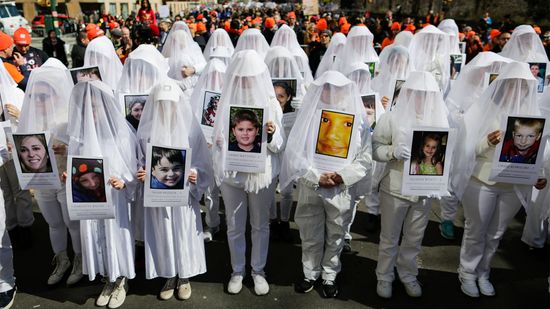
On December 31, 1999, Yeltsin resigned and named his prime minister, Vladimir V. Putin, as acting president; Putin was elected president in March, 2000. Earlier in 1999 the Russian army began a new campaign to fight Chechen rebels in Chechnya. Chechen rebels laid seige on the Moscow Theater in 2002, which resulted in the death of 130 hostages, and on a school in the Russian town Beslan in 2004, which resulted in the death of more than 300 hostages, mostly children.

Putin was reelected in March, 2004. Later that year the government under Putin took several actions seen as centralizing its power, including the abolishment of the direct election of governors.

Also that year, in September Chechen terrorists invaded a school in Beslan in southwest Russia. They took more than 1,000 people, many of them children, hostage. More than 300 hostages and approximately 30 terrorists died as a result of the three-day seizure.