Introduction to History of Turkey

The region occupied by Turkey was permanently inhabited at least as early as 7000 B.C. The Byzantine Empire, the great Christian empire that dominated the region for almost 1,000 years, fell to the Ottoman Turks in 1453 A.D. The Ottomans established an empire that lasted until the early 20th century.

For a summary of its history before the era of the Ottoman Turks, see Asia Minor.

The Ottoman Empire was dissolved after World War I. It had been allied with Germany and had been defeated. By the Treaty of Sèvres (1920), all non-Turkish possessions of the empire were surrendered, and parts of the Turkish homeland itself (in Thrace and Anatolia) were ceded to Greece. The breakup of the empire and the harsh provisions of the treaty rallied the people to a nationalist movement led by Mustafa Kemal, a Turkish army commander. In 1920 he called for the election of a new National Assembly. Elections were held; Sultan Mohammed VI was declared deposed; and a provisional government was formed, with Kemal as president. The assembly conferred on him the surname Atatürk, “father of the Turks.”

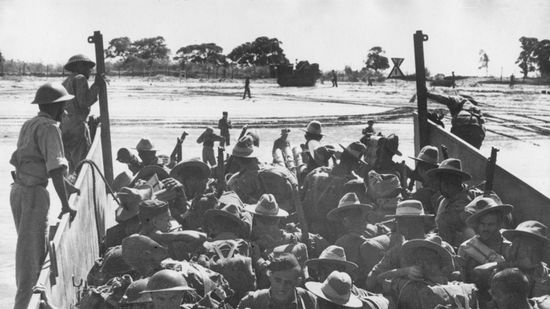
Gallipoli Peninsula.Gallipoli Peninsula. ANZAC (Australian and New Zealand Army Corps) and other Allied forces landed on the Gallipoli Peninsula in Turkey on April 25, 1915, during World War I (1914-1918). British forces landed on the tip of the peninsula, and ANZAC forces landed farther north, in an area later called Anzac Cove. The Allied campaign at Gallipoli failed, and the troops were withdrawn. The inset map shows the location of Gallipoli Peninsula in the Aegean Sea.

The new government at Ankara rejected the Treaty of Sèvres, and fighting broke out. During the Greco-Turkish War, or War for Turkish Independence (1920–22), the Turks drove out the Greek army. Russian, French, and Italian forces withdrew from Anatolia. When hostilities ceased, Sultan Mohammed VI, who had continued to head a rival government at Constantinople (Istanbul), was exiled. The Treaty of Lausanne (1923) was negotiated with the European powers. Under its provisions, Turkey was recognized as a fully independent state, and the ceded areas of Thrace and Anatolia were restored.

Turkish Republic

The Republic of Turkey was proclaimed in 1923, with Kemal Atatürk as its first president. Far-reaching political, social, and economic reforms were put into effect. Atatürk abolished the sultanate and later exiled all Ottoman heirs. He did away with old traditions associated with the empire—men could no longer wear the fez (a hat), nor women the veil. Women were given political and civil rights equal to those of men. Church and state were separated, and the property of the mosques nationalized. Universal education and a new law code were introduced. When many of these changes were not accepted by the people, Atatürk assumed unlimited dictatorial powers. After his death in 1938, the premier, Ismet Inönü, was elected president.

By the Montreux Convention of 1936, Turkey was given the right to fortify the Dardanelles and Bosporus straits. Treaties of alliance were signed with Great Britain and France in 1939. During World War II, Turkey remained neutral until 1944, when it broke relations with Germany. The following year, it declared war on Germany and Japan.

After World War II

In the cold war that followed World War II, Turkey became an ally of the West. The United States granted it military and economic assistance in accordance with the Truman Doctrine. In the election of 1950, the Republican People's party (founded by Atatürk) was defeated by the Democratic party, founded in 1945 and led by Celâl Bayar. Under President Bayar, Turkey, a charter member of the United Nations, sent a brigade to fight with UN troops in Korea in 1950. In 1952 the country became a member of the North Atlantic Treaty Organization.

Because its strategic location made it vulnerable, Turkey entered into a series of military alliances with its neighbors to bolster its defenses. A treaty of friendship was signed with Greece and Yugoslavia in 1953, and a 20-year mutual-aid pact the following year. Turkey completed an economic and political collaboration agreement with Pakistan in 1954. In 1955 it joined the alliance that became the Central Treaty Organization (CENTO) in 1959. (CENTO became defunct in 1979.)

In 1960, because of violence between political parties, the army seized control. Civilian government was restored in 1961.

Turkey wavered on the brink of war with Greece over the status of the Turkish minority on Cyprus in 1964 and 1967, and, after landing troops there, again in 1974.

Throughout the 1970's, Turkey suffered from unstable and ineffective government, in which no political party could sustain a working majority in parliament. Martial law was declared in 1971, 1972, and 1978 to quell violence between political factions. Mounting economic difficulties, and the government's inability to solve them, produced increased discontent.

In 1980, after renewed violence between political factions, the armed forces seized control of the government, disbanded the parliament, banned all political parties, suspended the constitution, declared martial law, and established a ruling junta of military officers. Within two years, the junta achieved political stability and in 1982 a new constitution was adopted restoring civilian rule. In 1983 the ban on most political parties was lifted. Martial law was phased out during 1984–87. In 1984 Kurdish separatists began a terrorist campaign against the government. The Turkish military launched reprisal raids throughout Kurdish regions in Turkey and, during the early 1990's, also attacked Kurdish settlements in northern Iraq. Approximately 30,000 people died as a result. Most of the fighting ceased after the capture of the Kurdish leader Abdullah Ocalan by the Turkish government in 1999.

Turkey's first woman prime minister, Tansu Ciller, served during 1993–95. In 1995 an Islamic party (the Welfare Party) won a plurality of votes in national elections and in the following year Necmettin Erbakan became prime minister. He was the first prime minister from an Islamic party in the history of the Turkish Republic. About a year later he resigned under pressure from the military.

Former Prime Minister Bulent Ecevit became Turkey's head of the government in 1999. Ahmet Necdet Sezer won the presidential post in 2000. The Justice and Development Party won a majority of the seats in the legislature in November, 2002, election, and Abdullah Gul became prime minister. Recep Tayyip Erdogan replaced Gul in March, 2003, following a special election.

Within a three-month period in 1999, Turkey was rocked by two strong earthquakes that killed more than 17,675 people.